

Oriental cockroaches in Belgium: Occurrence, survival and extermination
Contents
-
Oriental cockroach vs. German cockroach: Identifying the species present in Belgium
-
Origin and survival: Why does the Oriental cockroach thrive in our cellars?
-
Recommendations and treatment : Solutions for eradicating Oriental cockroaches
A black, glistening, almost motionless cockroach at the bottom of a cellar in Schaerbeek. This is the scene that dozens of Belgian homeowners describe to us every week. And almost every time, the same confusion: «It's a German cockroach, isn't it?» No. In 7 cases out of 10, when the cockroach is big, black and hangs out in a damp, cool place, we're talking about the Oriental cockroach, Blatta orientalis. A very distinct species, with its own habits, its own weaknesses, and above all its own survival strategies.
The problem is that most of the advice you find online mixes everything up. Protocols designed for the German cockroach are applied to an insect that doesn't live in the same places, doesn't react to the same baits and can withstand temperatures that its German cousin can't. The result: ineffective treatments, wasted money and an infestation that takes root. The result: ineffective treatments, wasted money and an infestation that takes root.
Things to remember
-
We look at the presence of the Oriental cockroach in Belgium from a scientific and local perspective.
-
The article explains why this specific pest (Blatta orientalis) differs from the German cockroach in its resistance to the cold, how trade has introduced it into our Belgian infrastructure and what rigorous protocol to adopt to secure Flemish, Brussels and Walloon homes.
-
Identify the species present in Belgium
-
Compare the different options before deciding.
This article sets the record straight. We'll look at how to identify a black cockroach in your cellar in Belgium, understand why it thrives in our Walloon and Brussels basements, and above all what protocol really works for exterminating oriental cockroaches in Belgium. No miracle recipes, just verified facts and solutions that work.
Oriental cockroach vs. German cockroach: Identifying the species present in Belgium
The first thing to do when you spot a cockroach in your home is not to panic, but to observe. The difference between cockroaches is far from anecdotal. It determines the entire treatment plan. Confusing an Oriental cockroach with a German cockroach is like treating the flu with an antibiotic: it doesn't target the right problem.
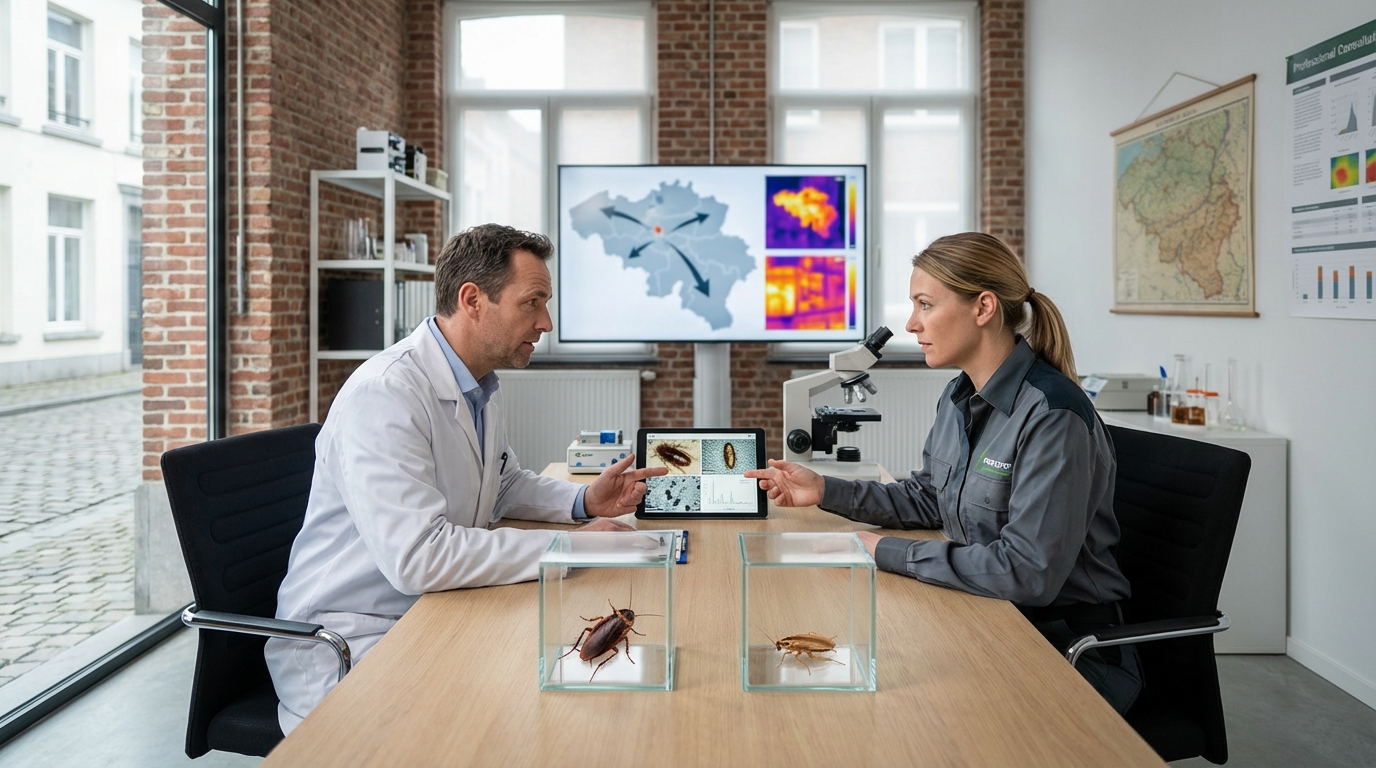
The Oriental cockroach (Blatta orientalis) measures between 20 and 27 mm as an adult. It is very dark brown, almost black, with a broad, flattened body. The male has wings covering about three-quarters of his abdomen, but does not fly. The female, on the other hand, has only wing stumps, small, useless blanks. This inability to fly is a reliable clue to identify a black cockroach: if the insect remains on the ground and never tries to fly away when you turn on the light, you're probably dealing with Blatta orientalis.
The German cockroach (Blattella germanica), it's quite a different story. Smaller (12 to 15 mm), light brown to beige in color, with two clearly visible dark longitudinal stripes on the pronotum (the «shield» behind the head). It's also considerably faster. When you turn on the light in an infested kitchen, Germanic moths fly like arrows. Oriental moths move slowly, almost lazily.
Where do you find them? This is the criterion that most often decides. The German cockroach loves the heat: kitchens, sculleries, catering facilities, wherever the temperature is between 25 and 30°C. It needs this heat to reproduce efficiently. The Oriental cockroach, on the other hand, prefers cool, damp environments. Cellars, basements, ventilated voids, manholes and drains. In Belgium, with our older housing stock and often poorly ventilated cellars, this is a perfect habitat.
One thing many people don't know: the Oriental cockroach gives off a particularly strong, unpleasant odor. A musky, rancid odor that permeates infested areas. If you smell something strange in your cellar but can't find an obvious source, it's a warning sign. This odor comes from chemical secretions that the insect uses to communicate with its congeners, as documented in a study by Bell and Adiyodi (The American Cockroach, Springer, 1981).
When should you worry about cockroaches? As soon as you see one in the middle of the day. Oriental cockroaches are strictly nocturnal. If they come out during the day, it's because the population has outgrown the available hiding places. This means that the infestation is already well established. An isolated individual in a cellar at night could be a scout. Three or four in the middle of the afternoon is a colony.
To sum up the difference between the cockroaches most commonly encountered in Belgium: black, slow, damp cellar, strong odor = Oriental cockroach. Small, light brown, hot kitchen, very fast = German cockroach. This identification is the basis of everything. Without it, treatment will be inadequate.
Origin and survival: Why does the Oriental cockroach thrive in our cellars?
We call it «oriental», but Blatta orientalis is probably not native to the Orient. Entomologists place its cradle somewhere around the Black Sea, possibly in North Africa. It spread across Europe via trade routes long before the industrial era. The exchange of goods between Mediterranean ports and northern cities did the rest. Belgium, with Antwerp as the hub of European trade for centuries, was a privileged gateway.
What makes this species so formidable in our latitudes is its resistance to the cold. Where the German cockroach dies at temperatures below 0°C after just a few days, Blatta orientalis survives temperatures close to -5°C for several weeks. A study published in the Journal of Economic Entomology (Appel et al., 1983) has shown that oriental cockroach nymphs tolerate prolonged exposure to low temperatures that other domestic species cannot. In practice, this means that our Belgian winters don't eliminate them. They slow down, burrow deeper into pipes and cracks, but they don't die.
Cellars in Belgium offer them an almost ideal ecosystem. Stable temperature between 8 and 15°C all year round, relative humidity often above 70%, access to water via condensation or infiltration, decomposing organic matter (cardboard, wood, mold). Nineteenth-century Brussels houses, with their porous brick cellars and sometimes dilapidated sewer connections, are highways for these insects. They ascend through dry siphons, degraded pipe joints and cracks in foundation walls.
What damage do Oriental cockroaches actually do? Beyond the disgust (which is legitimate), the risk is to health. Blatta orientalis frequents sewers and decomposing matter before wandering onto your surfaces. It carries pathogenic bacteria: Salmonella, E. coli, Staphylococcus. Their droppings and molt fragments are also powerful allergens. The WHO classifies cockroaches as mechanical vectors of gastrointestinal diseases. For asthma sufferers, an infestation in a cellar communicating with living areas can significantly worsen symptoms.
How to avoid bringing cockroaches home? The Oriental cockroach doesn't travel through your groceries like the Germanic cockroach can. Its mode of propagation is different. It arrives mainly via underground networks: sewers, service shafts, crawl spaces connecting adjoining buildings. In Brussels condominiums, this is a classic case. An infested basement apartment gradually contaminates the whole building via the downpipes. In Belgium, basement cockroaches are rarely a problem isolated to a single dwelling.
Humidity is the key factor. Without access to water, the Oriental cockroach won't last more than two weeks. This is their greatest vulnerability. Fixing a leak, ventilating a cellar, installing a dehumidifier: these simple gestures are not enough to eliminate a colony, but they do deprive it of its vital resource. Without humidity, there's no reproduction, no expansion.
A final point that is often underestimated: the Oriental cockroach reproduces more slowly than the German cockroach. A female produces around 8 oothecae (egg capsules) in her lifetime, each containing an average of 16 eggs. The German cockroach, on the other hand, can produce up to 8 egg capsules containing 30 to 40 eggs. Sounds reassuring, but it's deceptive. The longevity of Blatta orientalis more than makes up for it: an adult lives up to two years in good conditions. And in Belgium, «good conditions» describes just about any untreated cellar.
Recommendations and treatment : Solutions for eradicating Oriental cockroaches
Let's face it: the sprays sold in supermarkets won't solve your problem. They kill exposed individuals, yes. But the colony, tucked away in the interstices of your cellar walls or in the sewage system, remains unaffected. Worse still, some aerosol insecticides disperse the colony instead of concentrating it, which then complicates the work of a professional. If you have a real infestation of Oriental cockroaches, professional treatment is the only serious option.
Cockroach extermination in Belgium is based on a multi-stage protocol. The first is diagnosis. A qualified technician inspects the premises, identifies the species (because yes, even the pros check), assesses the level of infestation and locates entry points. This step determines everything else. A botched diagnosis leads to a botched treatment.
The reference method for treating oriental cockroaches is insecticide gel applied at strategic points. Not sprayed at random: applied in micro-droplets in cracks, along pipes, near drains, at wall-ground junctions. The principle is simple and highly effective. Cockroaches consume the gel, return to their hiding places, die, and are then eaten by their fellow cockroaches (cockroaches are both coprophagous and necrophagous). The domino effect eliminates the colony in depth. This mechanism, known as the «cascade effect», is documented in the scientific literature on fipronil- and indoxacarb-based gels.
For severe infestations, some pest control professionals in Brussels combine gel with targeted fogging. Nebulization sprays an insecticide in the form of micro-droplets that penetrate inaccessible nooks and crannies. This is particularly useful in crawl spaces and service shafts in older buildings. Caution: this technique requires temporary evacuation of the premises, and must be carried out by a certified operator. This is not a harmless treatment.
How much does it cost? This question comes up time and again, and rightly so. The price of pest control in Belgium varies according to the surface area to be treated, the level of infestation and the number of visits required. For a standard apartment with a cellar, expect to pay between 150 and 300 euros for a first pass with gel. Building infestations, which require coordinated intervention across several dwellings and common areas, run up to 500-1200 euros, depending on the size of the building. A second inspection, two or three weeks after the first, is almost always necessary. Beware of abnormally low prices: a treatment costing 50 euros is just a spray and a goodbye. The infestation will return.
The role of the property manager is central in apartment buildings. Intervention in a single dwelling is of no use if the common areas, the collective cellar and the pipe network are not treated simultaneously. Pests in Belgium, and particularly oriental cockroaches in condominiums, require a collective approach. The syndic can (and should) mandate a pest control company to treat the entire building. This is often a legal obligation under communal health regulations.
In terms of prevention, here's what really works after treatment:
-
Repair all water leaks and infiltrations in cellars and basements.
-
Install non-return valves on floor drains, especially those rarely used.
-
Actively ventilate cellars: a simple air extractor can reduce humidity from 80% to 55% in just a few weeks.
-
Seal cracks and cable penetrations with silicone sealant or expanding foam.
-
Eliminate food sources: cardboard boxes stored on the ground, unsealed garbage cans, pet food left out in the open.
A word about the «natural remedies» we see everywhere: bicarbonate, white vinegar, essential oils. No serious study has demonstrated their effectiveness against an established infestation of Blatta orientalis. Bicarbonate can kill an individual ingesting it, in theory. But you'll never eliminate a colony of several hundred individuals with bicarbonate. These methods give the illusion of action. Meanwhile, the colony grows.
Professional cockroach treatment, combined with structural preventive measures, remains the only approach that delivers lasting results. Not spectacular, not instantaneous, but effective. Certified companies in Belgium use biocides authorized by the FPS Public Health and follow CEN (European Committee for Standardization) protocols for pest management. Always ask for the certification number before signing anything.
Conclusion
The Oriental cockroach is not a cockroach «like any other». Its biology, preferred habitat and resistance to cold make it a pest particularly well-suited to Belgian conditions. Correctly identifying the species, understanding why it settles in your cellars, and applying a suitable treatment protocol: these three steps make all the difference between an infestation that drags on for months and a problem that's solved in a few weeks.
If you find black cockroaches in your cellar or basement, don't let the situation get out of hand. Contact a licensed pest control professional, have a precise diagnosis carried out, and demand a written treatment plan. At Pest Patrol, we intervene all over Belgium with protocols specifically adapted to Blatta orientalis. Because a well-identified cockroach is a half-eliminated cockroach.
Frequently asked questions
Where does the Oriental cockroach live?
They are often found in basements, crawl spaces and sewers. Oriental cockroaches can't climb, so they prefer to stay at ground level or in the lower parts of buildings. Oriental cockroaches vary in size from 2 to 3.5 centimetres long.
How to avoid bringing cockroaches home?
Avoid storing your luggage in bedroom cupboards or closets. These confined, dimly-lit spaces are natural breeding grounds for cockroaches. Leave your belongings in an open, well-lit space, away from sources of humidity such as the bathroom.
When should you worry about cockroaches?
As soon as you spot a cockroach, find its droppings or eggs, or smell its odor. Cockroaches can harm human health by producing allergens and carrying diseases, so it's important to act quickly in the event of an infestation.
What damage do cockroaches do?
Through food contamination and the dispersion of allergens inside homes, they can cause health problems such as food poisoning, eczema or respiratory problems with the development of asthma, particularly in children.
 Français de Belgique
  English
  Nederlands (België)