
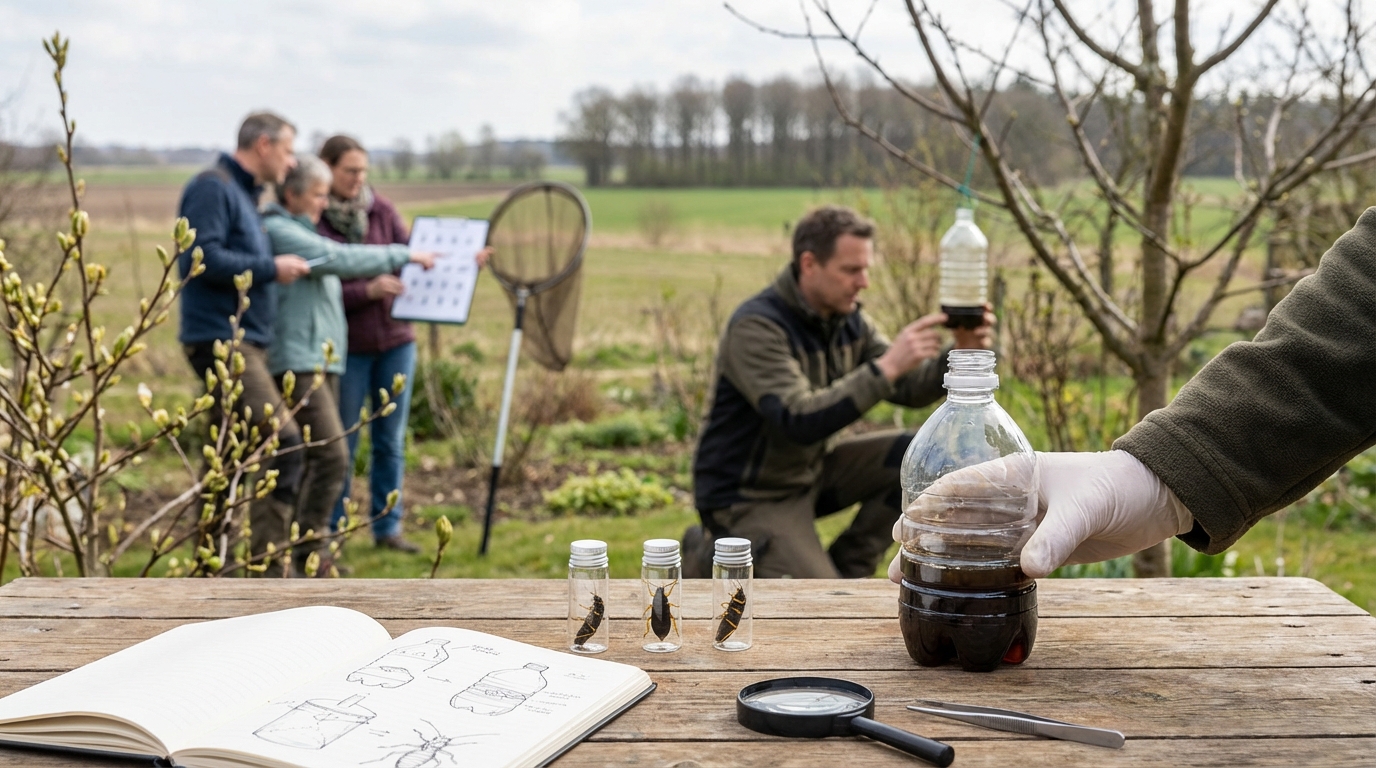
Asian hornets season 2026: the alert is launched by Pest Patrol
Contents
-
A practical guide to spring trapping: how to take effective action now
-
The impact of citizen trapping: the scientific basis for collective control
At Pest Patrol, we monitor field reports all year round. And what we've been observing since February is unprecedented: the first founding queens of Vespa velutina were caught three to four weeks ahead of schedule. Three weeks may not sound like much. Not at all. Each day gained by a queen means one more primary nest, hundreds more workers in the summer, and increased pressure on our bees and our biodiversity.
This article is not yet another alarmist paper. We'll explain why this early awakening is happening, how you can take concrete action with a selective trap made in twenty minutes, and what science really says about the effectiveness of citizen trapping. Because the fight against the Asian Hornet in 2026 starts now, in your own backyard.
Things to remember
-
Pest Patrol sounds the alarm after first reports of queen captures in early 2026
-
We are transforming this news from the field into a comprehensive guide combining science and citizen action to mobilize the French people in the face of a record invasion, with an emphasis on early selective trapping.
-
Why do hornet queens wake up so early?
-
How to take effective action now
Whether you're an amateur beekeeper, a hobby gardener or simply someone who wants to understand why these insects are invading Belgium so quickly, you've come to the right place. We're going to talk about biological cycles, scientific data and concrete actions. No useless jargon, no gratuitous panic: just what you need to know to take action.
Season 2026: why do hornet queens wake up so early?
At the end of February, a beekeeper in Auderghem found an active Asian hornet queen on an oak trunk. Outside temperature: 14°C. Normally, at this time of year, the founding queens are still hibernating, buried in the ground, under the bark or in a pile of wood. Except that «normally» doesn't mean much anymore with the winters we've been having.
Let's get back to basics. The life cycle of the Asian hornet is based on the seasons. In autumn, colonies produce fertilized queens that leave the nest to find overwintering shelter. They enter diapause, a state of dormancy that enables them to survive the cold. When temperatures rise permanently above 13°C in spring, they wake up, seek food (sugars, sap, damaged fruit) and establish a primary nest, often the size of a tennis ball, in a sheltered spot: a garden shed, a roller shutter, an eaves.
The problem is that this 13°C threshold was already reached in mid-February in much of the south-west and Atlantic seaboard. The Royal Observatory of Belgium recorded temperature anomalies of +2 to +3°C compared with thirty-year averages over January and February. As a result, the queens of Vespa velutina come out earlier. And when they come out earlier, they have more time to build a nest, more time to lay eggs, and colonies reach their peak population more quickly in summer.
A study published in Journal of Pest Science (Monceau et al., 2014) had already shown that winter survival of founding queens is directly correlated with winter mildness. Less prolonged frost means a higher survival rate. Today, we're seeing the consequences in real time. Monitoring networks such as CRAW (Centre wallon de Recherches agronomiques), Natuur Vlaanderen, and Bruxelles Environnement report a marked increase in the number of early reports compared with previous years.
What you need to understand is that an Asian hornet queen waking up in February instead of March isn't just «a little early». It's potentially an extra 20 to 30 days of egg-laying before summer. A single founding queen can produce a nest of several thousand individuals between June and October. Do the math: if winter survival rates increase by 15 to 20 % thanks to mild winters, and each surviving queen has an extra month to settle in, hornet proliferation takes an exponential trajectory.
At Pest Patrol, we don't say this to scare people. We're saying it because the window for action is now. Trapping founding queens in the spring is the most effective lever available to individuals. Each queen captured before she has established her primary nest means one less nest in the autumn. A nest that could have contained 6,000 individuals and produced 300 new queens. The current season is critical, and has started earlier than expected.
A practical guide to spring trapping: how to take effective action now
Anyone can make a hornet trap. Doing it properly is another story. Because the real challenge isn't catching insects: it's catching the right insects, without decimating the very pollinators we're trying to protect.
What exactly is a selective trap? It's a device designed to specifically attract Vespa velutina with a suitable bait, while allowing non-target insects (bees, butterflies, syrphid flies) to escape. Selectivity is the crucial point. A non-selective trap, such as a bottle with syrup at the bottom, will kill dozens of beneficial insects for each hornet caught. You do more harm than good.
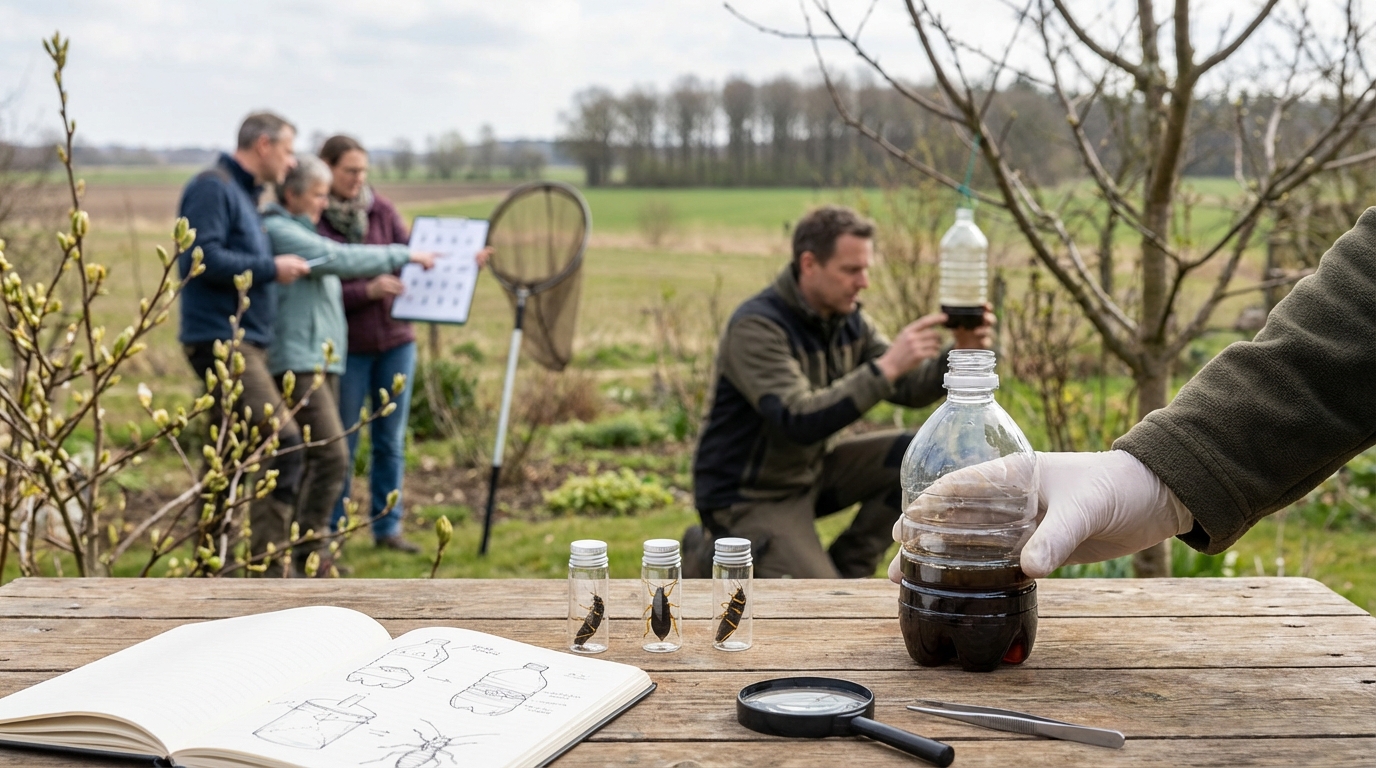
Here is a simple and effective hornet trap tutorial, validated by the recommendations of the MNHN (National Museum of Natural History - France):
-
Container: Take a 1.5-liter plastic bottle. Cut off the top third and turn it upside down into a funnel at the bottom. Classic, but it works.
-
Exhaust holes: this is where many people go wrong. Drill 5 to 6 5.5 mm diameter holes in the lower part of the bottle. Bees and small insects pass through these holes. Larger Asian hornets get stuck. Without these holes, your trap becomes an all-purpose trap, and we don't want that.
-
Bait: mix one third dark beer, one third white wine (bees have been known to hate white wine) and one third blackcurrant or grenadine syrup. No honey, ever. Honey massively attracts bees.
-
Installation: Hang the trap at a height of 1.5 m, sheltered from wind and direct rain, preferably near water or a fruit tree. Founding queens will be attracted to sources of sugar as they emerge from winter.
-
Maintenance: check the trap every two days. Change the bait every week, even if it doesn't look «stale». Fermented bait loses its attractiveness and starts to attract other species.
The optimum trapping period is from mid-February to the end of April. After that, the queens that have not been caught have already established their primary nests and are starting to produce workers. The trap is then of little use: the workers don't build nests, only the queens do.
An important point for the protection of biodiversity: don't leave your traps in place after May. MNHN studies are clear on this point. A trap left in place all summer massively captures non-target insects and contributes to the collapse of pollinator populations. Spring trapping is a precise window of action. We work hard for two months, then remove everything.
If you want to go further, there are commercial traps designed to be even more selective, with calibrated grids and exit systems for non-target species. At Pest Patrol, we recommend those that comply with the specifications of the national control program. They cost between 15 and 30 euros, a reasonable investment when you consider that a hornet's nest can require a professional intervention costing 150 or 200 euros in autumn.
Final tip: always photograph your captures. If you capture a founding queen, report her on the Inaturalist or Vespawatch. Each report is fed into the national mapping system, enabling the authorities to adapt their control strategy in real time.
The impact of citizen trapping: the scientific basis for collective control
We often hear that trapping a few queens in the garden is useless in view of the scale of the invasion. This objection is regularly voiced, even by some scientists. It deserves a qualified response, because reality is more complex than a simple «it works» or «it doesn't work».
First, the figures. A study carried out by ITSAP (Institut technique et scientifique de l'apiculture et de la pollinisation française) in collaboration with the CNRS has shown that in areas where coordinated spring trapping is implemented, the number of primary nests detected in summer falls by 30 to 40 %. Thirty to forty percent is not negligible. It's not eradication either, let's be honest. But it is a significant reduction in the pressure on bee colonies and local ecosystems.
The key word here is «coordinated». An isolated trap in a garden has a limited impact. Ten traps spread over a neighborhood is something else. One hundred traps in a commune, that's a whole new scale. The proliferation of the Asian hornet can only be combated by territorial networking. That's exactly what local authorities are doing by implementing structured control strategies: distributing selective traps, training residents and collecting data centrally.
The town of Auderghem is a good example. Their campaign against the Asian hornet is based on the mobilization of citizens, under the supervision of municipal services. The result: a documented drop in the number of secondary nests (the large summer and autumn nests) over three consecutive years. It's not magic, it's method.
Let's go back to biology to understand why spring trapping has such an impact. In spring, each founding queen is on her own. She doesn't yet have any workers to feed her or defend the nest. This is when she is most vulnerable. If she is captured before laying her first workers, the primary nest is abandoned. No primary nest, no secondary nest. No secondary nest, no production of new queens in autumn. The cycle is broken at its root.
Primary nests are often hard to spot. Small, inconspicuous, tucked away in nooks and crannies. Most people never see them. When they do discover an Asian hornet nest, it's usually the secondary nest, the one the size of a football (or larger), hanging high in a tree. At this stage, the colony already numbers thousands of individuals, and destruction requires a trained professional. Spring trapping can prevent this from happening.
Can citizen trapping alone stop the expansion of Vespa velutina in Belgium? No. Let's be clear. The species has been present in Belgium since 2015, it now occupies almost the entire country, and its complete eradication is unrealistic with current tools. What citizen trapping can do, however, is reduce colony density locally, protect apiaries and limit the impact on pollinating fauna. That's already a huge achievement.
A recent publication in Biological Invasions (Lioy et al., 2023) stresses that the most effective trapping programs are those that combine citizen participation with scientific coordination. Data collected by individuals, when centralized and analyzed, can be used to model population dynamics and anticipate areas at risk. Your garden trap isn't just a trap: it's a sensor in the national monitoring network.
At Pest Patrol, we believe in this hybrid approach. The fight against the Asian hornet cannot rely solely on professionals or solely on citizens. It works when everyone plays their part. Scientists model, local authorities coordinate, professionals intervene on dangerous nests, and private individuals trap in the spring. Every link counts.
Conclusion
The Asian hornet season in 2026 promises to be particularly intense. The signs are there: mild winters, early awakening of founding queens, steadily increasing population density. Waiting until summer to take action means allowing thousands of nests to become established.
Do you have a garden? Install a selective trap now. Follow the protocol, respect the selectivity, report your captures. If every reader of this article sets a trap correctly, we're talking about hundreds of queens intercepted before they found their colonies.
Pest Patrol will continue to publish field alerts and practical guides throughout the season. Stay informed, share this article with others, and above all: act now. The spring trapping window only lasts a few weeks. This is it.
Frequently asked questions
Why are Asian hornets emerging so early in 2026?
The early awakening of the queens is due to this winter's thermal anomalies, with temperatures in excess of 13°C as early as February. This early restart of the biological cycle gives them 3 to 4 weeks' head start in founding their colonies.
When is the best time to trap founding queens?
The ideal window of action is between mid-February and the end of April. This is the time when queens emerge from hibernation to feed and create their primary nests; after this period, trapping becomes useless and risky for biodiversity.
How do you make a truly selective Asian Hornet trap?
Use a bottle with a funnel and pierce 5.5 mm holes to let the small native insects escape. For the bait, mix dark beer, white wine and blackcurrant syrup, a cocktail that attracts hornets but repels bees.
Why should traps be removed after April?
Once spring has passed, the queens remain in the nest and only the workers emerge. Continuing trapping in summer would needlessly capture many pollinating insects, without having any impact on the proliferation of hornet colonies.
What should I do if I capture a queen or see a nest?
Photograph your capture and report it on platforms such as Vespawatch or iNaturalist. These data enable experts to map the invasion in real time and adjust local control strategies.
 Français de Belgique
  English
  Nederlands (België)