
How can I check whether a pest control company is registered?
Contents
-
Selection criteria: distinguishing a registered expert from an illegal service provider
-
Closed biocidal circuit vs. approval: official registers to consult
-
Pre-purchase recommendations: questions and proof of training required
You've got mice in the attic, cockroaches in the kitchen, and you type «deratting» into Google. Thirty results appear. Reassuring logos, slogans like «rapid intervention 24 hours a day», prices that range from simple to triple. How can you tell who's serious and who's improvising with a sprayer bought in a supermarket? The question is not insignificant: an unregistered service provider may use products that are prohibited, incorrectly dosed, or even dangerous for your children or pets.
Things to remember
-
Demystifying post-2016 legal obligations for 3D companies
-
Contrary to popular belief, conventional approval no longer exists: we teach customers to check the BCE number, the closed biocide circuit and BEPMA membership to guarantee safe, legal intervention in 2026.
-
Distinguishing between a registered expert and an illegal service provider
-
Compare the different options before deciding.
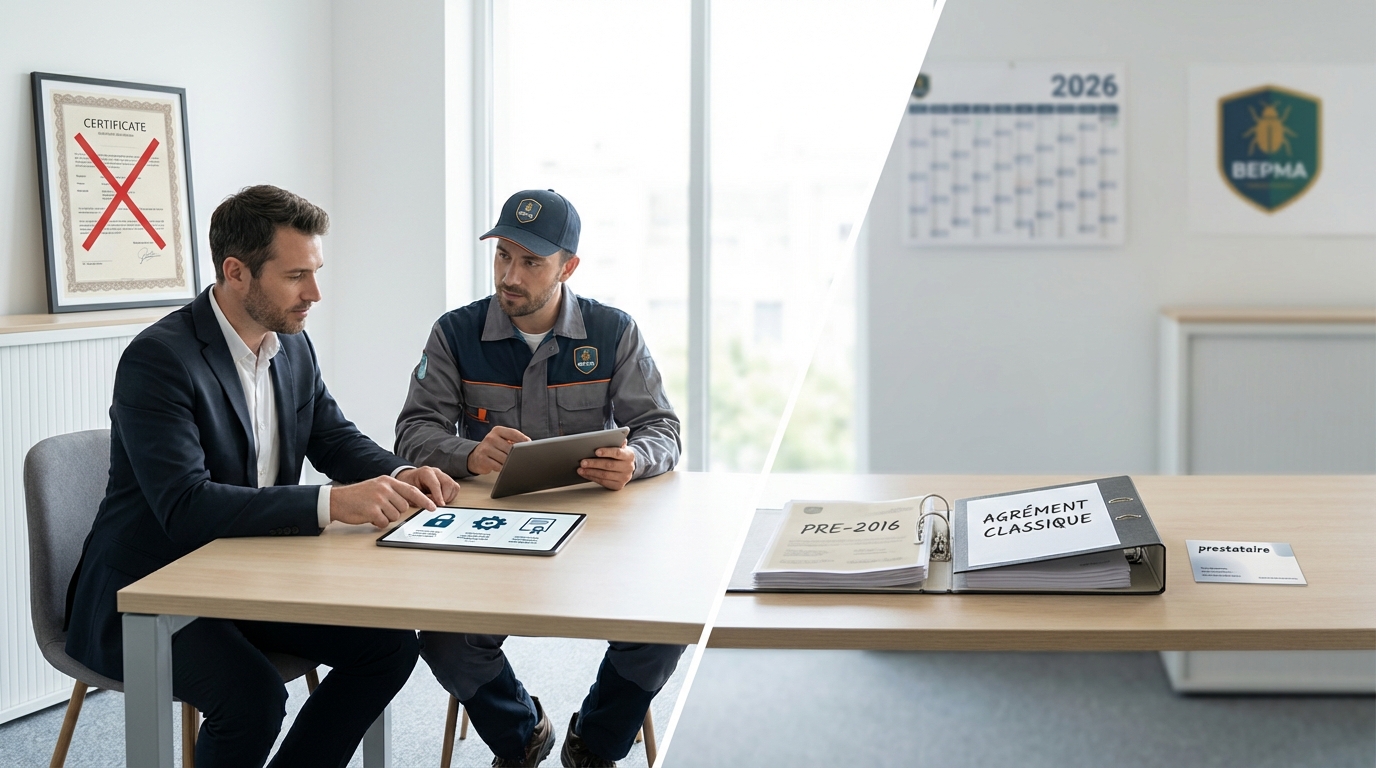
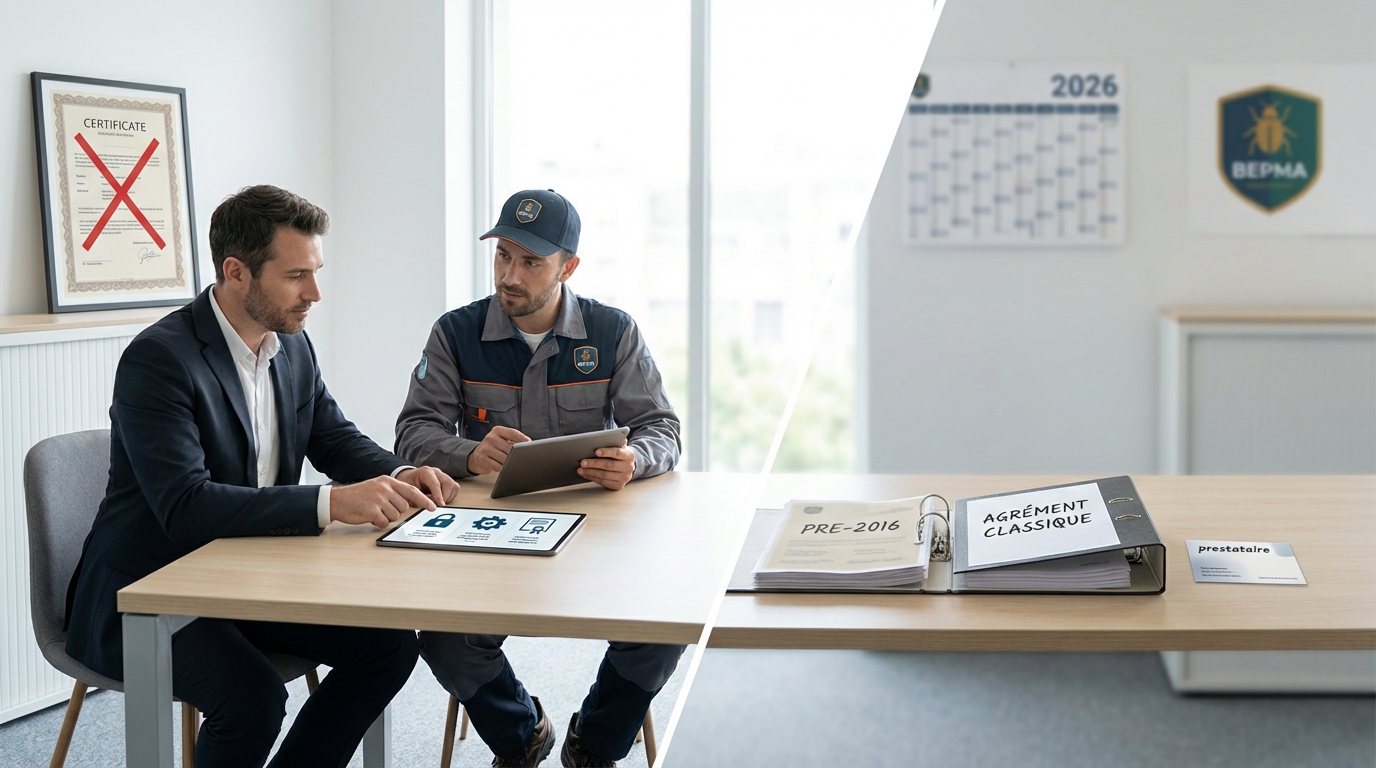
Since the 2016 reform, the old classic approval system for pest control companies has been thoroughly overhauled in Belgium. Many private individuals are still unaware of this. They look for an «approval number» that no longer exists in this form, and miss out on the real indicators of reliability. Today, the criteria have changed: BCE number, access to the closed biocide circuit, BEPMA membership. These are the concrete elements that distinguish a professional 3D expert from a potentially dangerous amateur.
This article will give you the keys to sorting this out yourself, without unnecessary jargon, with the right reflexes and the right addresses. Because when it comes down to it, checking that a pest control company is registered protects your health as much as your wallet.
Selection criteria: distinguishing a registered expert from an illegal service provider
The first and easiest thing to do is ask for the BCE number. The Crossroads Bank for Enterprises is the official register for all companies operating in Belgium. Each company is registered with a unique number, which can be consulted free of charge online. No BCE number? No legal company. Period. It's that simple.
Go to the ECB website and enter the company name or number. You'll immediately see if it's active, how long it's been active, and what activities it declares. A certified 3D company (deratting, disinsectisation, disinfection) must display NACE codes corresponding to pest control. In Belgium, this NACE code is «industrial cleaning».»
VAT verification is another quick indicator. Via the European Commission's VIES system or via SPF Finances, you can confirm that a VAT number is active and attached to the company sending you a quote. A service provider who refuses to disclose his VAT number or offers you a «black market» payment? Run away. It's not just a question of taxation: it's a wake-up call for all these practices.
Now, beyond the purely administrative, there's the question of actual competence. A BCE number doesn't guarantee that the technician ringing your doorbell knows what he's doing. That's where things get a little complicated, and that's where a lot of people get fooled.
Take a look at the service provider's website. A professional 3D expert usually displays his certifications, training courses, sometimes even the names of his technicians and their qualifications. They mention the products they use, their working methods and the species they handle. A vague site with just a phone number and generic photos found on the Internet is a red flag.
Remember to check reviews too, but not just any old way. Google reviews are useful, provided you actually read them. Look for the details: a customer who describes the intervention precisely («the technician inspected the crawl space, installed secure stations, and came back two weeks later to follow up») is far more reliable than a «Super service, I recommend!!!» without substance. According to a study by the DGCCRF in France (applicable by analogy in Belgium), nearly 35% of home service companies inspected had administrative anomalies. The pest control sector is no exception.
One final point is often overlooked: professional liability insurance. Ask for it. A professional pest control operator is insured for any damage caused by his work (material damage, accidental poisoning of a pet). Illegal service providers never are.
Closed biocidal circuit vs. approval: official registers to consult
This is the point that creates the most confusion. «Is your company licensed?» That's the question everyone asks. And the answer, from now on, is more nuanced than a simple yes or no.
The old approval system as we knew it has been replaced by a regulatory framework focused on access to biocidal products. Today, the key distinction in Belgium is the closed biocidal circuit. The most effective (and most toxic) products against rodents, insects or micro-organisms are not sold over the counter. They are reserved for registered professionals. This is what we call the closed circuit.
In practical terms, a pest control professional must be able to prove that he has the right to buy and use these products. Without this registration, he can only legally use products from the open circuit, those you find yourself at the DIY store. And if you pay a professional to apply the same products as those available on the shelves at Brico, what's the point?
To check this out, head to BEPMA.BE. The Belgian Pest Management Association is the industry's professional association in Belgium. Their site offers a list of member service providers, i.e. member companies that respect a code of ethics, train their technicians on an ongoing basis and use products within the legal framework. It's not a legal obligation to join, but it's a considerable guarantee of seriousness. It's a bit like choosing a doctor who's registered with the Order: technically, he or she has to be, but for an exterminator, membership of BEPMA is voluntary and therefore all the more significant.
Legislation in 2026 continues to evolve. European regulations on biocides (the notorious Regulation (EU) n°528/2012) are tightening regularly, with active substances being re-evaluated and sometimes withdrawn from the market. A serious professional follows these developments. He knows, for example, that certain second-generation anticoagulant rodenticides are now subject to much stricter restrictions on use than they were five years ago, to protect non-target wildlife (birds of prey, in particular, which get poisoned by eating contaminated rodents).
You can also consult the website of the FPS Public Health, which manages the registration of biocidal products authorized in Belgium. Each product has an authorization number. If a technician comes to your home, you have the right to ask him what products he is using and to check that they are authorized. This isn't paranoia, it's basic prudence, especially if you have small children or pets.
As for the cost of an exterminator, as the question often comes up, expect to pay between 120 and 300 euros for a standard residential treatment, depending on the surface area and the level of infestation. An abnormally low quote (50 euros to «treat everything») should raise a red flag. Either the service provider is using low-end products from the open circuit, or he's simply not registered and cuts corners on everything, including safety.
Pre-purchase recommendations: questions and proof of training required
A customer recently told me that he had called in a «rat remover» he'd found on a classified ads website. The guy arrived in his private car, without uniform, put three blocks of rat poison under the sink and took 80 euros in cash. No estimate, no invoice, no follow-up. Two weeks later, the neighbor's dog was hospitalized. You can imagine what happened next.
Before signing anything, ask specific questions. The first: «What training have you undergone?» A professional pest control operator has undergone specific training in pest control. In Belgium, such training is provided by recognized organizations and covers the biology of target species, product toxicology, application techniques, safety and regulations. These are not half-day courses: we're talking about serious training courses, often spread over several days, with a final exam.
Ask to see the certificate. A professional who has invested time and money in his pest control training will have no problem showing it to you. On the contrary, he'll probably be glad you asked, because it sets him apart from amateurs.
Second essential question: «Can you provide me with a detailed estimate?» A deratting estimate worthy of the name should mention the type of intervention planned, the products used (with their commercial names and authorization numbers), the number of passes included, the safety measures taken, and the total price including VAT. The same goes for pest control: demand transparency on the molecules used, the areas treated, and the time required to re-enter rooms.
On the subject of insect control, many people wonder whether it's compulsory. The answer depends on the context. For private individuals, no, unless the infestation represents a proven health risk (bedbugs in a building, for example, where co-ownership regulations may require treatment). For food professionals (restaurants, bakeries, warehouses), yes: HACCP standards require a pest control plan, with a certified pest control service provider intervening on a regular basis.
The third question is less obvious, but very revealing: «Do you offer post-intervention follow-up?» Pest control is almost never a one-off affair. Rodents come back. Cockroaches, if the conditions are right. A serious professional will include at least one inspection in his offer, sometimes two. He'll also give you preventive advice: seal entrances, store food properly, eliminate stagnant water. A service provider who applies his product and then disappears only does half the job.
One last thing: beware of companies that put you under enormous commercial pressure. «You have to intervene today, or it's going to get worse! Yes, an infestation can get worse. No, that doesn't justify signing a contract in a hurry without checking the service provider's references. Take an hour, consult the ECB, go to BEPMA.BE, read a few reviews. That hour could save you weeks of problems.
For those wondering about the cost of insect removal: prices vary even more than for pest control, depending on the insect concerned. A bedbug treatment, for example, can cost from 500 to over 600 euros, depending on the surface and the method used (chemical, steam, combined). A cockroach treatment for an apartment is likely to cost between 150 and 250 euros. In any case, compare at least two quotations, and never choose on price alone.
Conclusion
Checking that a pest control company is registered isn't complicated. It's just a habit to get into. BCE number, access to closed biocide circuit, training certificate, BEPMA membership: four checkpoints that take ten minutes and make all the difference between a reliable professional and someone who risks endangering your family.
The legal framework has changed a lot since the 2016 reform, and it continues to evolve. Requirements are getting stricter, products are better supervised, training is more rigorous. This is good news for you as a consumer: the tools to check exist, they're free, and they're accessible to all.
So the next time a pest control operator hands you his business card, take five minutes before you call. Check it out. Ask the right questions. And if the answers are unclear, move on to the next one. Your peace of mind is worth it.
Frequently asked questions
How can I check whether an exterminator is officially registered in Belgium?
The first thing to do is to consult the Banque-Carrefour des Entreprises (BCE) with the service provider's company or VAT number. A reliable company must be «active» and have a NACE code related to industrial cleaning or pest control, guaranteeing its legal and fiscal existence.
What is a «closed biocidal circuit» and why is it important?
Since the 2016 reform, the most effective products are reserved for professionals registered in the closed biocide circuit. Calling on a certified expert guarantees you the use of powerful active substances, inaccessible in DIY stores, while complying with safety standards for your children and pets.
Will deratting approval still be valid in 2026?
The former fixed approval number has been replaced by a system of training and registration certifications for the biocide circuit. To check the reliability of an expert, consult the BEPMA (Belgian Pest Management Association) website, which groups together companies committed to a quality and continuous training charter.
What documents do I need to present before a pest control operation?
Before making any payment, ask for a detailed quotation including the name of the products used (with their SPF Santé Publique authorization number) and the number of treatments included. A serious professional should also be able to provide professional liability insurance to cover any damage caused during treatment.
How can you spot an illegal or incompetent pest control company?
Beware of abnormally low prices (under €100 all-in), websites without clear legal notices or technicians who refuse to provide an invoice. A service provider who offers no post-intervention follow-up, or who fails to identify rodent entry points, often only solves the problem temporarily.
 Français de Belgique
  English
  Nederlands (België)