
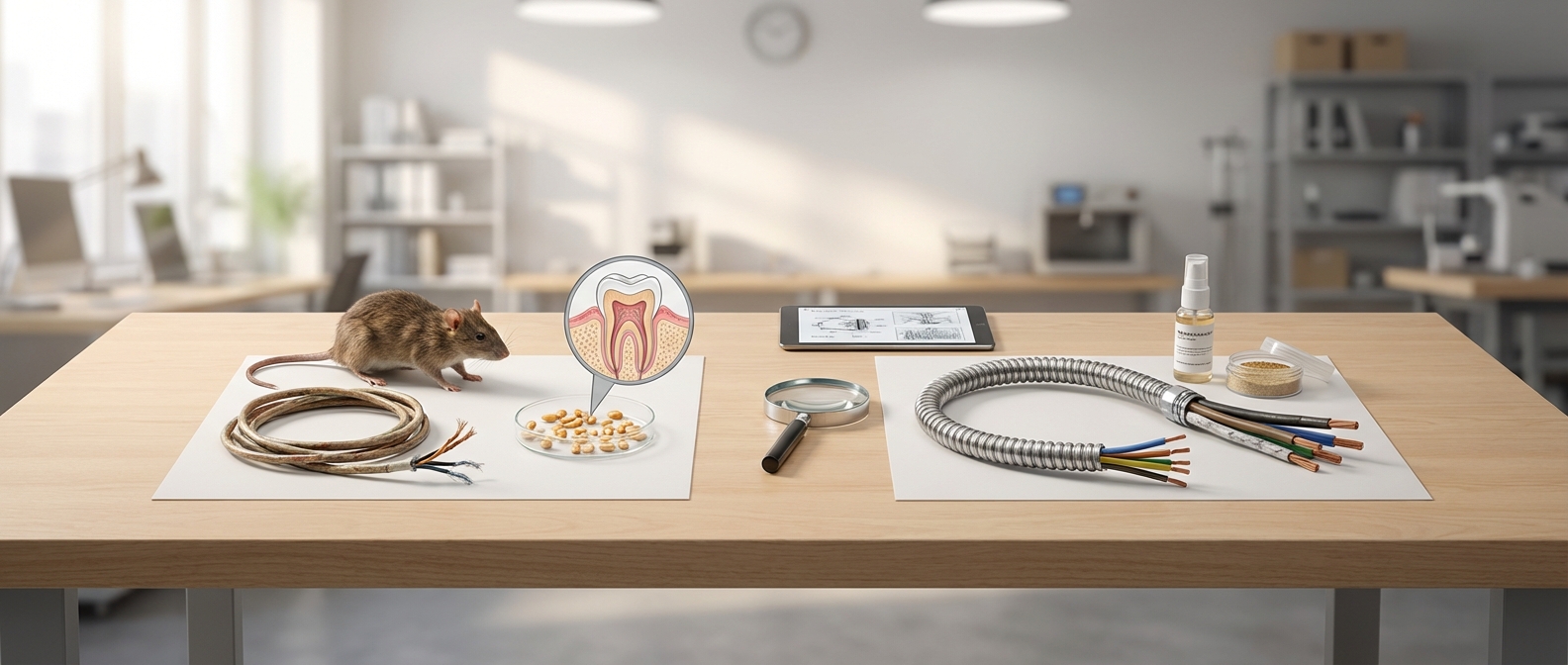
Why do rats eat electrical wires?
Contents
-
Mechanical sheaths vs. repellents: advantages and disadvantages of each solution
-
Our pre-purchase recommendations for securing your installations
One morning, you open the hood of your car and discover a nest of gnawed cables. Or worse: a power failure in the house, a circuit breaker blown for no apparent reason, and the electrician telling you that rodents have attacked your wiring. But you're not alone. Every year in France, insurers estimate that the damage caused by rats to electrical installations represents several tens of millions of euros in compensation. And the risk of fire due to short-circuiting is not an abstract statistic: it's a reality documented by the fire department.
Things to remember
-
Beyond the simple observation, Pest Patrol analyzes the double causality: the biological necessity of tooth wear and the chemical appeal of modern biosourced insulation (corn/soy starch).
-
We compare technical solutions to offer a sustainable defense strategy
-
Analysis of attraction criteria
-
Advantages and disadvantages of solutions
But why exactly do rats eat electrical wires? The answer can't be summed up in a single sentence. There's a deep, biological reason, linked to their anatomy. And there's a more recent, almost ironic reason: our efforts to make materials more eco-friendly have made some cables literally palatable to them. At Pest Patrol, we wanted to explore both causes and, above all, give you concrete, tested, prioritized solutions.
Don't panic, and don't worry about unnecessary jargon. We'll break down the problem and help you protect your equipment, whether at home or under the hood.
Biobased vs. biobased insulation: criteria of attraction
A rat's incisors grow continuously. Approximately 12 to 14 centimetres per year, according to a study published in the Journal of Mammalogy. Rodent tooth growth is not a mere detail: it's the main driving force behind their destructive behavior. If a rat doesn't gnaw regularly on hard materials, its teeth will eventually curl to the point where it can't eat. For a rat, gnawing is a matter of survival.
And they don't mess around. The bite force of a brown rat (Rattus norvegicus) reaches around 7,000 pascals per square centimetre. Enough to pierce copper, aluminum and, of course, any plastic sheathing. Electrical wires, with their cylindrical shape and slightly flexible texture, offer ideal resistance for filing incisors. It's a bit like a perfect nail file: not too hard, not too soft.
So much for mechanics. Now let's talk chemistry.
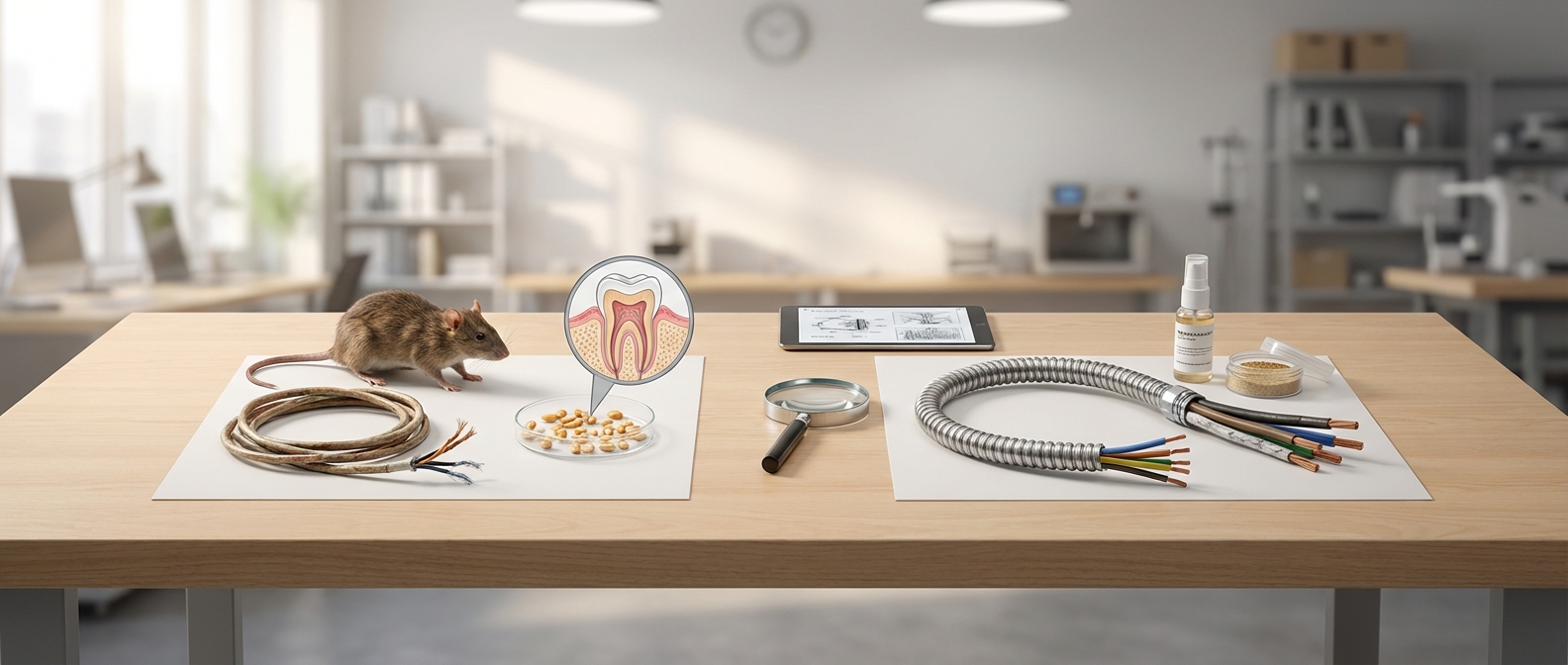
For the past fifteen years, the automotive and construction industries have been adopting bio-sourced insulation materials. The aim was laudable: to reduce dependence on oil and limit carbon footprints. Manufacturers have replaced some of their petroleum-derived polymers with compounds based on corn starch for cables, or soy-based insulation. Toyota, Honda, Kia: several manufacturers have made this choice for their vehicle wiring harnesses. The result? Rodents love it.
A study conducted by the University of Nebraska-Lincoln has shown that rodents are significantly more attracted to sheaths containing plant derivatives than to the older petrochemical 100 % sheaths. The rats don't «eat» the wires in the nutritional sense, but they chew them longer, more intensely, because the smell and taste of the plant components stimulate their exploratory behavior. A rat that detects an organic odor on a wire will test it. And for a rat, testing means biting.
Can rats gnaw through electrical cables in any environment? Yes, in garages, crawl spaces, attics, electrical panels and engine compartments. No place is spared if access is possible. An adult rat crawls into a hole 2 centimetres in diameter. Two centimetres. That's hardly wider than a 2 euro coin.
The real danger is the combination of the two factors. Biological necessity guarantees that the rat will gnaw on something. The chemical attractiveness of modern insulation guarantees that it will choose your cables first. The risk of fire due to short-circuiting is no longer a hypothesis, but a probability that increases every night the rodent has access to your installation.
Mechanical sheaths vs. repellents: advantages and disadvantages of each solution
7,000 pascals of pressure per square centimeter. That's right. So how do you stop rats gnawing on electrical wires with such force? There are two main families of solutions: physical barriers and repellents. Each has its strengths and limitations, and I'm going to be straightforward about what really works.
Mechanical sheaths: the most reliable protection for electrical cables
Anti-rodent sheathing is the most serious bulwark. There are several types:
-
Stainless steel braided sleeves : the most effective. No rodent will pierce braided stainless steel. They've been used in industrial environments for decades, and are now becoming more widely available for home use. Cost: between €5 and €15 per metre, depending on diameter.
-
Fiberglass sheaths : good mechanical strength, excellent thermal resistance. A little stiffer to install, but very durable.
-
Reinforced corrugated tubes : less expensive (€2 to €5 per meter), but beware: some low-end models in simple polyamide are not resistant to a specific rat. Check that the product is explicitly certified rodent-proof.
-
Anti-rodent adhesive tape (Honda or 3M type) : impregnated with capsaicin (the hot pepper compound). Easy to apply, especially to automotive wiring harnesses. Fairly effective in the short term, but must be reapplied every 6 to 12 months.
The advantage of mechanical sheathing is obvious: it creates a physical barrier that the rat simply can't cross. No chemicals, no recharging, no dependence on weather conditions. It's the most durable solution for insulating your wires against rodents.
The drawback? Installation. On an existing house, sheathing the entire electrical network is a major job. On a vehicle, it's much simpler: you protect the engine wiring harness, the accessible hoses and the identified zones of passage. Allow 1 to 3 hours' work for a standard engine compartment.
Repellents: useful but not enough on their own
Car rodent repellent spray is probably the most sought-after product on this subject. And I can see why: it's quick, cheap and easy to apply. The most common formulas contain capsaicin, lavender, peppermint, or synthetic bitters (bitrex).
Let's be honest: it works, but only partially. A study by the National Wildlife Research Center (USDA) showed that capsaicin-based repellents reduced damage by 40 to 60 % over the first few weeks. After that, some rats get used to them. Rodents are remarkably adaptive animals. A hungry rat, or one whose teeth are bothering it, will eventually ignore the unpleasant taste.
Ultrasonic devices? The scientific literature is unequivocal. A meta-analysis published in Pest Management Science concludes that ultrasonic devices have no lasting repellent effect on rodents. Rats get used to them within a few days. Save your money.
So how do you effectively protect electrical wires from rodents? The answer can be summed up in one word: combine. Mechanical sheathing in critical areas, additional repellent in hard-to-reach areas, and above all, treatment of the cause, i.e. the presence of the rats themselves. Here goes.
Our pre-purchase recommendations for securing your installations
Before ordering anything on the Internet, take 30 minutes to make a true rodent diagnosis of your situation. This diagnosis determines everything else.
Step 1: Assess the scope of the problem
Look for the classic signs: droppings (a rat produces 40 to 50 black droppings a day, shaped like an elongated grain of rice), grease marks along walls (rats always run along walls), nocturnal noises in partitions or ceilings, and of course, teeth marks on cables. If you find any open sheaths, check the depth of the bite marks. Superficial marks indicate recent passage. Cables stripped down to the copper indicate an established infestation.
For vehicles, open the hood and visually inspect wiring harnesses, hoses, and areas where insulating materials are visible. Also look for food debris, pieces of paper or cloth: rats sometimes build nests directly in the engine compartment.
Step 2: Treat the source before symptoms appear
Protecting your cables without eliminating rats is like putting a band-aid on a broken leg. Rats' worst enemy isn't cats or poison: it's lack of food and shelter. Eliminate accessible food sources (poorly closed garbage cans, open compost, animal bowls left out at night). Seal off access points: steel grills on air vents, steel wool-reinforced expanding foam in cable conduits, garage door seals in good condition.
If the infestation is confirmed, call in a professional pest control technician. Over-the-counter rodenticides are less effective than professional formulations, and above all, poorly controlled use presents risks for children, pets and non-target wildlife. A rat trap, whether mechanical or electric, should be positioned on identified traffic routes, not at random. Models are available from DIY stores, but placement makes all the difference.
Step 3: Choose the best rat protection for your situation
Here is our hierarchy, based on field feedback and technical literature:
-
For the engine compartment : capsaicin rodent repellent tape (Honda Rodent Tape or 3M equivalent) on main beams, supplemented by car rodent repellent spray on peripheral areas. Renew every 6 months. Total cost: €30 to €50 per application.
-
For domestic electrical systems (attics, crawl spaces, cellars) : stainless steel braided sleeving on exposed cables, primarily around the switchboard and identified passageways. Preventing an electrical fire starts with protecting key points. Call in an electrician if the cables are already damaged: a stripped cable in an attic insulated with glass wool is a classic fire scenario.
-
For outbuildings (garage, garden shed) : combination of reinforced ringed sheath + active trapping + suppression of food sources. It is in these semi-open spaces that the problem returns most quickly if the environment is left untreated.
What not to buy
Ultrasonic boxes, as we said. Mothballs too: toxic to humans, ineffective on rats, and banned for certain uses in Europe under the Biocides Regulation. Grandmother's remedies« based on pepper or white vinegar have no documented efficacy beyond a few hours.
One last important point: check your insurance policy. Many comprehensive home insurance policies cover damage caused by rodents, including to electrical wiring. For vehicles, coverage is more variable. Some car insurers consider rodent damage as an event covered by «all-accident damage», others do not. Read the fine print before incurring any costs, as you may be in for a pleasant surprise.
Conclusion
A rat gnawing on your electrical cables is not malicious intent. It's biology, amplified by industrial choices that have made our insulation more attractive. The good news is that solutions exist and are readily available: mechanical sheaths for critical areas, additional repellents and, above all, treatment of the infestation at source.
Don't leave it lying around. A corroded cable today means the risk of a short-circuit tomorrow. Make your diagnosis, protect sensitive points, and if the problem is beyond your control, call in a professional. At Pest Patrol, we're here to guide you, not to sell you fear. But on this particular subject, acting quickly isn't excessive precaution: it's common sense.
Frequently asked questions
Do rats really eat plastic wires?
No, rats don't eat cables for food. They gnaw them to file their incisors, which grow by 12 cm a year, and to test the biosourced insulation (corn or soy starch), which has an attractive odor for them.
How can I protect my car's cables from rodents?
The most reliable solution is to use braided stainless steel sheaths or technical tape impregnated with capsaicin (the hot pepper compound). Repellent sprays are a useful complement, but their effect wears off after a few weeks.
Are ultrasounds effective in keeping rats away from electrical installations?
The science is clear: ultrasound has no lasting effect. Rats are extremely adaptable animals that get used to noise in just a few days, making these boxes ineffective for long-term protection.
What is the main risk of a rat-gnawed cable?
The greatest danger is a house fire. By stripping wires down to the copper, rats cause short circuits which, when in contact with flammable insulation such as glass wool, can trigger an undetectable fire in partitions or attics.
Are there any electrical sheaths that rats can't cut?
Yes, reinforced ringed sheaths and braided stainless steel protectors can withstand the pressure of a rat's jaws (7,000 pascals/cm²). They're the most cost-effective way to secure an exposed electrical panel or motor harness.
Does my insurance cover electrical damage caused by rodents?
Does my insurance cover electrical damage caused by rodents?
 Français de Belgique
  English
  Nederlands (België)