
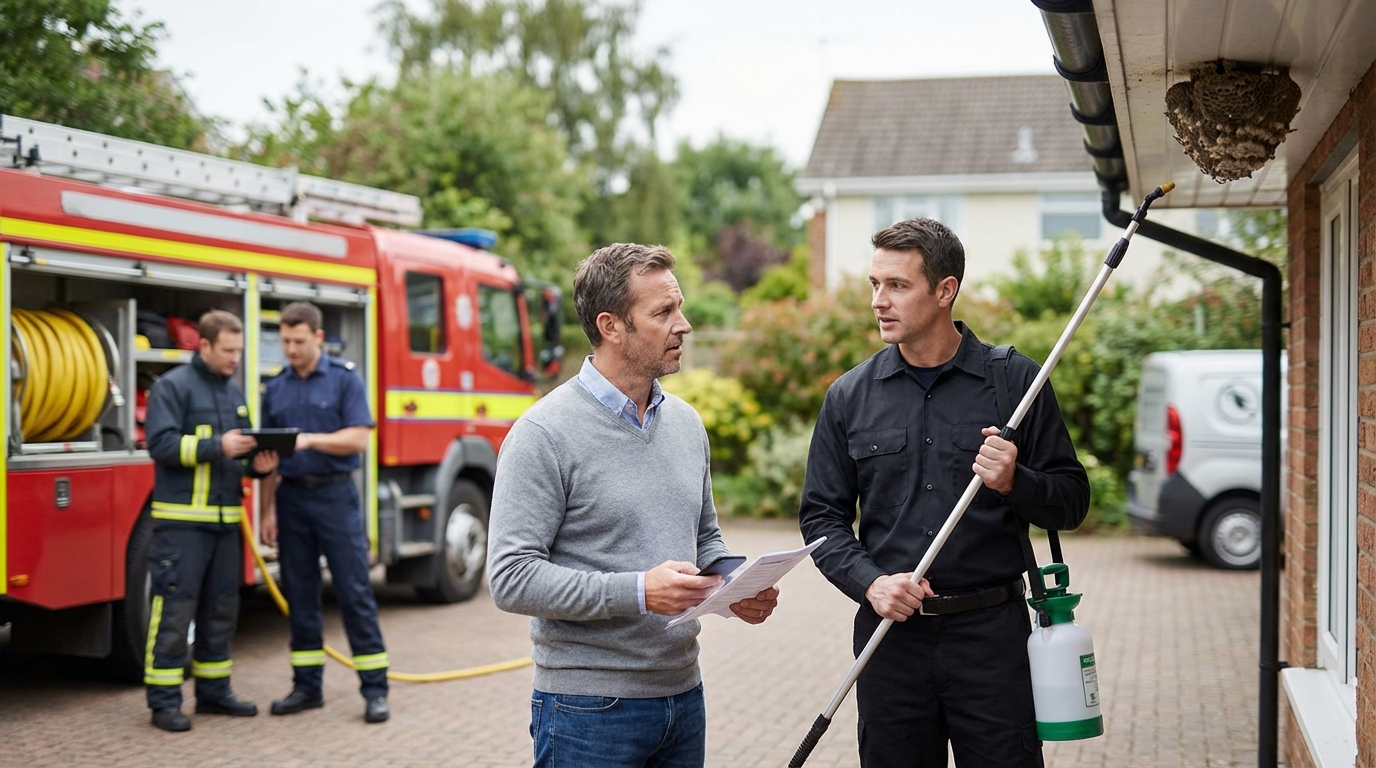
Should I call the fire department in the event of a wasp or hornet nest?
Contents
-
Why the fire department no longer responds to nests (except for life-threatening emergencies)
-
Pricing and billing: why firefighters cost more than professionals
-
How to deal with a nest and choose the right pest control expert
You've just spotted a wasp nest under your roof overhang. First instinct: call the fire department. It's what everyone does, or rather, what everyone did. Because reality has changed. In the vast majority of French departments, the fire department no longer comes to destroy a nest on a private home. And when they do, the bill may surprise you.
We often hear that firefighters will remove hornet or wasp nests free of charge. It's a persistent misconception, inherited from a time when fire stations had the means to handle such requests. Today, with the saturation of emergency services and the refocusing on vital missions, the situation is completely different. As a result, you risk either a polite refusal on the phone, or an intervention billed well above the rate of a professional exterminator.
Things to remember
-
Demystify the myth that the fire department is free: explain that they no longer come to deal with private nests, that they charge more than experts (often >180€) and why using Pest Patrol is the rational and economical choice in the face of saturated emergency services.
-
Why the fire department no longer responds to nests (except for life-threatening emergencies)
-
Why firefighters cost more than professionals
-
How to deal with a nest and choose the right pest control expert
So who do you call when you discover a wasp nest? How much does it really cost? And above all, how can you make the right choice without ending up with a hefty bill or, worse still, in danger? We take stock.
Why the fire department no longer responds to nests (except for life-threatening emergencies)
Just fifteen years ago, it was simple. You called 112, a team came, treated the nest and left. No bill, no questions asked. Those days are gone. The main reason can be summed up in one word: saturation. Rescue services are faced with a constant increase in the number of interventions, particularly for accidents, fires and medical emergencies. Every summer, requests for help with wasp or hornet nests explode. During hot spells, some fire stations were receiving dozens of calls a day for this reason alone. It's impossible to mobilize teams trained in first aid to go and deal with a nest in a garage.
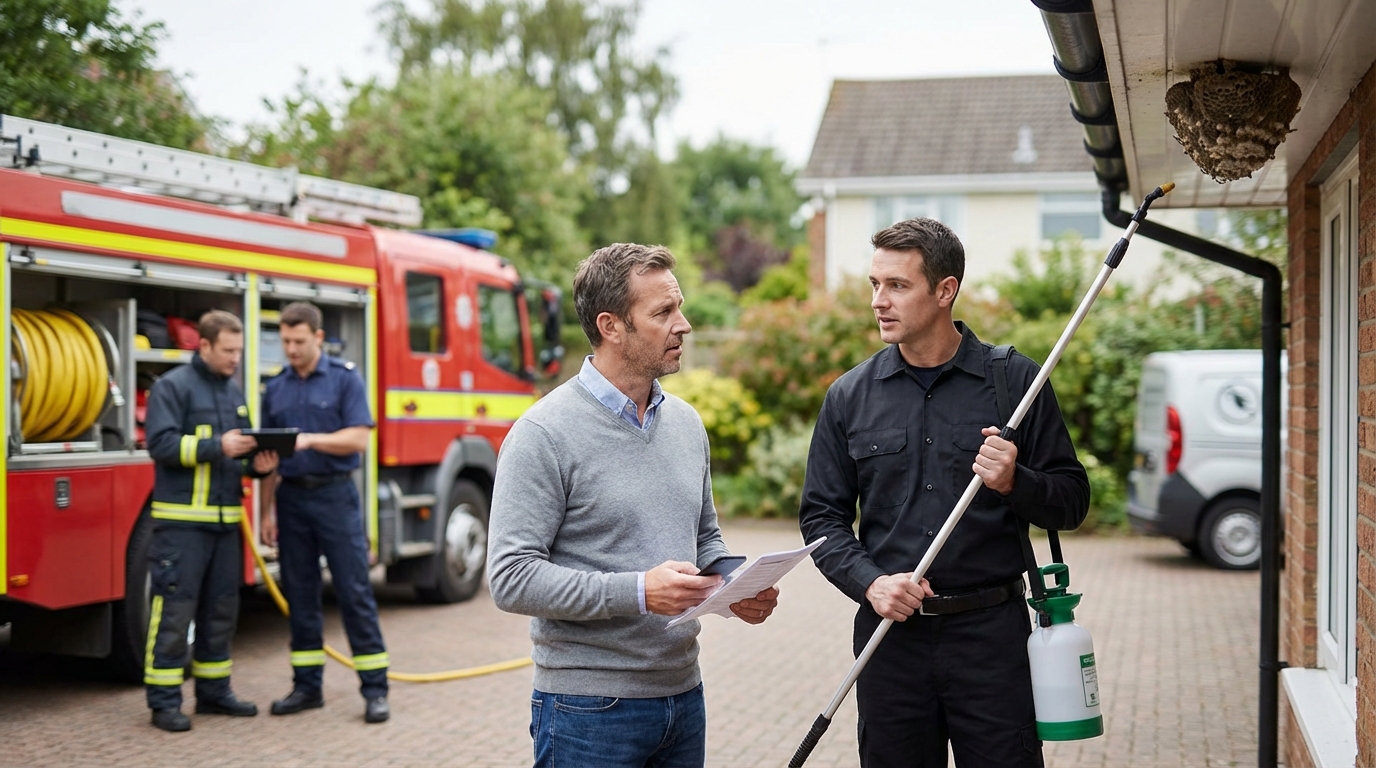
The FPS Interior has clarified the situation in several circulars. The destruction of Hymenoptera nests (wasps, hornets, bees) is not part of the fire department's public service mission, except in cases of immediate danger to the population. What exactly is an immediate danger? A nest in a schoolyard during school hours. A swarm blocking access to a public building. An allergic person in respiratory distress after a sting. These are the kinds of situations that call for emergency intervention.
A nest under your roof, in your garden or in your attic? It's not considered a life-threatening emergency by the fire department. Even if it makes you anxious, even if you have children, even if the nest is getting bigger by the minute. The advice is clear in almost all areas: refer to a private professional.
Do firefighters still remove Asian hornet nests? That depends. Some areas have maintained a specific system for Asian hornets (Vespa velutina), classified as an invasive alien species. But even in these cases, intervention is not systematic. It often involves notifying the local authority, which then decides what action to take. And delays can be long, very long, especially at the height of summer when the number of reports increases.
An important point that many people don't realize: when you call 112 for a wasp nest, you're mobilizing the emergency line. Every non-urgent call that reaches the treatment center slows down the treatment of genuine distress. Operators repeat this regularly. If your life is not in danger in the next few minutes, 112 is not the right number. Your local community can direct you to a referral center, which is often the quickest route.
Pricing and billing: why firefighters cost more than professionals
This is the paradox that no one anticipates. In the few areas where the fire department is still willing to respond to a nest in a private home, it has to be paid for. And not just a little. Fire department rates for a wasp or hornet's nest vary from area to area, but are generally between 150 and 250 euros. Many homeowners discover the bill after the fact, convinced that it was free. The average price is around 180 euros, sometimes more if the nest is high up or difficult to access.
How do the fire department's invoices work? The service issues an invoice directly to the caller, often a few weeks after the intervention. It's a rate voted by the zone's board of directors, covering travel costs, equipment and time mobilized. There's no negotiation, no prior estimate. You find out the amount once the job is done.
Now, let's compare the price of a pest control intervention by a private professional. A qualified exterminator will charge an average of between 80 and 150 euros for the destruction of a standard wasp nest. For a European hornet's nest, expect to pay between 80 and 180 euros, depending on location and accessibility. Asian hornets, which are a little more technical to deal with, are in the same high range. In all cases, you'll receive an estimate before the job is carried out. No surprises.
Why the price difference? Firefighters are simply not organized to optimize this type of service. Their cost structure is calibrated for heavy rescue missions: specialized vehicles, multi-person teams, rigorous protocols. When they intervene to remove a nest, it's with the same resources as a rescue operation. A professional insect killer, on the other hand, arrives with a light vehicle, the right equipment and targeted expertise. He knows the products, the techniques and the pitfalls to avoid. The result is the same (the nest is destroyed), but the cost is much lower.
And then there's the question of time. Calling the fire department about a nest, even in an area that still accepts nests, often means waiting several days. At the height of the season, requests pile up and priority nests take precedence. A private professional can usually intervene within 24 to 48 hours, sometimes the same day. When you have a hornet's nest two meters from your terrace and your children can no longer play outside, these few days make a real difference.
Is it possible to remove a wasp nest free of charge? Let's be honest: no. Neither firefighters nor professionals work for free. Some communes offer partial coverage for Asian hornet nests, but this is far from universal. Some home insurance policies include a «pest» clause that may cover all or part of the intervention, so it's worth checking your contract before calling anyone.
How to deal with a nest and choose the right pest control expert
First thing: don't touch anything. It sounds obvious, but every year people end up in the emergency room because they tried to take care of a nest themselves with insecticide spray from the supermarket, or worse, with fire. A wasp nest can contain several thousand individuals. A hornet's nest, several hundred. When they feel threatened, they attack in groups. Multiple stings can cause anaphylactic shock even in non-allergic people. The safest way to deal with a hornet or wasp nest is first and foremost to keep your distance, and not to attempt DIY.
Second reflex: identify what you're looking at. Is it a wasp, European hornet, Asian hornet or bee nest? The distinction is crucial, because it determines who to call. If it's bees, contact a beekeeper. Bees are protected, it's forbidden to destroy them, and a beekeeper will come and collect the swarm free of charge in most cases. You can find a beekeeper near you via your local town hall or beekeeping union. The choice between beekeeper or insect killer therefore depends entirely on the species.
For wasps and hornets, you need a professional insect killer. Not a do-it-yourselfer, not your neighbor who's «done it once». A trained, equipped and insured professional. How do you choose one? A few simple criteria. He must hold a biocides registration, mandatory for handling biocidal products used in nest destruction. He must be covered by professional liability insurance. And he must provide you with a clear estimate before any intervention.
This is exactly what Pest Patrol. Our technicians' professional expertise covers all Hymenoptera species: wasps, European hornets, Asian hornets. Each intervention follows a precise protocol, adapted to the location of the nest (roof, ground, tree, cavity wall) and the species identified. Our estimates are transparent, with no hidden charges, and we respond quickly, usually within 24 hours of your call.
Here are a few situations that call for particular urgency when dealing with an Asian hornet nest: the nest is close to a busy passageway (front door, playground), someone in the household is allergic to Hymenoptera venoms, or the nest is in a rapid growth phase (which happens mainly between June and September). In these cases, don't wait. The larger the nest, the more complex the intervention and the greater the risk of stings.
A final point that is often overlooked: after destroying the nest, the professional checks that there is no secondary nest nearby. Asian hornets, in particular, sometimes build a primary nest in spring, then migrate to a larger secondary nest in summer. A good pest control operator will inspect the surrounding area and advise you on preventive measures. At Pest Patrol, this is part of our standard service.
Conclusion
The fire department is no longer the right place to knock if you have a wasp or hornet's nest in your home. They used to be, they're not anymore. Their mission is to save lives in situations of immediate danger, not to manage the thousands of nests that appear in our gardens every summer. And when they still agree to intervene, the cost often exceeds that of a professional pest control service.
The rational choice is to contact an expert directly. You save time, you pay less, and you're guaranteed a job done right. If you come across a nest and don't know what to do, call Pest Patrol. We'll identify the species, give you an immediate estimate and get to work fast. No need to look any further.
Frequently asked questions
Do the fire department still respond to wasp nests?
In almost all regions, firefighters no longer respond to wasp or hornet nests in private homes. They concentrate solely on vital emergencies (schools, hospitals, stung allergy sufferers). For a garden or roof, you need to contact a private expert.
How much does it cost to have the fire department respond to a hornet's nest?
If the fire department agrees to come out, the cost is high, often between €180 and €250. On the other hand, a professional like Pest Patrol offers transparent and generally much lower rates (between €80 and €150) with a prior estimate.
Why are fire departments more expensive than professional insect killers?
Firefighters mobilize heavy rescue resources (truck, full team) that are not optimized for pest control. A Pest Patrol expert uses targeted, lightweight equipment, reducing travel and labor costs for the same result.
Can a wasp nest be removed for free?
Free disposal of wasp and hornet nests is no longer possible. Only bee swarms can be collected free of charge by a local beekeeper. For other pests, professional intervention is not free, but is essential for your safety.
How do I know if my nest needs urgent attention?
It's a real emergency if the nest is located near a high-traffic area (door, terrace), if children are playing nearby or if a member of the household is allergic. In these cases, Pest Patrol prioritizes your request for same-day neutralization.
 Français de Belgique
  English
  Nederlands (België)