
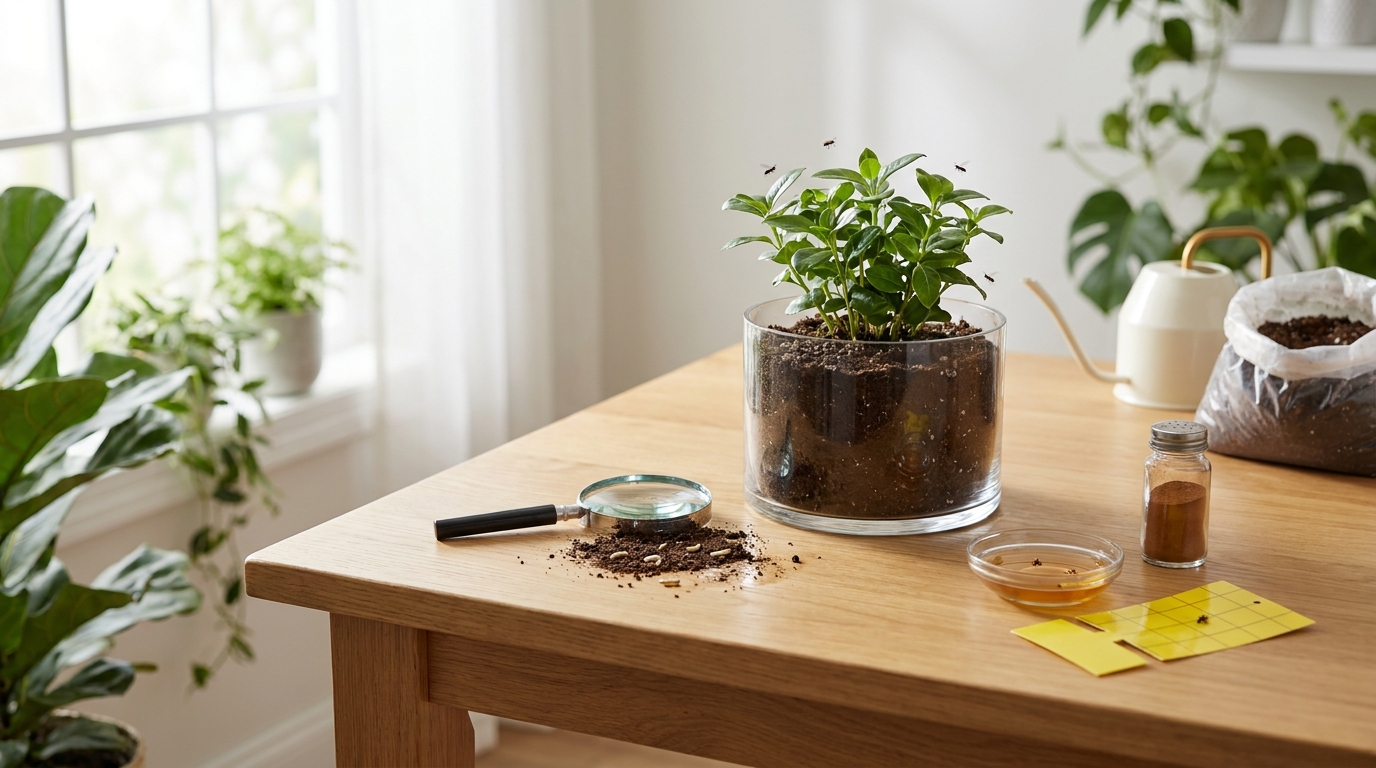
Why do I have midges in my plants and how can I get rid of them?
Contents
-
Understanding the origin: why potting soil flies invade your plants
-
Practical solutions and grandma's remedies to eradicate midges
-
Sustainable prevention guide: best practices to protect your potting soil
You water your ficus, and a swarm of little flies flies out of the pot. Classic. These bugs are houseplant midges, or more precisely Sciaridae (family Sciaridae). And if you're reading this article, it's probably because you're tired of seeing them hovering around your green plants, your coffee and your face.
Things to remember
-
We go beyond a simple list of tips to explain scientifically the link between the Sciaridae life cycle and potting soil moisture.
-
Pest Patrol brings technical authority, citing entomological biology, while remaining accessible through proven natural remedies.
-
why potting soil flies invade your plants
-
Practical solutions and grandma's remedies to eradicate midges
The reflex is to look for a houseplant midge killer, spray a chemical and hope for the best. But this never solves the underlying problem. These midges aren't there by chance: they're there because your soil offers them exactly what they need to reproduce. Understanding this is half the solution.
At Pest Patrol, we prefer to explain why those little flies in your houseplants appeared before we told you how to get rid of them. Because a home remedy applied without understanding the mechanism is like putting a band-aid on a broken leg. Together, we're going to take a look at the life cycle of these insects, the natural solutions that really work, and above all, the habits you need to change so you never have to go through this again.
Understanding the origin: why potting soil flies invade your plants
A figure to set the scene: a single female sciarid lays between 50 and 200 eggs in a single clutch. In moist soil, at room temperature (between 20 and 25°C), these eggs hatch in 4 to 6 days. In other words, if you don't react quickly, the situation will degenerate within a few weeks.
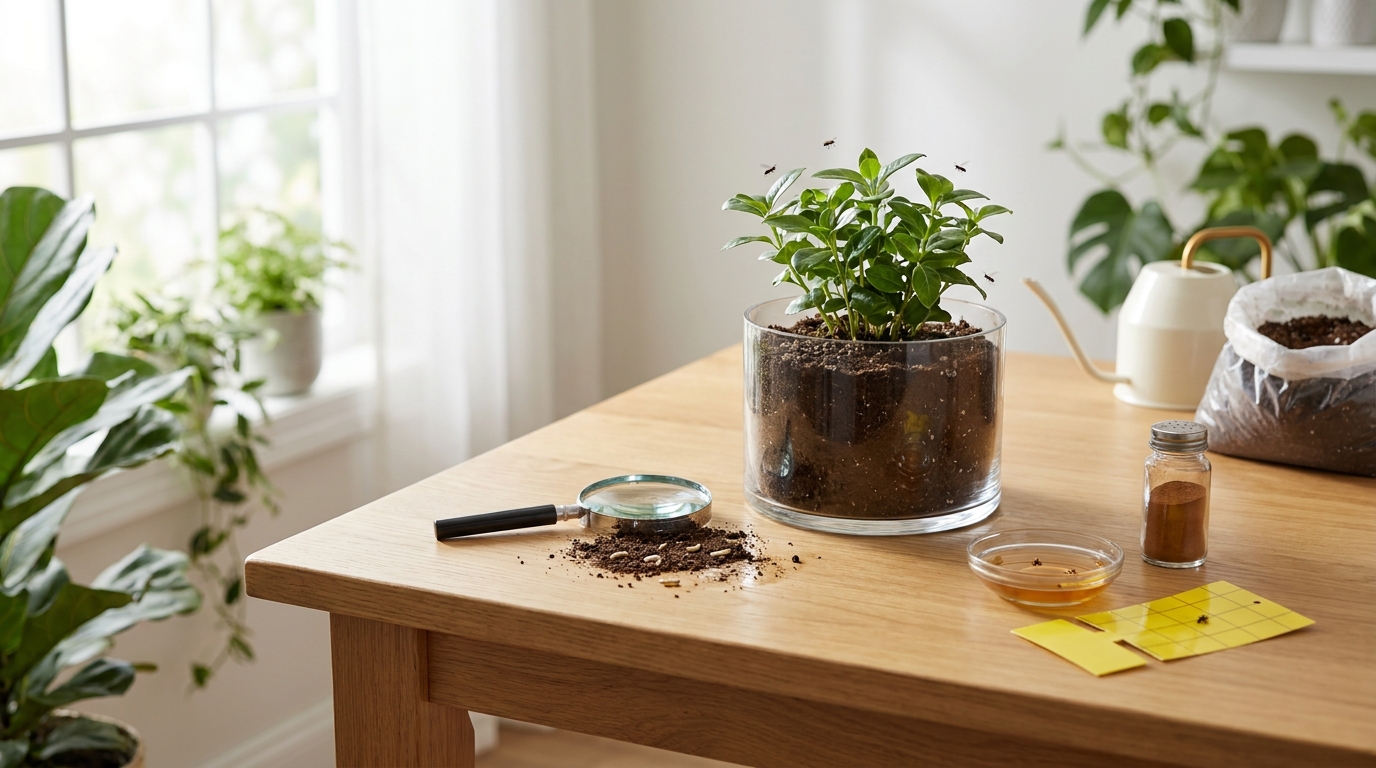
Potting flies, also known as «fungus gnats», belong to the Sciaridae family. They're Diptera, like conventional flies, but in miniature: 2 to 4 mm. Adults live only 7 to 10 days. They don't sting or bite, and frankly, they're pretty harmless at this stage. The real problem is the larvae.
Sciarid larvae are translucent, with a conspicuous black head. They measure 5 to 6 mm and live in the first few centimetres of soil. What do they eat? Microscopic fungi, decomposing organic matter, and sometimes the rootlets of your plants. A study published in the Journal of Economic Entomology (Harris et al., 1996) has shown that Bradysia spp. larvae can cause significant damage to young plants by directly consuming root tissue. On a healthy adult plant, damage remains limited. On a fragile seedling or cutting, it's a different story.
Let's go back to the complete life cycle. Egg, larva (4 larval stages over about 14 days), pupa (3 to 5 days), adult. From start to finish: 3 to 4 weeks in optimal conditions. What exactly are optimal conditions? Constantly moist soil, rich in organic matter, in a heated room. Your living room.
Substrate humidity is the number-one factor. Females only lay eggs in moist soil. If the surface of the soil is dry, they'll move on. It's as simple as that. Commercial potting soils, especially cheap universal ones, are often very rich in peat and little decomposed organic matter, which creates an ideal environment for the fungi on which the larvae feed.
Another underestimated factor is drainage. A pot without a hole, or one whose saucer remains full of water, is a permanent invitation. The water stagnates at the bottom, the potting soil remains waterlogged, and midges take up permanent residence. Gnats in the potting soil of your houseplants are not an unfortunate problem. It's an environmental problem. And the good news is that an environment can change.
A small but important detail: green plant midges rarely enter your home by flying in through the window. Most of the time, they arrive in the form of eggs or larvae already present in the potting soil you've just bought. You repot, water, and two weeks later, surprise! That's why prevention starts as soon as you buy the substrate.
Practical solutions and grandma's remedies to eradicate midges
Your monstera is infested, with dozens of midges taking off every time you touch the pot. So what do we do? Attack on two fronts: adults (to stop egg-laying) and larvae (to break the cycle). If you target only one of them, you're wasting your time.
Yellow sticky traps It's the first and simplest step. These small yellow cards coated with glue attract adults thanks to their color. Plant one or two per pot, and you'll capture most of the adults within a few days. It doesn't solve everything, but it does drastically reduce the number of egg-layers. You can find them everywhere for just a few euros. If you want to know how serious your problem is, count the number of gnats stuck together after 48 hours: over 20 or 30, the infestation is serious.
Black soap, This is the most frequently cited grandmother's remedy, and for good reason: it works. Dilute one tablespoon of liquid black soap (the real stuff, made from olive or linseed oil, not industrial detergent) in one liter of lukewarm water. Sprinkle the soil with this solution. Black soap acts as a surfactant: it destroys the lipid layer that protects the larvae and suffocates them. Two waterings spaced a week apart are generally enough to significantly reduce the larval population.
Powdered cinnamon. Sprinkle a thin layer of cinnamon over the surface of the potting soil. Cinnamon has documented antifungal properties (a study by Wang et al., 2005, in Postharvest Biology and Technology, confirmed the antifungal activity of cinnamaldehyde). By eliminating surface fungi, you deprive the larvae of their main source of food. Strictly speaking, it's not an insecticide; it's more subtle than that: you're making the environment inhospitable.
Cider vinegar as a trap. A small container, some cider vinegar, a drop of washing-up liquid. Adult midges are attracted by the smell of fermentation, land on the liquid, and the soap breaks the surface tension: they sink. Effective as a complement to yellow traps, especially if midges are also present in your kitchen.
Nematodes, and now we've gone up a notch. Entomopathogenic nematodes, in particular Steinernema feltiae, are microscopic worms that parasitize and kill sciarid larvae. You buy them as a powder to be diluted in water. This is a natural anti-mosquito product for houseplants, used in professional horticulture for decades. Its effectiveness is formidable: a study by Jagdale et al. (2004) in Biological Control showed larval mortality rates higher than 90 % with Steinernema feltiae. The only constraint: nematodes must be kept cool and used quickly. Follow the manufacturer's instructions to the letter.
Citronella essential oil can be used as a temporary repellent. A few drops on a cotton pad near the pot discourages adults from laying eggs. It's a complement, not a solution in its own right. Don't pour essential oils directly into potting soil: high concentrations can damage roots.
A common mistake: trying to eliminate midges from houseplants in a single action. The life cycle lasts 3 to 4 weeks, so you need to maintain your efforts for at least a month. Yellow trap + black soap + cinnamon + let the soil dry between waterings. This combination, applied regularly, eliminates almost all infestations without the need for a chemical insecticide for houseplant midges.
Sustainable prevention guide: best practices to protect your potting soil
Getting rid of gnats is good. Never seeing them again is better. Prevention rests on three pillars: watering management, choice of substrate and a few simple physical barriers.
Let's talk frankly about watering. Most plant lovers water too much. Not a little too much: far too much. The golden rule to avoid midges in the soil of your houseplants: let the first 2 to 3 centimetres of substrate dry out between waterings. Stick your finger into the soil. If it's still damp, don't water. That's all there is to it. For plants that tolerate a drier substrate (succulents, sansevières, ZZ), you can let the soil dry out even more. Watering from below (filling the saucer and letting the plant absorb by capillary action for 20 minutes, then emptying the excess) is an excellent alternative: the surface of the soil remains dry, and female sciarids have nowhere to lay their eggs.
Drainage. Every pot must have a drainage hole. Without exception. Add a layer of clay balls or pozzolan to the bottom of the pot to prevent the substrate from clogging. If you're using a decorative planter without a hole, remove the inner pot to empty the residual water after each watering. It takes 30 seconds and changes everything.
Mineral surfaces in top dressing. This is probably the most underestimated tip. Cover the surface of the potting soil with a 1-2 cm layer of coarse sand, fine gravel, perlite or vermiculite. This mineral layer dries very quickly and creates a physical barrier: females can no longer access the moist substrate to lay their eggs. It's simple, it's effective and, what's more, it's rather pretty. Some people use expanded clay balls, which also work.
Choice of potting soil. Avoid cheap universal potting soils full of undecomposed peat. Prefer draining mixes with perlite, composted pine bark or coir. An aerated, well-draining substrate dries faster on the surface and harbors fewer fungi, making it less attractive to sciarids. If you're repotting with new potting soil, you can put it in the microwave (5 minutes on full power for a 2-liter volume) or oven (90°C for 30 minutes) to kill any eggs and larvae that may be present. Yes, it smells a bit funny, but it's radical.
Room ventilation also plays a role. An interior that's too confined, with high ambient humidity, encourages the development of midge populations. Ventilate regularly, especially in rooms where your plants are grouped together.
The quarantine of new plants. When you bring a plant home from the store, isolate it for two to three weeks. Inspect the potting soil and place a yellow trap next to it. If midges appear, treat before installing the plant in the middle of your collection. This simple habit will prevent you from contaminating all your pots.
By combining these practices, you create an environment where sciarids simply can't get a foothold. There's no need for a fly-proof outdoor plant on your balcony or a miracle indoor fly-proof plant: the real protection lies in water and substrate management. Everything else is a bonus.
Conclusion
Midges in your houseplants are not inevitable. They are insects with a predictable life cycle, precise needs (humidity, organic matter, heat), and well-identified weaknesses. Let your potting soil dry, set yellow traps, use black soap or nematodes to eliminate larvae, and cover the surface of your pots with a mineral layer. Within a month, the problem is solved.
If, despite everything, the infestation persists or keeps coming back, don't hesitate to contact Pest Patrol. That's what we're here for: to help you understand what's going on in your home and find the right solution, without unnecessary products or panic. Your plants deserve better than clouds of midges, and so do you.
Frequently asked questions
Why do midges appear in plant soil?
These small insects, known as sciarids or soil flies, are attracted by heat, decomposing organic matter and, above all, constant soil moisture. Females take advantage of this to lay their eggs, finding in this moist environment the fungi they need to feed their larvae.
What's the most effective grandmother's remedy against potting flies?
Watering with water containing liquid black soap is excellent for eliminating larvae by smothering them in the substrate. In addition, sprinkling powdered cinnamon on the surface of the pot stops the development of the microscopic fungi on which the larvae feed.
How can you radically eliminate midge larvae in the soil?
The most formidable biological solution is to spray your plants with beneficial nematodes (Steinernema feltiae), microscopic worms that parasitize and destroy over 90 % of larvae. For this treatment to be successful, it's essential to keep the soil slightly damp throughout their period of action.
How can I keep midges out of my pots for good?
The golden rule is to always allow the first 2 to 3 centimetres of potting soil to dry out between waterings to prevent egg-laying. Adding a physical barrier of one to two centimetres of sand, gravel or clay balls to the surface of the pot will also block insect access.
 Français de Belgique
  English
  Nederlands (België)