
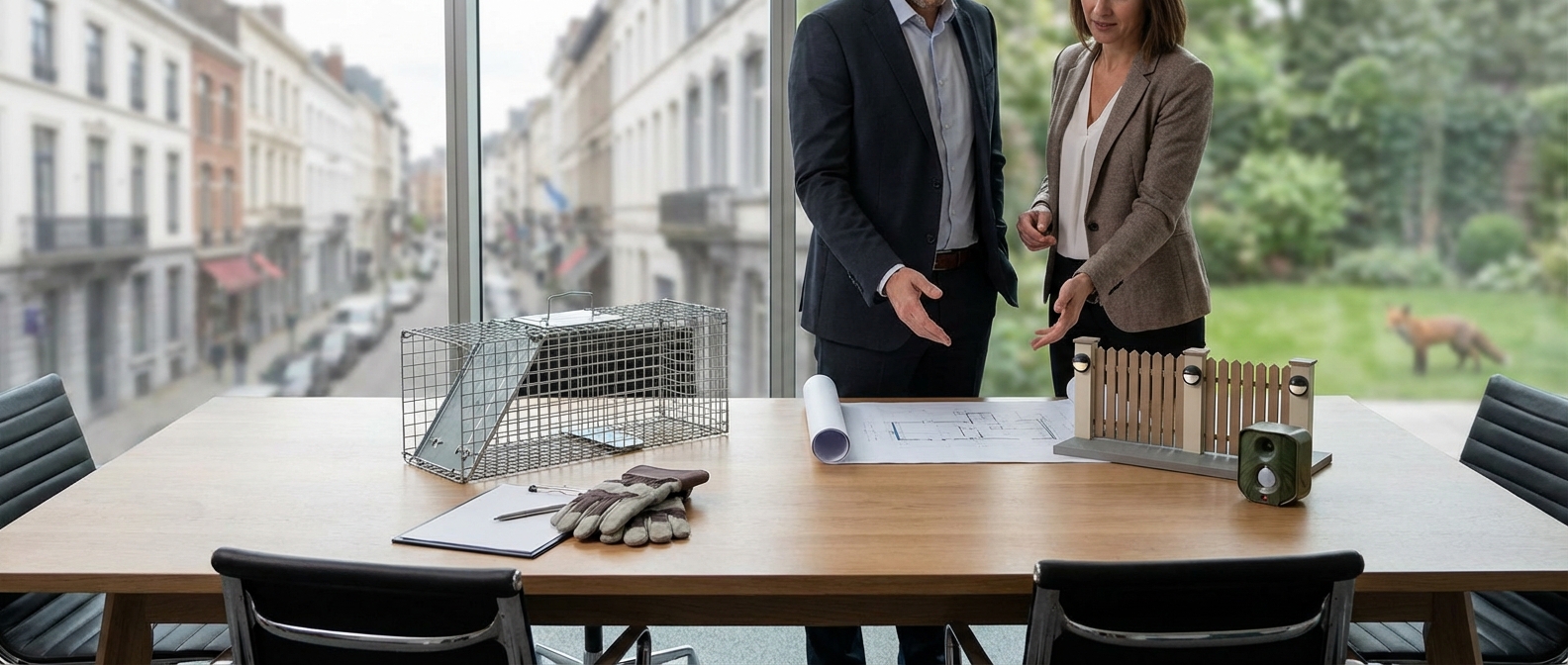
How do you legally manage the capture of a fox in Brussels?
Contents
-
Capture vs. Passive Distance: Choosing criteria for your garden
-
Public services vs. private experts: Benefits and limits of intervention
-
Our recommendations before considering removing a fox in town
A red fox rummaging through your garbage cans, digging burrows under your terrace or waking up the whole building at 3am with its cries: if you live in a condominium in Brussels, chances are you're familiar with this scenario. Your first instinct is to capture it and have it moved. Except that Brussels law doesn't let you do what you want. Far from it.
Things to remember
-
This article examines the strict legal framework of the Brussels Region through the concrete case of a condominium.
-
We contrast capture methods with passive removal strategies, using ethological studies to offer a sustainable and authorized solution.
-
Selection criteria for your garden
-
Compare the different options before deciding.
The urban red fox is a protected species in the Brussels Region, regulated by the 2012 nature conservation ordinance. Capturing a fox in Brussels without authorization is an offence. Period. Never mind the damage to your garden or the stress it causes your condominium. There is a precise framework, identified interlocutors and alternatives that are often more effective than trapping. And that's exactly what we're going to detail here.
We'll compare the options available to you, break down the legal procedures and give you concrete recommendations, based on what the ethological studies say and what Brussels Environment actually authorizes. Because there's a gulf between what you read on the forums and the reality on the ground.
Capture vs. Passive Distance: Choosing criteria for your garden
First thing to understand: capturing a fox in Brussels is not a default option. It is a measure of last resort, subject to a derogation issued by Brussels Environment. You can't just put a cage trap in your garden on a Saturday morning and say «we'll see». The law on nature protection in the Brussels-Capital Region is clear: the red fox (Vulpes vulpes) is a protected species. Its capture, possession and transport are prohibited unless expressly authorized.
So, when is capture really justified? When the animal is injured, trapped in a dangerous place (a window well, a cellar), or when it displays abnormal behavior that may indicate rabies or a neurological disease. Apart from these cases, Bruxelles Environnement systematically recommends passive removal. And frankly, in 90% of nuisance situations in condominium gardens, this is the right approach.
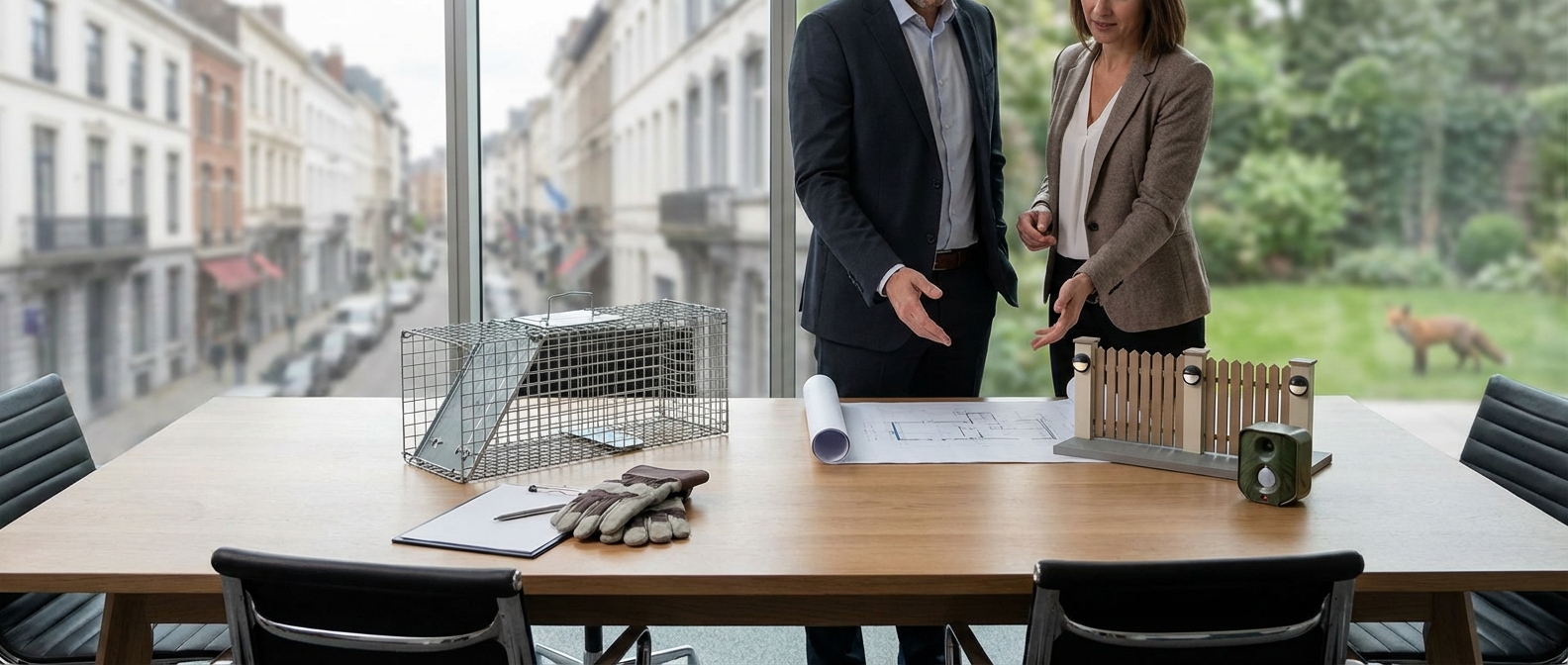
Why? Because capturing and moving a fox doesn't solve anything in the long term. A study published in the Journal of Applied Ecology (Baker and Harris, 2006) has shown that a territory left vacant by a fox is recolonized on average in 3 to 4 weeks by another individual. That's right. Three weeks. Your problem returns, with a new occupant. The territory is attractive because the conditions are right: accessible food, available shelter, little disturbance. As long as you don't change these conditions, you'll have foxes.
Passive distancing is exactly that: making your garden less attractive. We're talking about eliminating food sources (open compost, animal bowls outside, accessible garbage bags), closing off access under terraces and sheds, and installing devices that disrupt the animal's comfort without harming it. It's less spectacular than a trap, but it's what works for the long term.
For a condominium, garden nuisance often boils down to three things: droppings on the lawn, holes dug in the flowerbeds and night-time noise during the rutting season (January-February). None of these nuisances legally justifies capture. Brussels Environment explicitly states this in its advice sheets: coexistence is the norm, physical intervention the exception.
A point often overlooked: the urban red fox provides real ecological services. It regulates rat and pigeon populations, consumes fallen fruit and organic waste. A study by the University of Brighton (Scott, Baker and Henderson, 2014) estimated that an urban fox consumes an average of 3 to 4 kg of rats per month. In a city like Brussels, where the rodent problem is very real, it's an underestimated ally.
The real criterion for choosing between capture and removal is: does the animal represent an immediate danger to itself or to residents? If so, we contact the relevant authorities for a supervised intervention. If not, we work on the environment. It's less emotionally rewarding, I admit. But it's the only strategy that makes sense, legally and ecologically.
Public services vs. private experts: Benefits and limits of intervention
Who do you call when a fox is a problem in your condominium? The question comes up again and again, and the answer depends entirely on the situation. There's no single magic number here.
Emergency: a wounded, trapped or distressed fox. Here it's clear: contact the Brussels fire department (112) or the police. The SIAMU (Service d'Incendie et d'Aide Médicale Urgente) regularly responds to wild animals trapped in urban environments. They have the equipment and training to handle a stressed animal without getting bitten or injuring the animal. Once captured, the fox is transferred to an approved Wildlife Care Center, such as CREAVES or the Brussels revalidation center. The animal is treated there, and if it can be released, in a suitable environment.
If you find an adult fox that just seems to be «hanging out» in your garden in broad daylight, don't panic. A daytime fox is not necessarily sick. Urban foxes adapt their rhythm of activity. Brussels Environment receives dozens of calls a year about «abnormal» foxes that were just sleeping in the sun.
Persistent nuisance without urgency. It's the classic condominium scenario. The fox comes regularly, digs, leaves droppings and makes noise. Here, your first point of contact is Bruxelles Environnement. You can contact them via their online form or by telephone. They sometimes send an agent to assess the situation and advise you on removal measures. If the situation is exceptional (major and repeated damage, documented health risk), they can examine a request for a capture derogation. This derogation is governed by the Nature Protection Ordinance and is only granted on a case-by-case basis, after verification that all alternatives have been exhausted.
What about private pest management companies? Let's be straightforward: in the Brussels region, a private company can't legally capture a fox unless the client has a valid derogation. If someone offers to «solve the problem» without mentioning this legal framework, run away. You risk a fine, and so does the company. Some serious companies, such as Pest Patrol, intervene within the legal framework, offering site audits, recommendations for passive removal and assistance with administrative formalities if a derogation proves necessary.
A word about a question we're often asked: can you adopt a fox in Belgium? No. The red fox is a protected wild animal. Private ownership is prohibited in Wallonia, Flanders and Brussels. Videos of domesticated foxes on social networks generally come from countries with different legislation (Russia, some American states). In Belgium, it's a criminal offence.
To summarize the intervention channels:
-
Injured or trapped animal : Brussels fire department (112), then transfer to a Wildlife Care Centre
-
Recurring nuisance: Brussels Environment for advice and possible capture derogation
-
Technical support : private expert registered for audit, passive removal and follow-up
The trap that many managing agents fall into is the desire to move quickly. A co-owner complains, the AGM votes a motion, and you look for «someone to take care of it». The problem is that if you don't follow procedure, you expose the co-ownership to legal action. The Nature Protection Ordinance provides for fines of up to several thousand euros. Quiet.
Our recommendations before considering removing a fox in town
Before you talk about capturing or even calling anyone, there are a number of steps you need to take. They are simple, inexpensive and, in most cases, sufficient. We've tested them in the field, and feedback from Brussels condominiums is consistent with the scientific literature.
Remove food sources. This is the number-one measure, and by far the most effective. Urban red foxes are opportunistic feeders. It comes to your home because it finds something to eat. Loose garbage cans, open-air compost, cat kibble left on the terrace, fruit trees whose fruit is rotting on the ground: every food source is an invitation. In condominiums, this requires a collective effort. A single resident who leaves food lying around can keep the site attractive to foxes. The syndic has a key role to play here: providing information, reminding people of the rules and, if necessary, amending the by-laws.
Seal off access to potential shelters. Foxes seek out quiet, protected places to set up their burrows. Under a raised terrace, in a ventilated void, under a garden shed: these spaces are magnets. Grating openings with wire mesh buried 30 cm deep (foxes dig) is a durable solution. Caution: never block an access without making sure that no animals are inside. During whelping season (March-April), you run the risk of trapping fox cubs. Check first, or have it checked by a professional.
Repellents: what works and what doesn't. The market for fox repellents is vast and, let's be honest, uneven in quality. Repellents based on capsaicin or essential oils (lemongrass, peppermint) have a limited effect over time: they have to be renewed after each rain, and the fox gets used to them after a few weeks. Ultrasonic devices with motion detectors give better short-term results, but here again, habituation has been documented (Ward et al., 2008, Animal Behaviour). The most effective repellent is habitat modification. Less food + less shelter = less reason to come.
Secure domestic livestock. If someone in the condominium has a chicken coop (yes, it exists in Brussels, and it's authorized under certain conditions), it needs to be seriously secured. A fox can dig under a fence, force open a poorly-fixed door or get through a hole 12 cm in diameter. To secure a henhouse, you need an underground fence, a solid closure and, ideally, an automatic locking system at nightfall. Fox damage to poultry houses in condominiums accounts for a significant proportion of complaints, and is almost always avoidable.
Accept a share of urban cohabitation. I know it sounds frustrating when you pick up fox droppings every morning. But the reality is that the fox is part of the urban fauna of Brussels. It's estimated that there are between 2,000 and 3,000 foxes in the Brussels region. They're everywhere: in Uccle, Watermael-Boitsfort and Auderghem, but also in Schaerbeek and Jette. Where can you find red foxes in Brussels? Everywhere there are gardens, parks and railroad embankments. The question is no longer «how to get rid of them», but «how to live together intelligently».
Urban cohabitation with the fox is a mutual adjustment. The fox adapts to us (it has modified its activity schedules, its diet, its social behavior). It's up to us to do our part: manage our waste, protect our pets, and stop unwittingly feeding wildlife. Condominiums that have implemented these measures see a significant reduction in nuisance within a few weeks. Not disappearing altogether, but going from a daily problem to an occasional, manageable event.
One last point, often overlooked: document the nuisance. Photos, dates, description of damage. If you ever need to apply for a derogation from Brussels Environment, this file will be indispensable. Without concrete proof of repeated nuisance despite distance measures, the application will be refused.
Conclusion
Capturing a fox in Brussels is neither simple, nor harmless, nor free of rights. It's a regulated procedure, reserved for situations where no other solution will work, and requires an official derogation. Brussels law protects the red fox, and for good ecological reasons.
What works, in the vast majority of cases, is passive distancing: cutting off access to food, condemning shelters, securing domestic livestock. It's less spectacular than a trap, but it's durable and legal.
If your condominium is experiencing fox nuisance and you don't know where to start, contact us. We'll assess the situation, identify the points of attraction, and put in place an action plan that complies with Brussels regulations. No miracle promises, just solutions that last.
Frequently asked questions
Is it legal to capture a fox in your garden in Brussels?
No, the capture of a fox is strictly forbidden without a specific derogation issued by Brussels Environment. The red fox is a protected species under the 2012 ordinance; any attempt to trap or transport it without authorization exposes you to heavy criminal fines.
What should I do if a fox is injured or trapped on my property?
In case of emergency (animal in distress, injured or stuck in a window well), contact the Brussels fire department immediately (112). They have the necessary equipment to handle the animal safely before transferring it to an approved revalidation center (such as CREAVES).
How can I keep foxes out of my condominium for good?
The most effective method is passive deterrence: remove all sources of food (secure dustbins, no cat bowls outside) and block access under terraces or garden sheds with buried fencing. A fox will only stay where it can easily find food and safe shelter.
Does moving a fox solve the nuisance problem?
No, moving a fox is often pointless, as its territory will be recolonized by another individual in just 3 to 4 weeks. For a lasting solution, it's better to modify the environment to make it less attractive, rather than trying to physically remove the animal.
Are there any effective fox repellents?
Ultrasonic devices with motion detectors offer good short-term results, but habituation is common. Olfactory repellents (essential oils, capsaicin) are not very long-lasting, as they disappear with the first rain; waste management remains the best natural repellent.
 Français de Belgique
  English
  Nederlands (België)