
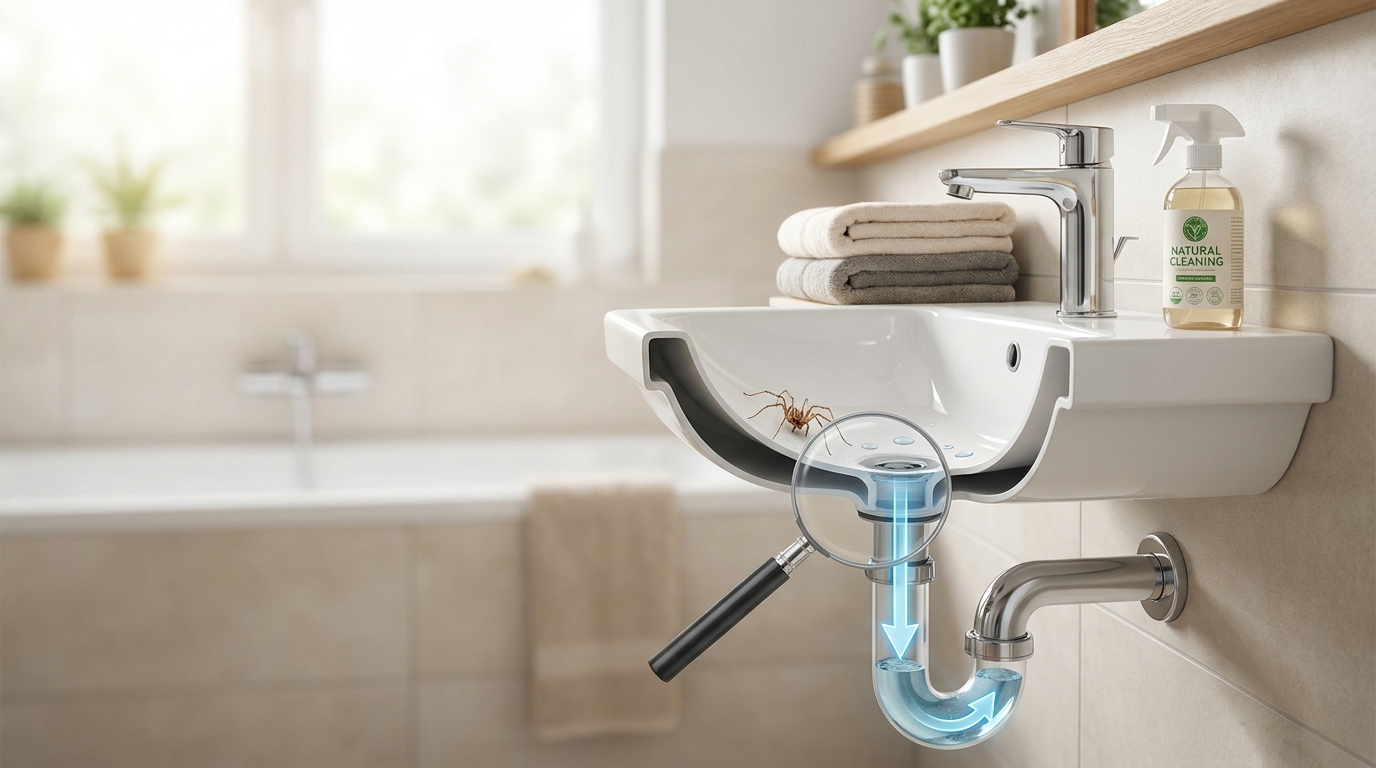
Spider in the siphon: Myths, realities and solutions
Contents
You open the shower curtain one morning and there's a spider staring at you from the bottom of the bath. First instinct: it's come up the drain. Doesn't that make sense? There it is, right next to the drain, soaking wet and looking a bit pitiful. But this explanation, intuitive as it is, is wrong. And we're going to find out why together.
Things to remember
-
This content deconstructs the myth of the spider crawling up the sewer by scientifically explaining the role of the U-shaped siphon as a hydraulic barrier.
-
It analyzes the ecology of the bathroom to explain why humidity attracts spider prey, addresses the issue of domestic hygiene and proposes an exclusion protocol based on professional entomological data.
-
How the siphon works and the myth of the sewer spider
-
why do spiders show up?
This myth has a long life. It circulates in conversations, on forums, and even some websites repeat it without checking. The reality is both simpler and more interesting: the drain in your bath or sink is designed precisely to prevent anything from coming up. The spiders you find in your plumbing have arrived by a completely different route, and understanding which one completely changes the way you deal with the problem.
We'll take a look at how the siphon actually works, explain why your bathroom attracts so many of these bugs, and above all give you a concrete protocol to stop them squatting in your water points.
How the siphon works and the myth of the sewer spider
Take two minutes to look under your sink. You'll see a U-shaped (or sometimes S-shaped) pipe. This is the U-trap, and its principle is frighteningly simple: it permanently retains a small quantity of water at the bottom of its curvature. This stagnant water forms what's known as a hydraulic barrier. Its primary role is to block rising sewage gases, those nauseating odors that would otherwise make your bathroom unbearable.
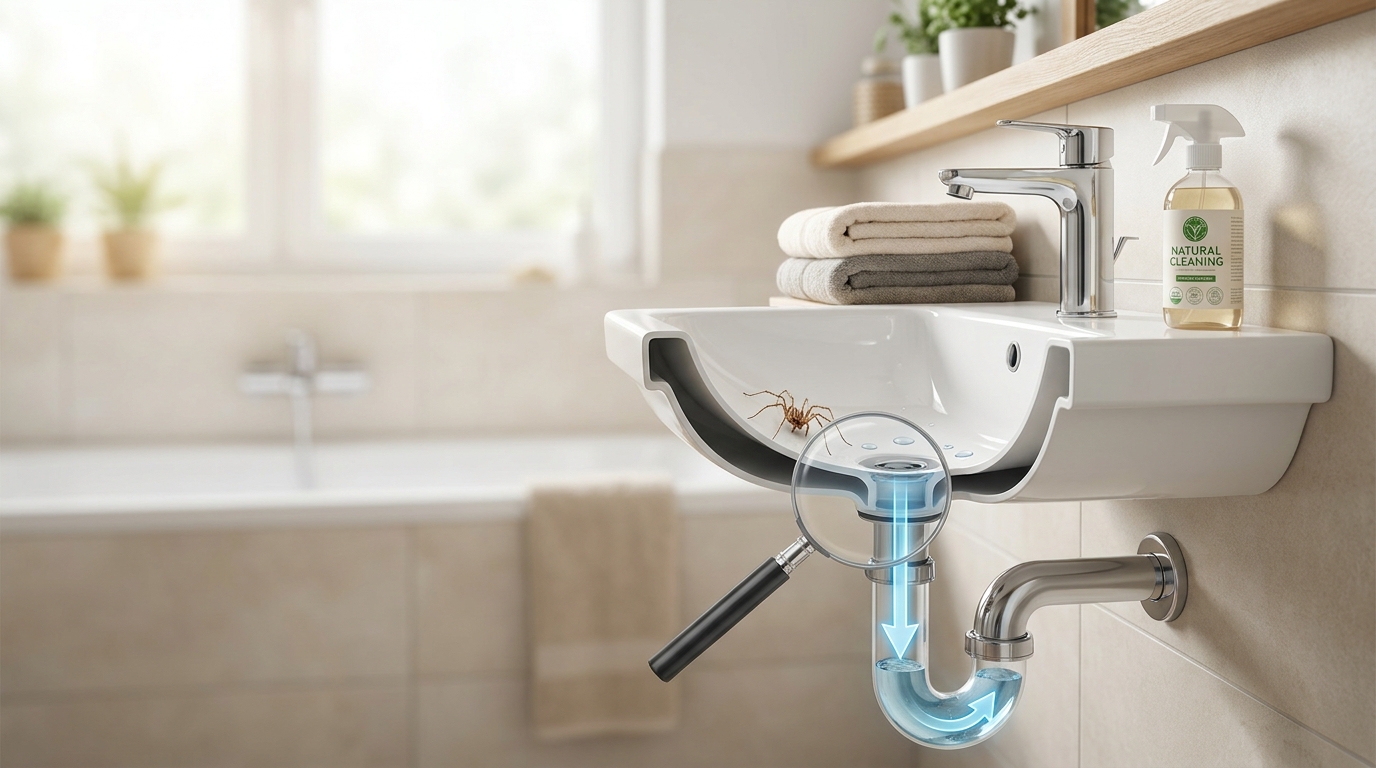
This hydraulic barrier also blocks anything that might try to climb up the pipes. Crawling insects, rodents and, of course, spiders. For a spider to get through this water plug, it would have to swim apnea in a narrow tube filled with water, upstream in a current. Spiders don't breathe underwater. They have lamellar lungs and tracheae that capture atmospheric oxygen. Plunge a spider into water: it may survive for a few hours thanks to an air bubble trapped in its hydrophobic hairs, but it won't actively «swim» through a pipe. A study by London's Natural History Museum, often cited in mainstream entomology, confirms that no common domestic species is capable of passing through a functional siphon.
The key word here is «functional». If your siphon is dry (because you haven't used a sink in weeks, say in a second home), then yes, the way is theoretically clear. No water, no barrier. A crawling insect could technically get through. But even then, the chances of a spider making it all the way from the sewer to your bathtub are slim to none. Sewer systems are not ideal habitats for spiders: too damp, too few aerial prey, too many water currents.
So how did this spider in the bath get there? The answer is almost disappointingly banal. It came through the house. Through a half-open window, a crack in a wall, a passage under a door, or even the ventilation system. In fact, many people wonder whether spiders come through the VMC: it's quite possible, as ventilation ducts offer dry, dark and quiet conduits, exactly what a spider is looking for to get around.
Once in the bathroom, the spider explores. It descends into the bathtub or sink, attracted by residual moisture or simply by chance. The problem is, it can't get back in. The smooth enamel or acrylic walls are too slippery for her paws. She's trapped. You find her in the morning, and your brain takes the shortcut: she's near the siphon, so she came from the siphon. It's a classic cognitive bias, not a scientific observation.
To sum up: there's virtually no such thing as a spider in your drain. The siphon does its job. The spider you see is a tenant in your home, not a sewer explorer.
Hygiene and hazards: why do spiders invite themselves in?
One question always comes up: «Does this mean my house is dirty?» No. Finding a spider in your bathtub is absolutely not a sign of dirtiness. Quite the opposite, in fact. Spiders are predators. If they settle somewhere, it's because there's prey to eat: gnats, mosquitoes, small crawling insects. A house with spiders is often a house with an active indoor ecosystem, which is perfectly normal.
Bathroom humidity plays a central role. Not for spiders directly, but for their prey. Midges, sowbugs, silverfish - all these little organisms love damp environments. Your bathroom, with its temperature variations, condensation and dark corners, is an ideal larder for an opportunistic spider. They don't come for the water: they come for what the water attracts.
The species you'll come across most often in this situation is the Domestic Tegenaria (Eratigena domestica or Tegenaria domestica according to the classification). Big, brown, fast, with long legs. It's undeniably scary. But it's totally harmless to humans. Its chelicerae (mouth hooks) are too weak to pierce our skin in the vast majority of cases. And even if they did, their venom has no noticeable effect on us.
The other species frequently found in bathrooms is the Pholque (Pholcus phalangioides), the tiny-bodied spider with disproportionately long legs often seen in ceiling corners. The Pholque is a formidable ally: it eats other spiders, including species larger than itself. Two Pholcs in your bathroom and you can say goodbye to the Tegenaria.
Let's talk about dangerous spiders, since that's the real concern behind all this. In Belgium, there is only one species of real medical concern: the Mediterranean black widow spider (Latrodectus tredecimguttatus), and lives exclusively outdoors in the south of the country, in garrigues and rocky areas. You won't find it in your siphon in Rennes or Lille. The Loxosceles rufescens (fiddlehead spider) is sometimes mentioned, but confirmed cases of bites in Belgium are exceptional and mainly occur around the Mediterranean. As for the question «Does the water spider bite?», the argyronet (Argyroneta aquatica) lives in ponds, not in your drains. Its bite is painful but not serious, and your chances of coming across one in your bathtub are close to zero.
The important thing to remember is that 99% of the spiders you find in your home in Belgium are perfectly harmless. They don't bite spontaneously, they don't transmit disease, and they actively help to regulate insect populations in your home. A study published in PeerJ in 2017 by Martin Nyffeler and Klaus Birkhofer estimated that spiders consume between 400 and 800 million tons of insects a year worldwide. On the scale of your apartment, that translates into fewer mosquitoes and flies.
Solutions and prevention to keep spiders away from water sources
Now, even knowing all this, you don't have to like spiders. If you want them to stop getting trapped in your bathtub, here's a protocol that works, based on principles of mechanical exclusion and environmental management.
First step: cut off access. The most effective spider solutions are always mechanical. Install screens on your windows, including bathroom windows. Check door seals. Inspect cable and pipe penetrations: every hole just a few millimeters wide is a highway for a spider. A tube of silicone sealant and an hour of your time is all it takes to seal 80% entry points. It's the most reliable physical barrier there is.
For CMV ducts, install a fine-mesh screen (2 mm maximum) over the extract units. This blocks spiders without affecting airflow. It's a simple and definitive solution.
Step two: manage humidity. Preventing humidity in your bathroom reduces prey insect populations, making it less attractive to spiders. Ventilate for at least 15 minutes after each shower. If you don't have a window, check that your ventilation system is working properly (a tissue should stick to the extract unit when it's running). Wipe down any surfaces where water stagnates. A dehumidifier can help in chronically damp rooms.
Third step: natural repellents. Peppermint and Horse Chestnut essential oils have shown some repellent efficacy in behavioral studies on spiders. Mix 15 to 20 drops of peppermint essential oil in 500 ml of water, add a teaspoon of washing-up liquid (to emulsify), and spray around windows, baseboards and drains. Repeat every week. It doesn't kill them, it discourages them. Honestly, it's only moderately effective compared with mechanical exclusion, but it's a useful addition.
Chestnuts in the corners of the room? Folklore. No serious study has demonstrated their effectiveness. Ditto for white vinegar: it cleans well, but doesn't significantly repel spiders.
Fourth step: the bung. If you regularly find spiders in your bathtub, put a drain plug in at night. Not because they come up that way (we've seen that's a myth), but because spiders explore dark cavities and the open drain attracts them like a potential burrow. By plugging it, you remove this signal.
Last but not least: if you find a trapped spider, the simplest thing to do is to use a glass and a sheet of paper. You capture it, release it outside or in a room where it doesn't bother you. Killing spiders systematically means depriving yourself of an extremely effective natural regulator of crawling insects. Entomologists at the Muséum National d'Histoire Naturelle repeat: every spider killed means potentially dozens more mosquitoes in your home this summer.
Conclusion
The spider in the drain is a persistent myth, but one that's easy to debunk. The U-trap does exactly what it was designed to do: it blocks everything that comes from below. Your spider in the bath is a resident of your home who has found herself trapped on a surface too smooth for her.
Its presence has nothing to do with a problem of cleanliness. It just means that your home is home to a small ecosystem, which is normal and even quite healthy. If you want to limit encounters, concentrate your efforts on mechanical exclusion (screens, seals, VMC grilles) and humidity management in your bathroom. Natural repellents are a bonus, not a miracle solution.
At Pest Patrol, we always prefer to give you the facts rather than miracle recipes. If, despite all these measures, the problem persists, or if you have any doubts about the species you've found, don't hesitate to contact us for identification and advice tailored to your situation.
Frequently asked questions
Can spiders really crawl up pipes?
No, it's a myth. U-shaped siphons permanently contain stagnant water that forms an impenetrable hydraulic barrier for spiders, since they can't swim apnea or breathe underwater.
So why do we find spiders at the bottom of the bath or sink?
Spiders enter through windows, cracks or the VMC, then descend into the bath, attracted by humidity or by chance. Once at the bottom, the enamel or acrylic walls are too smooth for them to grab hold and climb up.
Is finding spiders in your bathroom a sign of poor hygiene?
Not at all. Spiders are opportunistic predators that settle where their prey (midges, silverfish, mosquitoes) are. Their presence simply indicates that the room is damp and that it harbors a natural ecosystem.
Are house spiders in Belgium dangerous or biting?
No, the common domestic species are harmless. The Tegenaria or the Pholca do not have fangs strong enough to pierce human skin, and their venom is not toxic to humans; they would much rather flee than bite.
How to prevent spiders from squatting on water features?
Choose mechanical exclusion by installing fine screens on your ventilation units and mosquito screens on your windows. And don't forget to close your bathtub drain in the evening to eliminate access to the dark cavity that attracts them.
 Français de Belgique
  English
  Nederlands (België)