
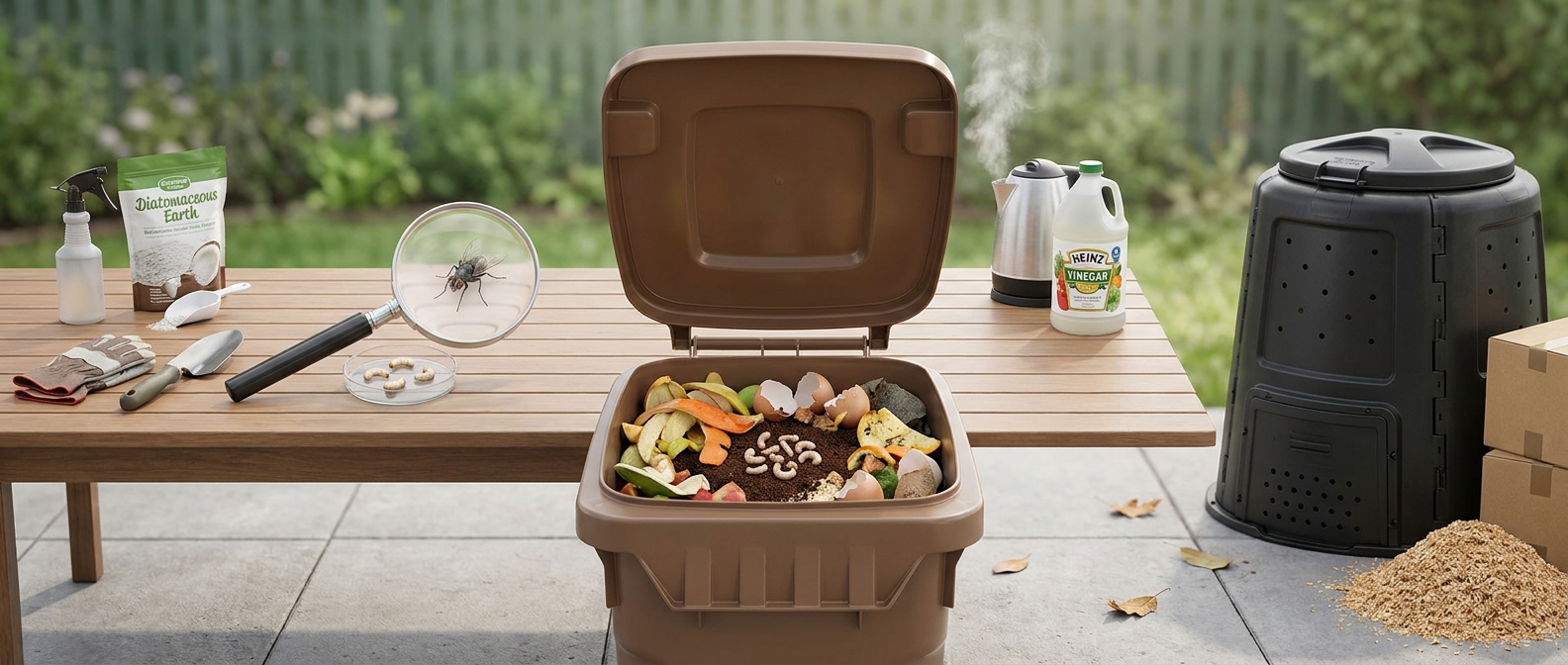
How do you get rid of grubs in the garbage can?
Contents
-
Identification and life cycle: why are grubs invading your garbage can?
-
Practical eradication guide: natural and radical methods for killing maggots
-
Waste prevention and management: how to prevent the return of larvae in the long term
You open the lid of your garbage can and there, surprise: dozens of little white worms are swarming all over your garbage. Your first instinct is to close the lid and pretend nothing's happened. Not a good idea. Those white worms in the garbage can are fly larvae, and if you do nothing, the problem will get worse in just a few days.
Things to remember
-
Pest Patrol offers a rigorous approach that combines scientific expertise on the life cycle of houseflies with practical solutions.
-
Unlike generic guides, this article explains the biological origin of infestations to help prevent them, while providing a step-by-step sanitation protocol validated by professional disinsectisation methods.
-
Why are grubs invading your garbage can?
-
Natural and radical ways to kill maggots
At Pest Patrol, we get this question every summer: «I've got grubs in my garbage can, what can I do?» The answer is threefold. Understand where they come from (spoiler: it's purely biological, not a sign of chronic filth). Eliminate them with methods that really work. And above all, prevent it from happening again. We'll break it all down, step by step, with the science behind it so you know exactly what you're dealing with.
Identification and life cycle: why are grubs invading your garbage can?
Those nauseating little white worms have a more technical name: maggots. They are the larvae of flies, mainly houseflies, Musca domestica. A study published in the Journal of Medical Entomology reminds us that this species is one of the most prolific in the world, with a reproductive capacity that makes your head spin.
A single female fly lays between 75 and 150 eggs at a time. And she can repeat this process up to six times in her lifetime, i.e. potentially 900 eggs per individual. These tiny eggs (around 1.2 mm) are deposited directly on decomposing organic matter. Your garbage can, especially in summer, is the ideal place to lay eggs: warmth, humidity, abundant food. It's all there.
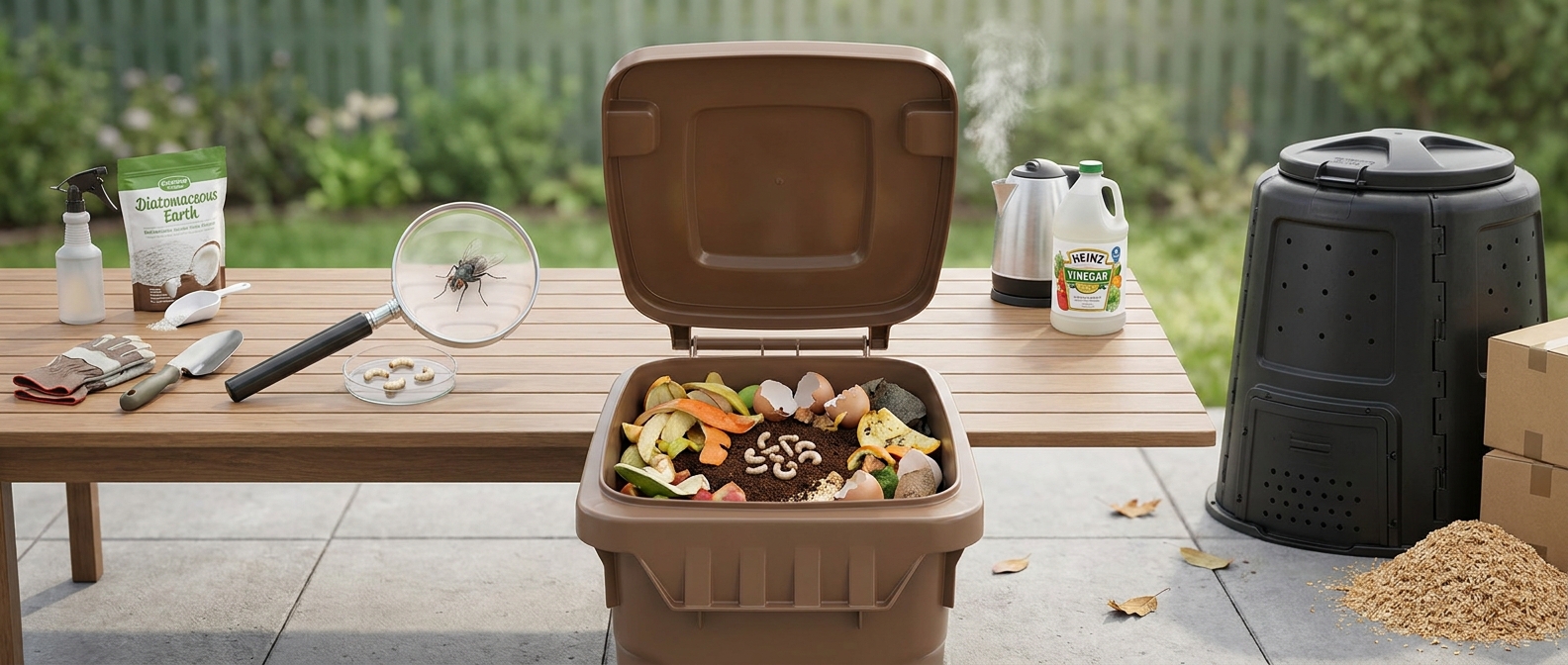
The reproduction cycle of Musca domestica is frighteningly fast. At 30°C, eggs hatch in just 8 to 12 hours. The white larvae that emerge go through three larval stages in 3 to 5 days, feeding on organic waste. They grow rapidly: from one millimeter at birth, they reach 12 mm before transforming into pupae. Two weeks later, a new generation of adult flies is ready to start the cycle all over again.
Why do we find these white larvae in the garbage can rather than elsewhere? The answer is chemical. Decomposing food waste releases volatile compounds, notably ammonia and fatty acids, which attract flies from dozens of meters away. Research by the University of Florida has shown that pregnant females (ready to lay eggs) are particularly sensitive to these olfactory signals. They don't choose your garbage can at random: they detect it.
The problem worsens with heat. Above 25°C, the complete egg-larva-pupa-adult cycle is completed in 7 to 10 days. Below 15°C, everything slows down considerably. That's why grub invasion in the dustbin is almost exclusively a summer phenomenon. In winter, flies are less active and lay far fewer eggs.
A point often misunderstood: these maggots are not dangerous in themselves. They don't sting or bite. However, they are an indicator of an environment conducive to bacterial development. Fly larvae carry pathogens such as Salmonella, E. coli or Shigella, according to the World Health Organization. So beyond disgust, there's a real health issue at stake in dealing with the problem quickly.
If you have an outdoor garbage can, the risk is even higher. A grub in an outdoor garbage can has access to more direct heat (sunlight), and flies enter more easily than inside a kitchen. Municipal garbage bins, often poorly cleaned, become veritable maggot incubators in the warmer months.
Practical eradication guide: natural and radical methods for killing maggots
So, now that you know what these bugs are and why they're there, let's move on to what really interests you: how to get rid of them. There are several methods, some gentle, some radical. Here are the ones that work, ranked by effectiveness.
Boiling water: the fastest method. It's brutal, but frighteningly effective in killing maggots instantly. Boil a large pot of water (2 to 3 liters minimum) and pour it directly into the garbage can, over the infested areas. The heat kills the larvae instantly. According to a Cambridge University study on the thermal tolerance of Diptera, the larvae of Musca domestica do not survive above 60°C. Boiling water at 100°C gives them no chance. Repeat the operation twice, 24 hours apart, to catch any larvae that may have hatched in the meantime.
White vinegar: cleaning and repellent. White vinegar is an invaluable ally in destroying grubs in the garbage can. Mix one part white vinegar to one part hot water, and pour into the emptied bin. Leave for 30 minutes. Vinegar's acidity (pH around 2.5) creates a hostile environment for larvae and disinfects surfaces. It's also an excellent natural deodorizer, neutralizing volatile compounds that attract flies. As a result, you kill any maggots present and make the garbage can less attractive to future egg-layers.
Salt and baking soda. If you don't have vinegar on hand, sprinkle coarse salt generously over the larvae. The salt causes them to dehydrate by osmosis, a process which kills them within a few hours. Baking soda works on a similar principle. Allow around 200 grams for a standard 120-litre tank.
Diatomaceous earth. Less well-known to the general public, diatomaceous earth is a natural powder made from fossilized micro-algae. Its microscopic particles abrade the cuticle of larvae, causing them to dry out. Used in professional pest control, it is totally non-toxic to humans and pets. Sprinkle a thin layer on the bottom of the dustbin after cleaning.
Here's the complete protocol we recommend for eradicating a maggot infestation in the trash:
-
Empty the garbage can completely into an airtight bag and seal it immediately.
-
Pour 2 to 3 liters of boiling water into the tank to kill any remaining larvae.
-
Leave to cool for 10 minutes, then drain off the water.
-
Prepare a mixture: 1 liter white vinegar, 1 liter hot water, 2 tablespoons washing-up liquid.
-
Scrub the inside of the tray with a stiff bristle brush and this mixture.
-
Rinse thoroughly with clean water.
-
Leave to dry in the open air, ideally in the sun (UV rays have an additional purifying effect).
-
Sprinkle the bottom of the dry tray with diatomaceous earth or bicarbonate.
This protocol takes about 30 minutes. It's the most reliable way to eliminate grubs in the garbage can and completely sanitize the bin. Chemical insecticides? Frankly, for a domestic garbage can, they're excessive and potentially toxic for you. The above natural methods are just as effective, without the risks.
One last point: if the infestation is massive (we're talking hundreds of larvae, pupae visible on the walls, flies coming out by the dozen when you open the door), it may be wise to call in a professional insect killer. This is not over-reaction, it's common sense when the situation goes beyond the stage of home treatment.
Waste prevention and management: how to prevent the return of larvae in the long term
Eliminating maggots is good. Preventing them from coming back is better. And that's where most online guides stop short. Prevention rests on three pillars: reducing the attractiveness of your garbage can, creating physical barriers, and maintaining regular bin cleaning.
First pillar: cutting off access to flies. The most effective way to avoid grubs in the garbage can is to prevent flies from laying eggs. Always use a closed garbage bag. It may seem obvious, but many people throw loose waste into their outdoor bins. Each bag must be tied before being deposited. For kitchen garbage cans, opt for a model with a hermetically sealed lid. Flies can't lay eggs if they can't get in.
Second pillar: make the environment hostile. Essential oils are real natural fly repellents. Lavender, citronella, eucalyptus or peppermint essential oils have all been shown to be effective repellents in entomological studies. A publication in Parasitology Research (2011) showed that lemongrass essential oil reduced by 74% the number of eggs laid by Musca domestica on treated surfaces. Simply soak a cotton pad in a few drops and place it under the lid of your garbage can. Repeat every week. You can also add 10 drops to your cleaning water when disinfecting your garbage can.
Third pillar: regular bin cleaning. This is the most important measure, and the most neglected. A bin that is never washed accumulates organic residues on the bottom and sides, even with bags. These residues ferment, release odours and attract flies. The bin should be cleaned at least once a month in winter, and every two weeks in summer. Use the white vinegar and hot water mixture described above, or an enzymatic cleaner that breaks down residual organic matter.
A few simple habits can also make a big difference in keeping flies out of your garbage:
-
Never throw meat or fish directly into the garbage can without wrapping it in newspaper or a separate bag. This is the most attractive waste for laying flies.
-
Put your garbage cans out on collection day, not the night before. Less time out, less risk.
-
Place your outdoor planter in the shade if possible. Direct sunlight heats the contents and accelerates decomposition, multiplying attractive odors.
-
Sprinkle baking soda regularly at the bottom of the garbage can liner. It absorbs moisture and neutralizes odours.
-
In hot weather, empty your kitchen garbage can every day, even if the bag isn't full.
For those who have a composter, beware: it's a frequent source of grub infestation near garbage garbage cans. Make sure you cover your compost and balance it correctly (green/brown matter ratio). Poorly managed compost attracts flies just as much as an open garbage can.
A trick few people know: cloves. Stick a dozen or so into half a lemon and place it next to your garbage can. The eugenol in cloves is a powerful natural fly repellent. It costs next to nothing and works for several days.
If, despite all this, you regularly find maggots, the problem may lie with your bin itself. Old garbage cans made of cracked or split plastic are impossible to clean properly. Cracks trap organic matter and provide perfect nooks and crannies for maggots. In this case, replace the bin. It's an investment of 20 to 40 euros, which often solves the problem once and for all.
Conclusion
Grubs in the garbage can are not inevitable. It's a biological problem with identifiable causes and practical solutions. To recap: a fly lays eggs, the larvae develop in a few days thanks to heat and organic waste, and the cycle starts all over again if you do nothing. Boiling water and white vinegar eliminate maggots. Regular cleaning, essential oils and good waste management practices prevent their return.
Take action at the first sign of infestation. The longer you wait, the more the infestation spreads. And if the situation gets out of hand, don't hesitate to consult a pest control professional. At Pest Patrol, we always prefer to give you the tools to manage things yourself, but some situations require expert intervention. In any case, you now have all the keys you need to regain control of your dustbin.
Frequently asked questions
Why are there grubs in my garbage can?
White grubs are maggots, or fly larvae (mainly houseflies). The females are attracted by the odors of your decomposing organic waste and take advantage of the summer heat to lay hundreds of eggs.
How do you instantly kill maggots in a dustbin?
The quickest and most radical method is to pour 2 to 3 liters of boiling water directly onto the infested areas, killing the larvae instantly. You can also use hot white vinegar or a generous sprinkling of coarse salt to dehydrate them.
What are the best natural repellents for flies and larvae?
Essential oil of citronella, lavender or peppermint, placed on a cotton pad under the lid, drastically reduces egg-laying. Placing half a lemon studded with cloves or sprinkling diatomaceous earth on the bottom of the tank are also excellent professional and natural remedies.
How can you prevent the return of grubs for good?
Always seal your garbage bags, wrap up any leftover meat or fish, and wash your bin twice a month in summer with white vinegar. Finally, place your outdoor garbage can in the shade to slow the decomposition of waste and avoid attracting flies.
 Français de Belgique
  English
  Nederlands (België)