
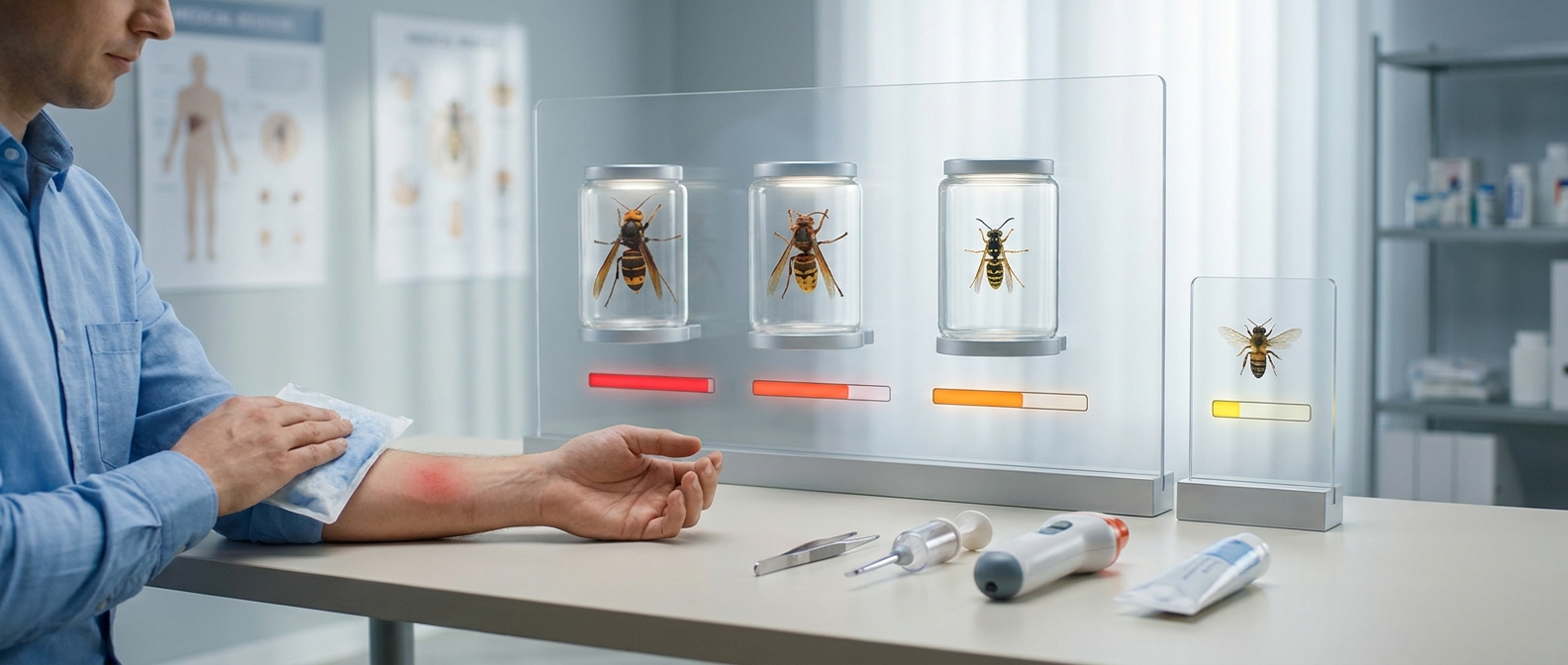
Hornet stings: Intensity, comparison and remedies
Contents
-
Understanding the pain of a hornet sting: Venom and comparative intensity
-
A step-by-step guide to relieving the pain of a hornet sting
-
Differentiating the pain of the hornet from that of the wasp and the bee
You never forget a hornet's sting. Those who have experienced it often describe the same thing: a sharp, immediate pain, like a white-hot nail being driven into your skin. And then the worry that follows, because you never really know if it's «normal» or if it's going to get worse. Does a hornet's sting really hurt more than a wasp's? How long does it last? Should we rush to the emergency room?
Things to remember
-
An unprecedented comparative analysis based on the Schmidt Index to scientifically assess pain between Asian, European hornets, wasps and bees, while providing care protocols validated by experts in entomology and emergency medicine.
-
Venom and comparative intensity
-
A step-by-step guide to relieving the pain of a hornet sting
-
Differentiating the pain of the hornet from that of the wasp and the bee
We'll sort it all out with solid scientific data, including the Schmidt Index, a pain scale created by an entomologist who was voluntarily stung by dozens of Hymenoptera species. We'll compare the pain of an Asian hornet sting, a European hornet sting, a wasp sting and a bee sting. Above all, we'll give you a clear protocol for relieving pain quickly and knowing when to be alarmed.
No panic, no unnecessary dramatization. Just facts, figures and gestures that work.
Understanding the pain of a hornet sting: Venom and comparative intensity
Justin O. Schmidt is an odd fellow. An entomologist at the Carl Hayden Bee Research Center in Arizona, he has spent years cataloguing the pain of insect bites. His tool, the Schmidt Index, ranks pain on a scale of 1 to 4. Level 1 is hardly any discomfort at all. Level 4 is a bullet ant, something that will pin you to the ground for hours. Where does the Hornet fit in?
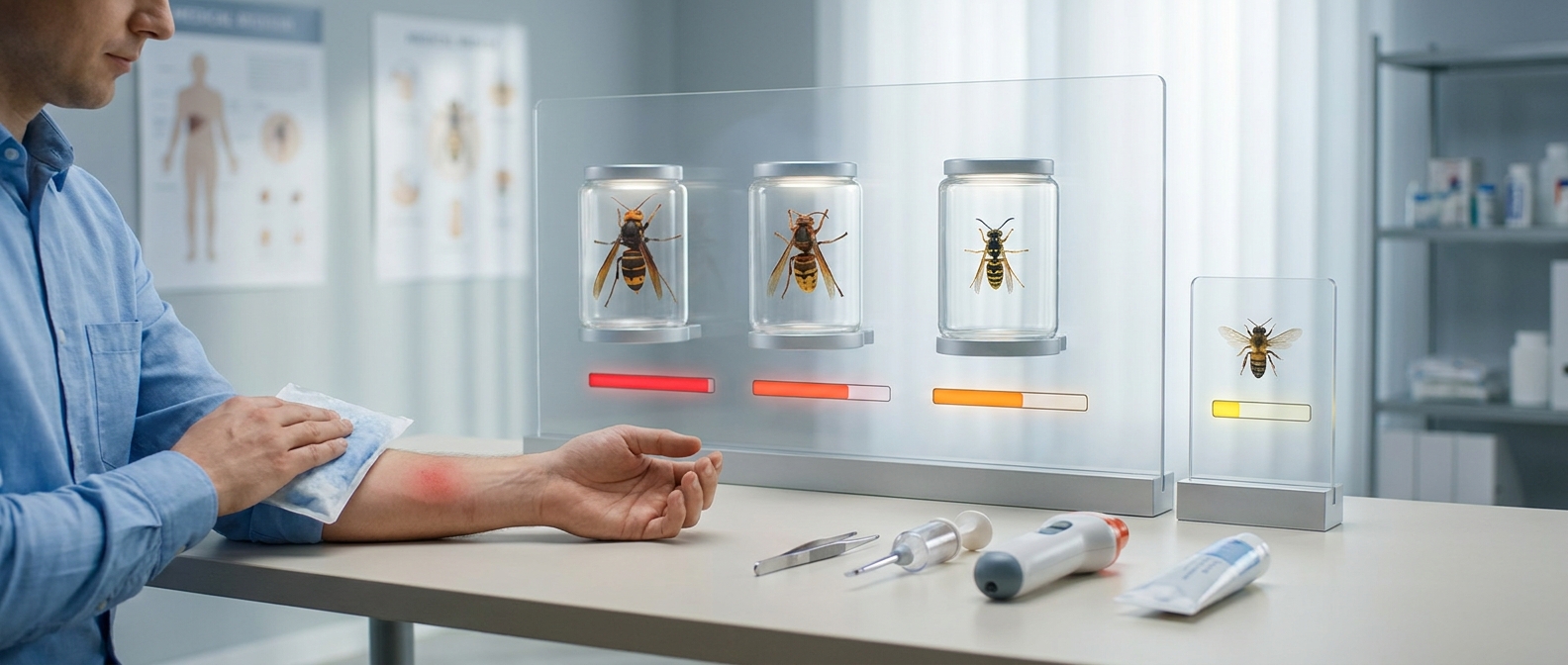
The European hornet (Vespa crabro) is ranked 2 on the Schmidt index. Surprising, isn't it? Many people think it's the worst stinging insect in our gardens, but scientifically, its sting is on a par with that of the honey bee. The difference is perception. The Hornet is big, noisy and impressive. Its sting is longer (around 3 mm vs. 1.5 mm for a bee), penetrates deeper into the skin, and the quantity of venom injected is much greater.
Hornet venom contains a fearsome cocktail: acetylcholine (a neurotransmitter that directly stimulates pain receptors), serotonin, histamine and kinins. It's this combination that causes that intense, immediate burning sensation. A study published in Toxicon (2016) has shown that the venom of the European hornet contains around 10 to 15 micrograms of active substances per sting, compared with 50 to 65 micrograms for the honeybee. Less venom, but a more «effective» venom in terms of immediate pain, gram for gram.
And the Asian hornet (Vespa velutina) ? This is where it gets interesting. The pain of an Asian hornet sting is often described as comparable to that of the European hornet, and sometimes slightly less. The Muséum national d'Histoire naturelle in Paris confirms this: the Asian hornet is no more dangerous than its European cousin in terms of venom toxicity. Its bad reputation stems above all from its highly aggressive defensive behavior around nests and the number of stings a swarm can inflict simultaneously.
When it comes to the intensity of hornet-related pain, we need to distinguish between two things: acute pain (the first 5 minutes, a sharp burn, a 7 or 8 out of 10 for most people) and residual pain. How long does the pain of an Asian hornet sting last? In general, the peak pain subsides within 30 to 60 minutes. The area remains sensitive, swollen and warm for 24 to 48 hours. In some people, the local reaction may persist for up to a week, with swelling extending over 10 cm or more around the sting. This is not necessarily an allergy: it's a widespread local reaction, unpleasant but not dangerous in itself.
The real danger is not the pain. It's the allergy to hymenoptera venom. Approximately 3 % of the French population is allergic to wasp and hornet venom, according to Anses. An anaphylactic reaction can occur within minutes: generalized urticaria, swelling of the face or throat, breathing difficulties, drop in blood pressure. At this point, we're no longer talking about pain, but about a life-threatening emergency. We'll come back to this in the section on what to do.
A step-by-step guide to relieving the pain of a hornet sting
You've just been stung. The pain is there, unmistakable, impossible to ignore. Here's exactly what you need to do, in order, to relieve the pain of a hornet sting effectively.
Step 1: Walk away calmly. A stinging hornet releases alarm pheromones. If you're near a nest, other hornets may attack. Don't run, waving your arms: walk quickly, without sudden movements, and keep at least 20 meters away.
Step 2: Check the stinger. Unlike the bee, the hornet doesn't usually leave its stinger in the skin. The stinger is smooth and is removed after stinging. If, by exception, a fragment remains (a rare occurrence), remove it by scraping with the edge of a bank card. Never use pliers: you risk squeezing the venom sac and injecting more venom.
Step 3: Apply a heat source. It's the most effective and least publicized procedure. Hornet venom is thermolabile: its proteins denature above 45°C. Hold a heat source (hair dryer, cup of hot water, unlit lighter with still-warm metal) close to the sting for 30 to 60 seconds. Caution: do not burn the skin. The heat is sufficient to neutralize some of the venom. Studies have shown that venom extractors sold in pharmacies have a limited effect, but heat has proven its worth. A publication in Clinical Toxicology (2012) confirms that the local application of heat significantly reduces the pain and swelling associated with Hymenoptera bites.
Step 4: Disinfect. Clean the area with soap and water, then apply an antiseptic (chlorhexidine, Betadine). Hornets can carry bacteria on their stings. Superinfection is not unusual.
Step 5: Apply cold. After heat (which neutralizes the venom), go cold. An ice cube wrapped in a cloth, a gel pack, a bag of frozen peas: 10 to 15 minutes, no more. Cold reduces inflammation, slows residual venom diffusion and numbs pain. The combination of heat and cold gives the best results.
Step 6: Treat pain and inflammation. An oral anti-inflammatory (ibuprofen) or paracetamol is sufficient in most cases. If itching is severe, an oral antihistamine (cetirizine, loratadine) helps. Mild corticosteroid creams (hydrocortisone 1 %) can reduce the local reaction if it spreads.
A few natural remedies are circulating: cider vinegar, halved onion, lavender essential oil. Honestly, the scientific evidence is thin. Onion has a mild, documented anti-inflammatory effect, lavender aspic contains linalool with modest analgesic properties. If it gives you relief, why not, but don't rely on it alone. The heat-cold-antiseptic-anti-inflammatory protocol remains the most reliable basis for treating a hornet sting properly.
When should I call 112? Immediately if you notice one or more of these signs: swelling of the face, lips or tongue, difficulty breathing or swallowing, dizziness or malaise, hives that spread away from the sting, chest tightness. These are the signs of anaphylactic shock. If the person has an adrenaline auto-injector pen (such as Epipen), now is the time to use it, without delay. Every minute counts.
Differentiating the pain of the hornet from that of the wasp and the bee
Which is the most painful sting between a wasp and a hornet? That's the question on everyone's lips. The answer is less clear-cut than you might think.
On Schmidt's index, the common wasp (Vespula vulgaris) is rated at 2, exactly the same as the European hornet and the honey bee. Same level. Yet nobody describes these three pains in the same way, and that's logical: the chemical composition of the venom differs, so does the quantity injected, and the depth of penetration of the sting changes everything.
A wasp sting is often described as a sharp, brief pain, a sharp sting followed by a burning sensation that subsides in 15 to 30 minutes. The local reaction is generally moderate: redness of 2 to 5 cm, slight swelling. The wasp can sting several times in succession (its sting is smooth, like that of the hornet), which increases the dose of venom if it persists.
The pain of a bee sting is different. The bee leaves its stinger and venom sac in the skin. As a result, the venom continues to diffuse for 2 to 3 minutes after the sting, unless the stinger is quickly removed. The pain is more gradual and dull, with swelling often greater than that of the wasp. A study by Michael L. Smith (2014), published in PeerJ, In a study conducted in the United States and Europe, a study conducted in the United States and Europe showed that the location of a bee sting has an enormous influence on pain perception: a sting on the nostril is rated 9 out of 10, whereas on the forearm it's more like a 3. The same venom, the same quantity, but pain three times more intense depending on the location.
Back to the hornet. The main difference between a hornet sting and a wasp or bee sting is its immediate intensity and duration. The hornet injects more venom (up to 3 times more than a wasp per sting), its sting penetrates more deeply, and the local reaction is almost always more extensive. Swelling can reach 10 to 15 cm in diameter, and the area remains painful to the touch for 48 hours. In both Asian and European hornets, it's this combination of venom volume and sting depth that makes the difference.
The normal symptoms after a hornet, wasp or bee sting are similar: local pain, redness, swelling, heat and sometimes itching. It's a classic local reaction. As long as these symptoms remain confined to the area of the sting and are not accompanied by general signs (malaise, shortness of breath, facial swelling), there's no need to panic.
A quick overview:
-
Wasp: brief, acute pain, moderate swelling, resolves in a few hours. May sting several times.
-
Bee: progressive pain (stinger left in place), sometimes severe swelling, resolves in 24-48 hours. Only one sting per bee.
-
European hornet : immediate sharp pain, extensive swelling, residual pain 24-72h. May sting several times.
-
Asian hornet : profile very similar to that of the European hornet, more dangerous in the event of multiple stings (densely-populated nests, collective defensive behavior).
The question «bee sting or wasp sting, which is more painful?» often comes up too. Honest answer: it depends mainly on where on the body you are and your personal sensitivity. On the Schmidt scale, it's a tie. In real life, the bee tends to cause longer-lasting swelling because of the stinger, while the wasp hurts more on the spot.
What should really concern you is not so much the comparison of pain between these species. It's your own reaction. If you've already had an allergic reaction to a wasp sting, you're potentially at risk with a hornet: the venoms of the Vespidae (wasps and hornets) share common allergens, notably phospholipase and antigen 5. Talk to an allergist, and a check-up and possible desensitization could save your life.
Conclusion
A hornet's sting is undeniably painful. But it's not the catastrophe many imagine. On the Schmidt index, it's on a par with a bee or wasp sting. What changes is the quantity of venom, the depth of the sting and the extent of the local reaction. The protocol is simple: heat to neutralize the venom, cold to calm the inflammation, antiseptic to prevent infection, and monitoring for signs of allergy.
If a hornet's nest has taken hold in or near your home, don't try to destroy it yourself. Call in a professional. At Pest Patrol, we work quickly and safely to eliminate both European and Asian hornet nests. Your peace of mind is our business.
Frequently asked questions
Is a hornet's sting more painful than a wasp's?
Scientifically, the hornet is classified at level 2 on the Schmidt index, like the wasp and the bee. However, its sting is perceived as more intense because its stinger is longer and it injects a greater quantity of venom, causing a deeper burn.
What can be done immediately to relieve a hornet sting?
As venom is thermolabile, apply heat (around 45°C) for 60 seconds to neutralize it, then cold to reduce inflammation. Then disinfect the area and watch for allergic signs for 30 minutes.
How long does the pain and swelling last?
The sharp pain usually subsides within 30 to 60 minutes. However, the area may remain red, hot and swollen (sometimes over 10 cm) for 24 to 48 hours, or even a week depending on individual sensitivity, without necessarily being an allergy.
Is the Asian Hornet more dangerous than the European Hornet?
The toxicity of their venom is virtually identical. The Asian hornet is not «more dangerous» per individual sting, but its aggressive defensive behavior around the nest can lead to multiple stings, increasing the risk of serious reaction.
When should you call the emergency services (112) after a sting?
Call immediately if you experience breathing difficulties, swelling of the face or throat, dizziness or generalized hives. These symptoms indicate anaphylactic shock, a life-threatening emergency requiring prompt medical attention.
 Français de Belgique
  English
  Nederlands (België)