
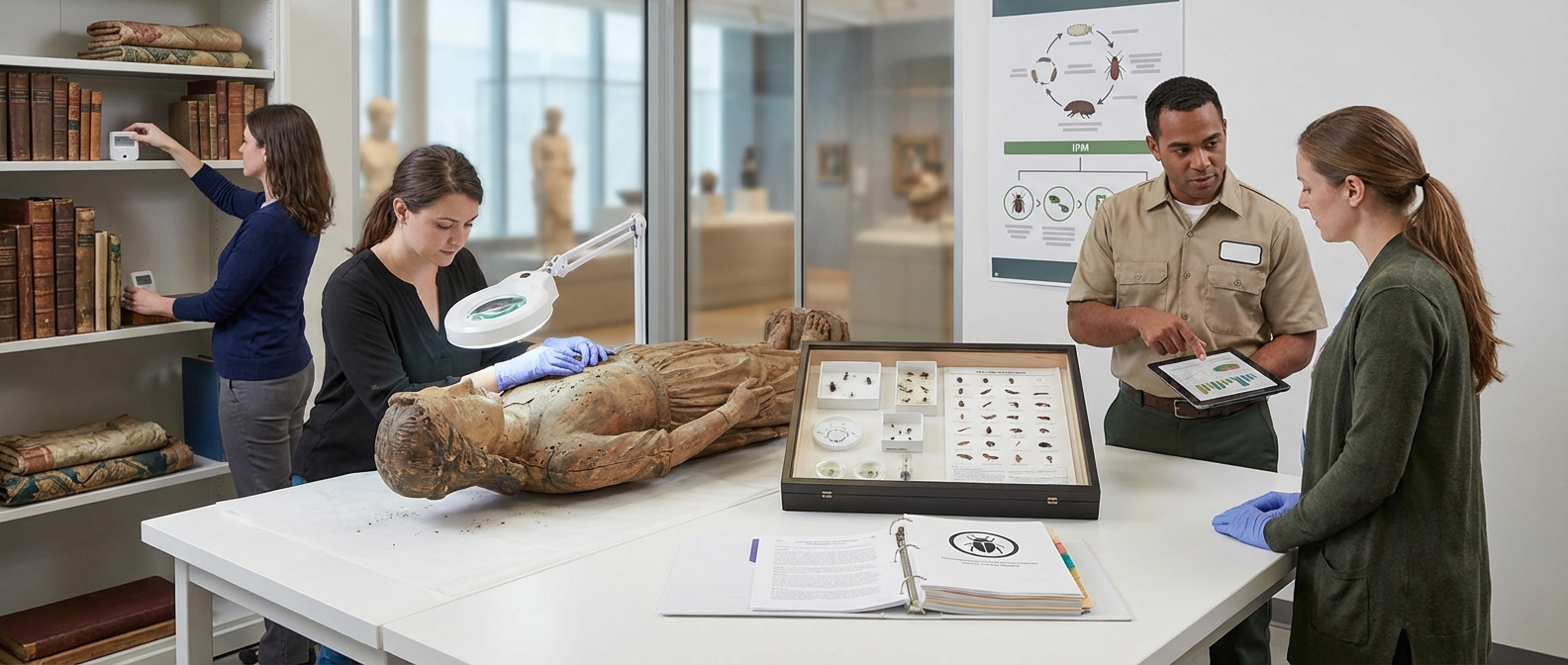
Why and how do you set up a pest control plan for your museum?
Contents
A 2 mm hole in 18th century woodwork. It doesn't look like much. Except that behind the hole is a beetle larva that has been burrowing silently for months, already turning the inside of the wood to sawdust. By the time you notice it, the damage is done. This is exactly the scenario faced by dozens of small museums and collection owners in France every year, often without even realizing it.
Things to remember
-
Pest Patrol popularizes conservation science to protect heritage
-
We explain biological threats based on ICCROM research, while proposing an integrated management methodology (IPM) accessible to non-experts.
-
The article concludes with a concrete case study of a customer rescued from a beetle infestation to demonstrate the effectiveness of our approach.
-
Pest threats and risks for museum collections
Protecting museum collections from pests is not just a matter for the Louvre or the British Museum. Any place that preserves organic objects (wood, textiles, paper, leather, feathers) is a target. And the good news is that you don't need a huge budget to protect yourself. What's needed is a method. A real pest control plan adapted to the museum, built on solid scientific foundations, but applicable even with a small team.
At Pest Patrol, we draw on the work of ICCROM and Integrated Pest Management (IPM) protocols to support structures of all sizes. The aim of this article is to give you the keys to understanding the threats, building your own preventive conservation plan, and seeing how it works in the field with a real-life case study.
Pest threats and risks for museum collections
The biodiversity of a museum is underestimated. Not the kind on display, but the kind that takes up residence uninvited. A study carried out by London's Natural History Museum has identified over 80 species of insect pests potentially present in heritage buildings. 80. And it only takes one poorly managed species to cause irreversible damage.
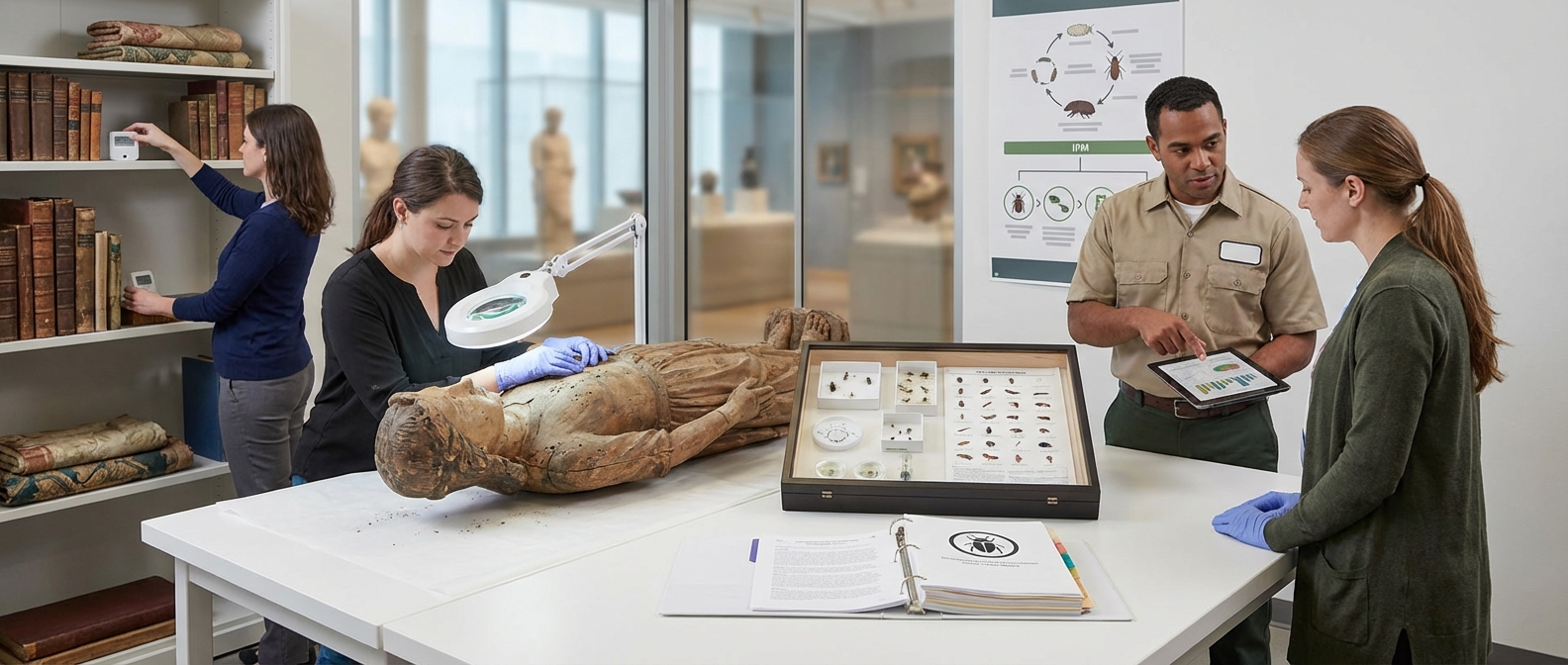
Among the most dreaded, beetles (Anobium punctatum) attack wood: frames, sculptures, furniture, frameworks. Their larvae develop inside the material for two to five years before emerging. When you see the characteristic round holes, the next generation is already laying eggs. Clothing moths (Tineola bisselliella) target textiles, wool, silk and feathers. A 19th-century military uniform, a medieval tapestry, a stage costume: anything goes. Dermestes, silverfish and cockroaches complete the picture. Each with its own food preferences, each with its own mode of propagation.
Heritage degradation caused by these organisms is often slow and invisible. That's what makes it so dangerous. An ICCROM report on risk management applied to collections (published in 2016) ranks biological pests among the ten major agents of deterioration, on a par with fire, water or theft. The difference is that fire is visible. Dermestes infestation in a poorly ventilated storeroom, much less so.
And there are many aggravating factors. An old building with cracks, poorly insulated attics, an aging ventilation system: these are all doors of entry. Relative humidity above 65% favors mold growth, which in turn attracts certain insects. Temperature also plays a role: most insect pests reproduce actively between 20 and 30°C. A non-air-conditioned store in summer becomes an incubator.
There's also a human factor that's often overlooked. New acquisitions, inter-institutional loans, uninspected donations: every item that enters your premises can be a Trojan horse. ICCROM systematically recommends quarantine and visual inspection of all new arrivals. How many small museums actually do this? Very few, in our experience.
The cost of an undetected infestation is measured in lost objects. Not in euros. Because once a 17th-century worm-eaten piece of furniture has been reduced to dust, no budget will bring it back. That's why we talk about preventive conservation in museums: act before, not after. The safeguarding plan for cultural assets cannot be limited to fire and flood risks. Museum pests deserve the same rigor.
Key steps in designing an integrated management plan (IPM)
IPM in museums isn't about laying sticky traps in corners and crossing your fingers. It's a structured methodology, originally developed for agriculture, then adapted to cultural heritage in the 1990s by researchers like Tom Strang at the Canadian Conservation Institute. The principle: minimize the use of chemicals by combining prevention, monitoring and targeted intervention.
Here's how to structure a concrete plan, step by step.
1. The initial audit: knowing what you have and where you stand
It all starts with an inventory of fixtures. We inspect the building (roof, windows, doors, drains, vents), storage areas and showrooms. We look for signs of activity: droppings, molts, emergence holes, suspicious dust traps. We record climatic conditions using dataloggers. Temperature, relative humidity, seasonal variations: these data are the basis of everything.
We also map collections by material. A museum that holds mainly metal and ceramics does not have the same risk profile as a textile museum or a writer's house filled with books and wooden furniture. This mapping enables us to prioritize: which areas are most vulnerable, which objects to watch out for first.
2. Setting up the monitoring network
Integrated pest management is based on data. Not impressions. We install a network of non-toxic traps (sticky traps, light traps, pheromone traps, depending on the species targeted) in strategic locations: near entrances, along walls, in storerooms, near organic collections. Each trap is numbered and positioned on a map.
Surveys are carried out at regular intervals, ideally every four to eight weeks. We identify the species caught, count the individuals and note trends. A sudden spike in captures on a given trap is a warning signal. This continuous monitoring makes it possible to detect incipient infestation long before it becomes visible to the naked eye.
3. Preventive measures: closing doors to pests
Prevention is 80% of work. Seal cracks and gaps. Install brushes under doors. Check window seals. Implement a quarantine protocol for new acquisitions (minimum two-week isolation with inspection). Control climatic environment to maintain relative humidity between 45% and 55%. Limit food sources: no open garbage cans, no potted plants in rooms, regular cleaning of organic dust.
Basically, preventive conservation is common sense applied with rigor. Every gesture counts. A maintenance worker trained to spot a beetle moult is as good as a pheromone trap.
4. Remedial action: act quickly, act well
When prevention isn't enough, we take action. Treatment by anoxia (oxygen deprivation) is now the benchmark for heritage objects. The infested object is placed in a hermetically sealed bubble, air is replaced by nitrogen, and an atmosphere of less than 0.1% oxygen is maintained for three to four weeks. All life stages (eggs, larvae, nymphs, adults) are eliminated, without any chemical residue on the object. This is the method recommended by the Centre de Recherche et de Restauration des Musées de France (C2RMF).
For localized infestations, controlled freezing (-30°C for at least 72 hours) is an effective alternative for objects that can withstand it. Chemical treatments still exist, but we reserve them for cases where no other option is viable, and always with products approved for heritage use.
5. Documentation and continuous improvement
There's no such thing as an undocumented museum IPM plan. Every trap reading, every intervention, every change in the environment must be recorded. This data makes it possible to assess the effectiveness of the plan, identify weak points and adjust actions. It's a cycle: observe, act, measure, adjust. ICCROM stresses this point in its risk management guide: without monitoring, there can be no improvement.
Case study: Implementing the Pest Patrol plan at a customer site
In early 2023, we were contacted by a museum association. Their collection includes regional furniture from the 17th and 18th centuries, liturgical textiles and a few woodcuts. The building is a former presbytery, beautiful but not airtight. Two volunteers run the day-to-day operations. Limited budget.
The problem reported: fine sawdust found under several pieces of furniture in storage. The team thought it was dust from the roofing work carried out the previous year. Except that the sawdust had a peculiar, granular, regular texture. When we examined it, the diagnosis was clear: woodworm. And not just a little.
Phase 1: Diagnosis and scope assessment
Each piece of furniture in the storeroom was inspected. Out of 34 wooden pieces, 11 showed recent emergence holes (recognizable by their light color and the presence of fresh worm damage). Three were severely affected, with areas where the wood sounded hollow when tapped. We also set 25 sticky traps and 8 pheromone traps specific to beetles throughout the building to map activity.
Result after four weeks of trapping: captures were concentrated in the storeroom and an adjoining room used as a workshop. The showrooms, better ventilated and drier, were virtually unaffected. Relative humidity in the storeroom oscillated between 68% and 75%. Far too high.
Phase 2: Curative treatment of infested objects
The three worst-affected cabinets were treated with on-site anoxia. Sealed barrier film bubbles were used, with nitrogen injection and continuous monitoring of oxygen levels. The anoxic treatment lasted 28 days at an ambient temperature of 22°C, in accordance with the protocol validated in the scientific literature (Selwitz & Maekawa, 1998). The other eight pieces of furniture showing less advanced signs of infestation were treated by controlled freezing in partnership with a local service provider equipped with a deep-freeze cell.
Phase 3: Environmental correction
Curative treatment is useless if you don't change the conditions that led to the infestation in the first place. We worked with the museum team on several fronts. Installation of seals on the storeroom windows. Installation of a dehumidifier with hygrostat set to maintain 55% relative humidity. Sealing of doorways. Thorough cleaning of the storeroom (removal of mould, cobwebs and accumulated organic debris). The storage area was also reorganized: furniture no longer touches the walls, improving air circulation and facilitating visual inspections.
Phase 4: Follow-up and training
Pheromone trapping continued after treatment. Six months later, adult beetle catches had dropped by 93%. One year later, there were zero captures on three consecutive surveys. We trained the two volunteers to collect the traps, identify the most common species and fill in the monitoring chart we provided. It takes them an hour every two weeks.
The total cost of the intervention, including treatment and compliance, was less than 10,000 euros. The museum had estimated the insured value of the three pieces of furniture most affected at over 45,000 euros. The ratio speaks for itself.
This case illustrates something fundamental: protecting museum collections doesn't require excessive resources. It requires method, regularity and a minimum of training. Once a museum's pest control plan is in place, it practically runs itself if the foundations are solid.
Conclusion
Museum pests don't anticipate. They settle in, they reproduce, they destroy, and by the time you notice them, the damage is often well advanced. An integrated pest management plan is not a luxury reserved for large institutions: it's an accessible, pragmatic tool that protects your heritage on a daily basis.
At Pest Patrol, we help organizations of all sizes to implement these plans, from initial diagnosis to long-term monitoring. If you manage a collection, a historic site or a house museum, and you don't yet have a formal pest control strategy, now's the time to get started. Contact us for an initial discussion: together we'll see where you stand and what we can build on.
Frequently asked questions
What are the main insects that threaten collections?
The most fearsome are beetles (wood), moths (textiles, feathers) and beetles (organic matter). There are over 80 species capable of turning historic objects into dust.
How can I treat an infested object without damaging it?
The reference method is anoxia: the object is placed in an oxygen-free bubble (replaced by nitrogen) for 21 to 28 days to eliminate all biological stages of the insect.
Is cold an effective alternative to chemical treatment?
Yes, controlled freezing at $-30$°C for at least 72 hours is radical for objects that can withstand thermal variations, such as certain textiles or stable woods.
Why are small holes in wood a cause for alarm?
An emergence hole means that a larva has already been burrowing into the wood for two to five years. When you see the hole, the insect is already an adult and ready to lay the next generation.
 Français de Belgique
  English
  Nederlands (België)