
Bedbugs in a baby carriage: how to get rid of them safely?
Contents
-
Dry steam vs. chemical treatments: Comparison of methods for baby carriages
-
Washing at 60°C vs. freezing: Advantages and disadvantages for childcare equipment
-
Selection criteria and recommendations before buying a new baby carriage or protective device
Your baby wakes up with little stitches all over his arms or legs after a stroller ride. You turn over the baby carriage mattress and there they are: tiny brown spots, black dots along the seams. Cimex lectularius, bed bugs have taken up residence in childcare equipment. Your first instinct is to spray everything with insecticide. Stop. It's probably the worst thing to do when you're talking about equipment where an infant spends hours with its nose stuck to the fabric.
This guide is designed for young parents, nursery assistants and all childcare professionals who find themselves faced with this very real problem: how to disinfect a stroller contaminated by bedbugs without endangering the child's health? We'll discuss thermal decontamination protocols, mechanical methods, and above all, we'll compare what really works with what's just marketing. Each recommendation here is based on scientific data, including the work of Dang et al. (2017) on the thermal lethality of bedbugs and Anses guidelines.
Things to remember
-
This exclusive guide focuses on infant safety by proposing scientifically validated thermal and mechanical decontamination protocols, avoiding the toxic chemical residues often recommended in generalist guides but dangerous for childcare equipment.
-
Comparison of methods for baby carriages
-
Advantages and disadvantages of childcare equipment
-
Selection criteria and recommendations before buying a new baby carriage or dis...
No miracle recipes based on essential oils. No «natural» products sold at a premium on Instagram. Just facts, precise temperatures, tested protocols.
Dry steam vs. chemical treatments: Comparison of methods for baby carriages
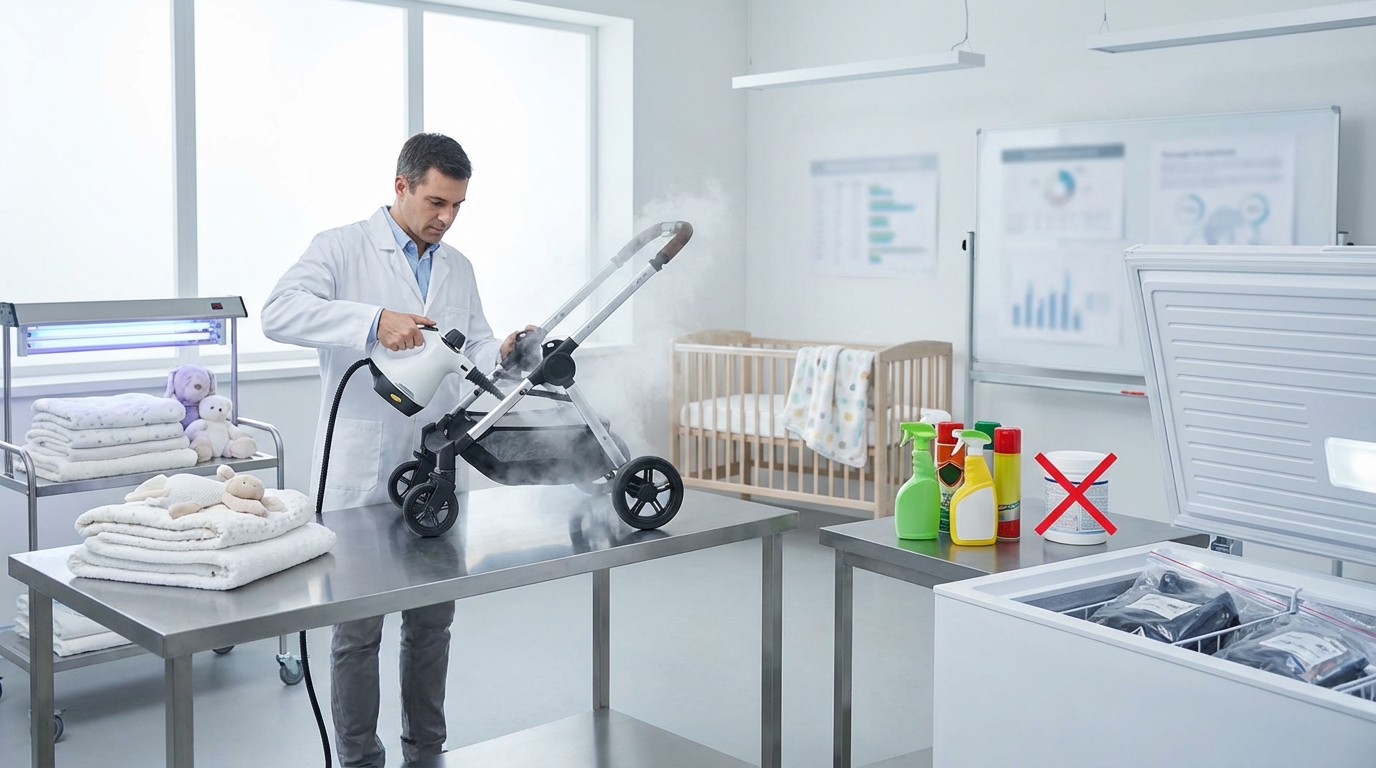
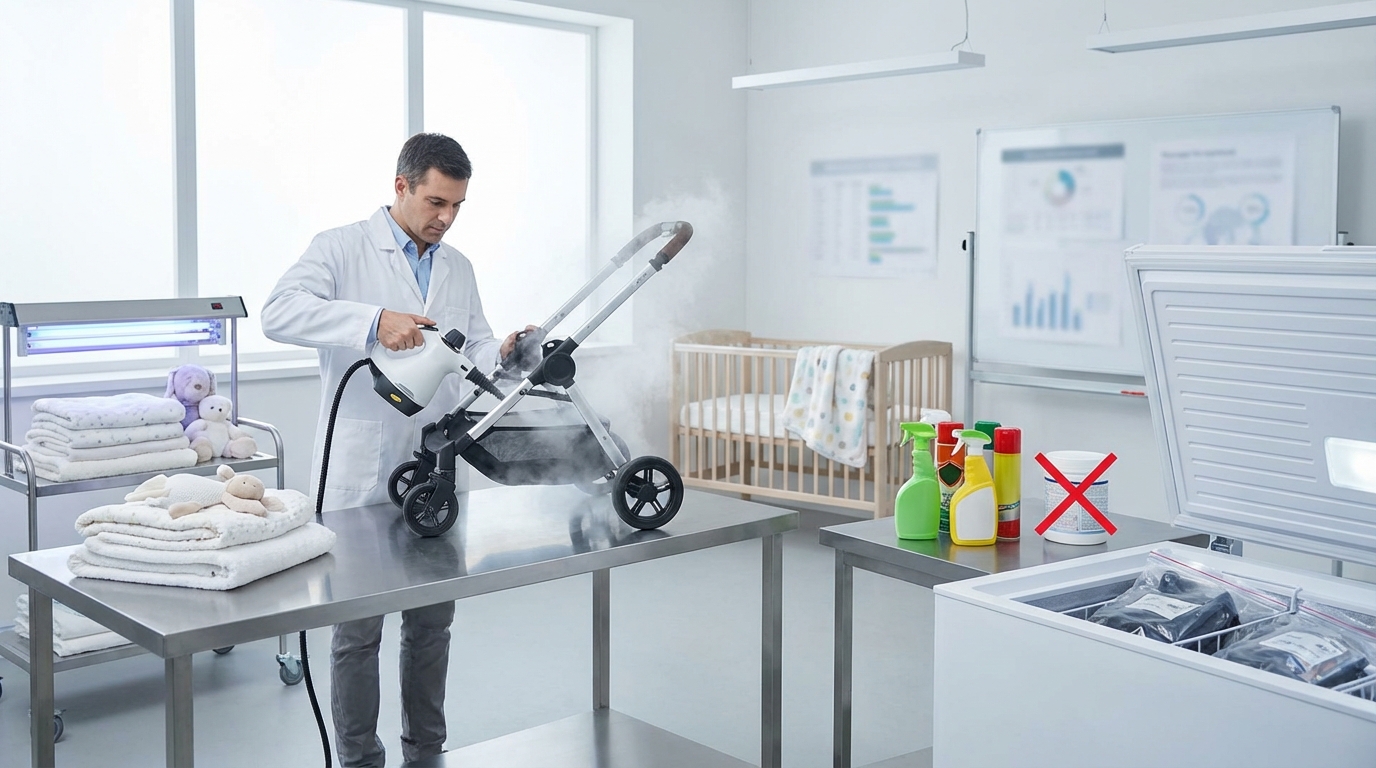
A figure to start with: 100 % of bedbug life stages (including eggs) die at 48°C maintained for 90 minutes, according to a study published in the Journal of Economic Entomology. Dry steam rises well above this threshold. Professional steam cleaners deliver a 180-degree jet from the nozzle. Even after heat loss due to the distance of the spray, the lethal threshold is still well above. This is why heat treatment of a baby carriage with dry steam is the method of choice when it comes to eliminating bedbugs without leaving toxic residues.
The principle is simple. You pass the nozzle slowly, about 2-3 cm from the surface, insisting on the seams, the folds of fabric, the interstices of the structure. Slow is the key word. We're talking 30 seconds per 10 cm zone. Too fast and the heat won't penetrate deeply enough, and the eggs nestling in the fibers will survive. A methodical pass over the entire baby carriage takes between 20 and 40 minutes, depending on size.
Now, why not use an insecticide? After all, that's what comes up first when you type «what's the most effective product against bedbugs» into Google. The problem is twofold.
First problem: the danger of an insecticide to a baby is real and documented. Pyrethroids, the family of molecules most commonly found in consumer bug sprays, are suspected endocrine disruptors. Anses has published several reports warning of the exposure of infants to household biocides. A baby carriage is a confined space. Babies spend hours in them, breathing just a few centimetres from the treated fabric, and putting their hands to their mouths after touching the walls. Even a so-called «natural» insecticide based on plant pyrethrum leaves active residues on textiles for days. The risk is disproportionate to the benefit.
Second problem: it doesn't even work that well. The populations of Cimex lectularius in Belgium have pyrethroid resistance rates in excess of 90 % in some regions, according to data from the European monitoring program. You spray, the bugs survive, and you've got a contaminated baby carriage AND one full of chemical residues. Nice result.
Dry steam against bedbugs generates no resistance. It's physics, not chemistry. Heat kills by denaturing cellular proteins. No living organism develops resistance to cooking. This is also why heat treatment of baby carriages remains the number-one recommendation of public health bodies when it comes to childcare.
A practical point: which appliance to use? Small, entry-level household steam cleaners aren't always enough. Check that the nozzle outlet temperature exceeds 110°C (some models have an outlet temperature of 100°C, which is borderline after heat loss). A professional or semi-professional appliance with a pressure of at least 4 bars is ideal. If you don't have one, some companies specializing in bedbug treatment offer targeted interventions on childcare equipment. These cost between 80 and 150 euros on average, and are infinitely safer than any spray.
An important reminder: after steaming, allow the baby carriage to dry completely before putting baby back in it. Dry steam leaves little residual moisture, but on a stroller mattress, it's best to wait two to three hours in a well-ventilated area.
Washing at 60°C vs. freezing: Advantages and disadvantages for childcare equipment
Not everything on a baby carriage can be steam-cleaned. Removable covers, sheets, blankets, mattress protectors: for these textiles, you have two options. Machine washing at 60°C and freezing. Both work, but not under the same conditions.
Washing at 60°C kills adult bedbugs, nymphs and eggs. The proof is in the pudding. The eradication temperature for bedbugs is 48°C for 90 minutes for eggs (the most resistant stage). A washing machine cycle at 60°C far exceeds this threshold, and the combination of heat + water + mechanical agitation leaves no chance. For disinfecting contaminated baby textiles, this is the most accessible and reliable method.
There's one detail many people forget: your machine's «eco» program doesn't actually heat up to 60°C for the entire cycle. Instead, it alternates between lower-temperature phases to save energy. Use the classic cotton program at 60°C, without eco mode. And if the fabric can withstand it, tumble dry at maximum temperature for 30 minutes. Double guarantee.
One problem remains: some parts of the baby carriage are not machine-washable. These include the main mattress, upholstered parts and rigid fabric-covered structures. That's where freezing comes in.
The bedbug life cycle comprises five nymphal stages before adulthood, and each of these stages is vulnerable to extreme cold. But «extreme» is the important word. You need to reach -18°C and maintain this temperature for at least 72 hours (three full days) to guarantee the elimination of all stages, eggs included. Some sources mention 48 hours, but the work of Olson et al. (2013) shows that eggs can survive at -16°C for more than two days. Don't take any chances: 72 hours minimum at -18°C.
How do you do it? Wrap the item in an airtight plastic bag (a large garbage bag will do), press out as much air as possible, and place in the freezer. The airtight bag is essential: it prevents the bugs from escaping during the temperature drop, and prevents the humidity in the freezer from damaging the material.
The standard domestic freezer goes down to -18°C. Check yours with a thermometer. Some older models freeze as low as -15°C, which is not good enough. If your freezer doesn't reach -18°C, freezing is not a reliable option.
Which method to choose? Here's my clear opinion:
-
Covers, sheets, mattress protectors, blankets wash at 60°C + tumble dry. It's fast (2-3 hours total), radical, and also eliminates allergens and bedbug droppings that cause skin reactions.
-
Baby carriage mattresses, non-washable upholstery elements freezing for 72 hours at -18°C, then dry-steaming once thawed. The dual method eliminates any doubt.
-
Rigid baby carriage structure (frame, wheels, chassis): vacuum thoroughly (empty the bag into an airtight bag immediately afterwards), then dry steam all junctions and nooks and crannies.
A word about the «tips» you read everywhere. No, leaving the baby carriage in the sun in summer is not enough. The temperature inside a stroller cabin in the sun rarely reaches 48°C on an even, prolonged basis. You may kill the adults on the surface, but the eggs in the seams survive. Don't count on that.
And what is it that most attracts bed bugs to a baby carriage? Baby's exhaled CO2 and body heat. That's what guides them. They are not attracted by dirt or lack of hygiene. A brand-new, spotless baby carriage in an infested home will be colonized just as quickly as an old model.
Selection criteria and recommendations before buying a new baby carriage or protective device
Sometimes, the simplest solution is to start from scratch. If the infestation is massive, if the baby carriage is old with foam structures that are difficult to treat, replacement may be the most rational decision. Before you buy, there are a few criteria worth considering.
First criterion, and by far the most important: removability. A good baby carriage, from the point of view of infestation prevention, is one in which all textiles can be easily removed and machine-washed at 60°C. Check care labels before you buy. If the manufacturer says «dry clean only» or «wash at 30°C maximum» on the carrycot, don't bother. You'll be stuck if anything goes wrong.
The second criterion is the simplicity of the structure. The fewer nooks and crannies, folds and inaccessible padding, the fewer hiding places for bedbugs. Models with smooth, hard plastic shells are easier to inspect and decontaminate than all-fabric models with thick padding. It's not a criterion you'll find in the usual stroller comparisons, but when you've been through an infestation, you'll quickly understand why it matters.
Protective covers for baby carriages are available and can play a role in prevention. The idea is to wrap the mattress in an integral zipped cover, similar to anti-mite covers but designed to prevent bedbugs from entering or leaving. The fabric must be tight enough to block the passage of first-stage nymphs (about 1 mm wide). Certified «bedbug-proof» covers with micro-tooth zips are the only really effective ones. Basic covers with a simple standard zip let the youngest nymphs through the gaps in the zip.
Bedbug interceptors are a detection tool often overlooked by the general public. They are small plastic devices placed under the legs of a bed to trap bedbugs attempting to climb out. For a free-standing baby carriage or cradle, the principle is the same: place interceptors under each wheel or foot. The bugs fall into the trap as they try to reach the bedding, and can't get out thanks to the smooth inner walls. It's not a treatment, it's an early warning system. You'll know within a few days if bedbugs are circulating around your child's equipment.
How can you tell if you've got bedbugs on baby equipment? The signs are the same as on an adult mattress: small black spots (droppings) along the seams and in the folds, traces of dried blood (bedbugs are sometimes crushed by the weight of the baby after feeding), and of course the presence of live, flat, oval, reddish-brown insects measuring between 1 and 7 mm depending on their stage. Systematically inspect the baby carriage if you live in an affected building, have recently stayed in a hotel, or have bought second-hand equipment.
Second-hand: this is a major vector of infestation for childcare equipment. A baby carriage bought from a resale website may well harbor bedbug eggs in the seams, invisible to the naked eye. Recommended protocol before use: steam dry all parts, wash all removable textiles at 60°C, and install interceptors for two weeks. If nothing appears in the traps after 14 days, you're in the clear.
A final word on so-called «natural» insecticides sold as preventive solutions for baby's equipment. Diatomaceous earth, for example, is often presented as harmless. It actually kills bedbugs by desiccation (the microscopic crystals perforate their exoskeleton). The problem: it's a fine silica powder. Inhalation of crystalline silica particles is classified as carcinogenic by the IARC. Sprinkling diatomaceous earth in a baby carriage where an infant can breathe for hours on end is a very bad idea. The same goes for sprays based on essential oils (clove, tea tree): there is no proven efficacy against the effects of diatomaceous earth. Cimex lectularius according to the scientific literature, and a risk of respiratory and skin irritation in infants.
Preventing infestation of childcare equipment rests on three pillars: regular inspection, frequent washing of textiles at high temperatures, and the use of passive detection devices such as interceptors. No need for miracle products. Just rigor.
Conclusion
In a nutshell. When faced with bedbugs in a baby carriage, forget insecticides: the danger to a baby is too high and the effectiveness too low. High-temperature dry steam is your best weapon for the structure and non-washable parts. Washing at 60°C followed by tumble-drying removes everything from removable textiles. Freezing at -18°C for 72 hours completes the arsenal for items that can't stand water or steam.
If you have to buy a new baby carriage, choose a model with textiles that can be fully removed and washed at high temperatures. Install interceptors under the wheels. Inspect seams and nooks regularly. And if the infestation exceeds what you can manage on your own, call in a certified professional who uses thermal, not chemical, methods. Your child's safety is non-negotiable.
Frequently asked questions
How can I tell if a stroller is infested with bedbugs?
Inspect the seams and folds of the fabric for small black spots (droppings) or traces of dried blood. You may also spot flat, brown insects measuring 1 to 7 mm, or whitish eggs nestling in the nooks and crannies of the structure.
What's the safest and most effective treatment for a baby carriage?
Dry steam heat treatment is the benchmark method, as it kills 100 % of bedbugs and eggs without chemical residue. Use a professional device (over 110°C), passing slowly over each area to ensure total elimination by heat.
Why avoid using insecticides on baby's equipment?
Infants are particularly vulnerable to the endocrine disruptors present in chemical sprays, even «natural» ones. What's more, bedbugs develop a strong resistance to conventional insecticides, rendering these products often ineffective and toxic for the child.
At what temperature should the stroller's textiles be washed?
A machine wash at 60°C (classic cotton program, not «eco») is essential to exterminate all insect life stages. For maximum safety, complete with a 30-minute tumble-dry cycle at high temperature.
 Français de Belgique
  English
  Nederlands (België)