
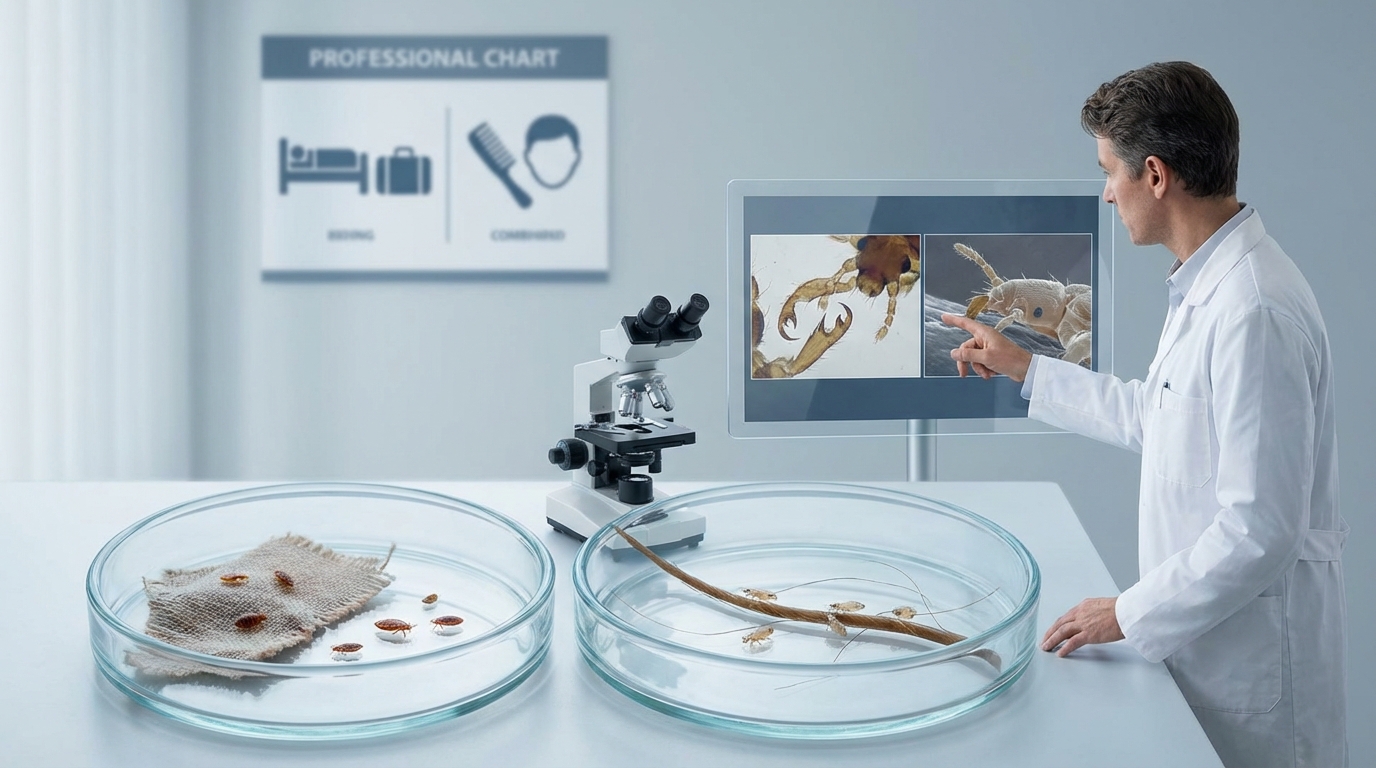
Can bedbugs live in your hair?
Contents
-
Bedbugs vs. Lice: Comparison of attachment and survival patterns
-
Pre-purchase recommendations: Treat the environment rather than the hair
Do you wake up scratching your head and wonder if a bedbug in your hair is possible? The question comes up again and again. On forums, in doctors' surgeries, among people who discover bites near the nape of the neck or on the scalp. And frankly, confusion with head lice doesn't help.
Things to remember
-
The article uses an entomological approach to demonstrate the physical inability of Cimex lectularius to anchor itself to human hair.
-
By comparing the survival criteria of bedbugs vs. lice, we redirect the control strategy to bedding sanitation, while citing academic sources to establish Pest Patrol's authority.
-
Comparison of attachment and survival modes
-
Insect selection criteria
Let's get one thing straight right away: no, bed bugs don't live in your hair. Not because we've decided to, but because their biology forbids it. Visit Cimex lectularius, is simply not equipped for this. Its legs, its morphology, its feeding behavior, everything pushes it to flee your hair to hide in your mattress.
But that doesn't mean the problem doesn't exist. Do you have nocturnal itching or stinging marks on your head? There's bound to be an explanation. This article will give you the keys to understanding what's really going on, differentiating between bedbugs and lice, and above all, taking action where it counts: your sleeping environment.
Bedbugs vs. Lice: Comparison of attachment and survival patterns
When you discover little bugs biting near your scalp, your first instinct is to think of lice. The second, increasingly common with the media coverage of infestations, is to suspect bedbugs in the hair. The confusion is understandable, but the difference between a bedbug and a louse is radical. We're talking about two insects that have almost nothing in common, apart from the fact that they feed on human blood.
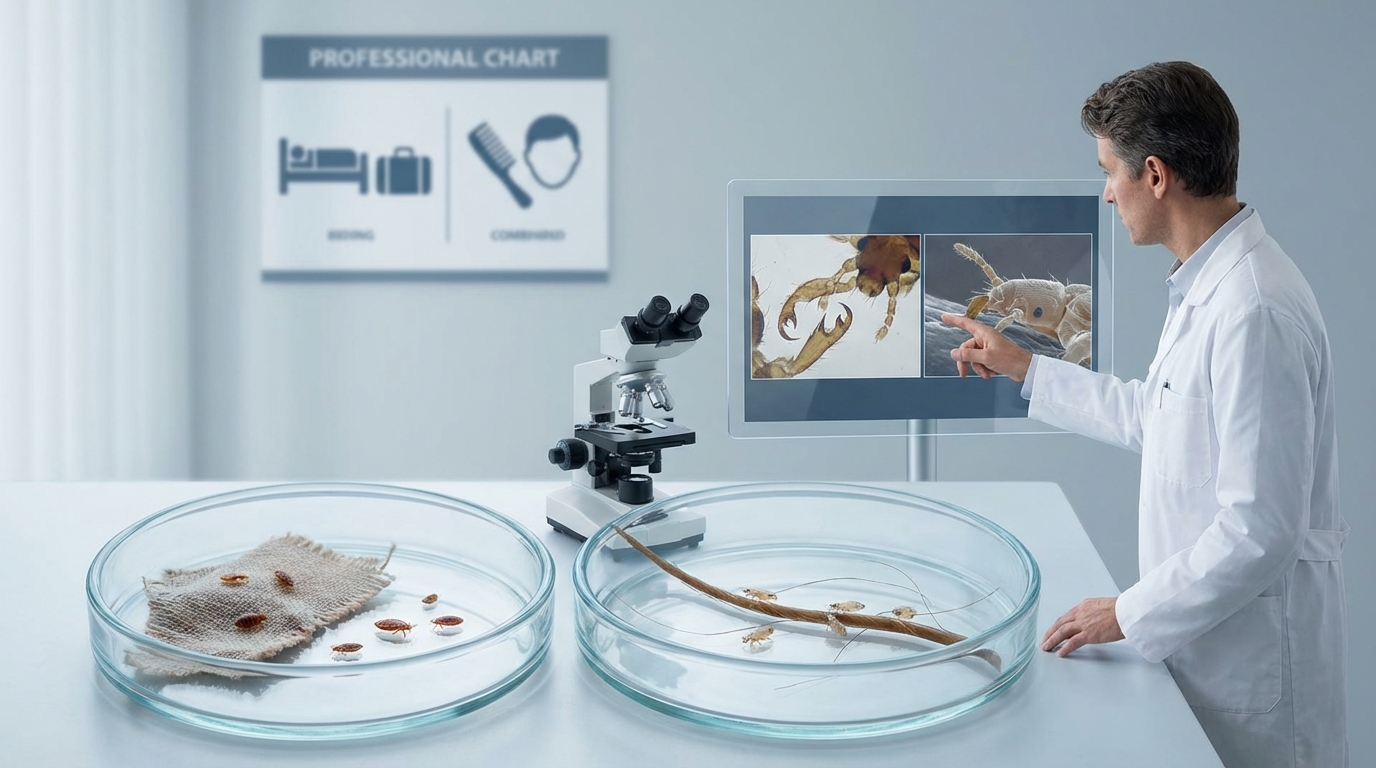
The head louse (Pediculus humanus capitis) has hook-like claws specially designed to grip hair shafts. A study published in the Journal of Medical Entomology has shown that these claws function like pincers: they grip the hair with remarkable precision, enabling the louse to remain attached even when you scratch or comb it. The louse lays its nits directly on the hair, a few millimeters from the scalp, with a biological glue that's almost impossible to dissolve with water. It lives there, it eats there, it reproduces there. Human hair is its natural habitat.
Bedbugs? None of the above. Its legs are flat and wide, with adhesive pads adapted to smooth or textile surfaces: sheets, mattress seams, wood crevices. Not hair. It is physically impossible for them to attach to hair. Its tarsi (the tips of its legs) can't grip a thin cylindrical rod like a human hair. It's like trying to catch a fishing line with mittens.
Another essential point is the life cycle. Lice remain permanently on their host. If separated, they die within 24 to 48 hours. Bedbugs, on the other hand, only stay on you long enough to feed, between 5 and 10 minutes. Then they go back to hiding. A bedbug in the hair would have no interest in staying there: it can't cling to it, lay eggs or hide effectively.
What about eggs? I'm often asked the question: can you find a bedbug egg in your hair? The answer is no. Bedbugs lay their eggs in dark, confined places, close to their food source, but never on the host itself. They use an adhesive substance to stick their eggs to rigid surfaces such as box spring slats, mattress seams and baseboards. Human hair meets none of these criteria. If you find eggs in your hair, they are lice nits, not bedbug eggs.
To sum up the fundamental difference: the louse is a permanent ectoparasite, adapted to life on the human body. The bedbug is a temporary parasite that lives in your furniture and only visits you to eat. Two completely opposite strategies, two insects that must not be confused if the right treatment is to be applied.
Why your hair is no refuge: Insect selection criteria
A researcher at the University of Sheffield, Dr Michael Siva-Jothy, has devoted much of his career to studying the behavior of the Cimex lectularius. His work shows that this insect is extremely selective in its choice of habitat. And your hair doesn't tick any boxes.
Let's start with morphology. The body of an adult chinch bug is oval, flattened and 5 to 7 mm wide. This shape enables it to slip into gaps the thickness of a bank card. Convenient for cracks in parquet or mattress seams. Totally unsuitable for navigating through hair. The bedbug is slow, clumsy on uneven surfaces, and unable to move efficiently through hair, whether thin or thick. It is a flat-surface insect.
Body temperature also plays a role. The human scalp maintains a temperature of around 35°C, sometimes higher. Bed bugs, however, prefer resting areas between 20 and 25°C. They feed on warm skin, yes, but they don't want to stay there. Too hot, too exposed, too much movement. Everything they hate. After their blood meal, they return to hiding places where the temperature is lower and more stable: the back of a headboard, a box spring frame, a wall socket.
Do bedbugs bite in the hair? On rare occasions, bedbugs may bite the back of your neck or the top of your forehead. But that's simply because these areas of skin were accessible while you were sleeping. The bedbug didn't «settle» in your hair to bite. It crawled up from the mattress, found exposed skin, fed, and left. A bedbug bite near the hair does not mean a hair infestation.
There's also the question of light. Bedbugs are lucifuges: they actively avoid light. Your hair, even at night, is not a sufficiently dark and confined shelter. Compare this with a 2 mm gap between two wooden slats. That's where bedbugs feel safe, not on your head.
A 2016 study published in Scientific Reports (Benoit et al.) has confirmed that bedbugs select their refuges according to very precise criteria: darkness, proximity to the host (less than 2 meters away), rough or textile surface for adhesion, and presence of congeners (they group together thanks to aggregation pheromones). Human hair meets none of these criteria. Zero.
So why does this idea persist? Probably because nocturnal itching of the scalp is frequent and distressing. When you know you've got bedbugs in your home, you project the problem everywhere. Scalp itching at night can have dozens of explanations: seborrheic dermatitis, dust mite allergy, stress, lice of course, or even simply too aggressive a shampoo. Bed bugs don't go in your hair, period.
Pre-purchase recommendations: Treat the environment rather than the hair
If you're reading this article, there's a good chance you're looking for a product to put on your hair to get rid of bedbugs. Don't do it. You'll be wasting your money and precious time.
Some websites suggest using a hair dryer to kill bedbugs. The idea is to expose the insects to heat to kill them. On paper, this isn't completely absurd: bedbugs actually die after 48°C of prolonged exposure. A hair dryer can reach these temperatures. The problem is, the bugs aren't in your hair. Running a hair dryer over your head won't kill any bedbugs, because there aren't any there. It's a bit like watering your garden to put out a fire in the kitchen.
Heat treatment, on the other hand, is formidably effective when applied in the right place. Bedbug eradication professionals use 180°C dry steam generators to treat mattresses, box springs, bed frames and surrounding furniture. The heat penetrates the seams, nooks and crannies where bedbugs and their eggs hide. According to a study by the University of Minnesota (2013), a professional heat treatment eliminates 100% of bedbugs and their eggs in a single session when the temperature of 50°C is maintained for 90 minutes throughout the room.
For people who want to do things themselves before calling in a professional, here's what really works:
-
Anti-bug mattress cover But not just any cover. Choose a certified integral cover with a micro-tooth zipper. It traps bedbugs already in the mattress (they'll starve to death in a few months) and prevents new ones from settling in. This is the first purchase you should make, before any insecticide.
-
Wash at 60°C minimum sheets, pillowcases, comforter covers, anything that goes through the washing machine. Bedbugs and their eggs don't survive at this temperature. Do this every week until the infestation is resolved.
-
Thorough vacuuming Vacuum the mattress, box spring, baseboards and behind the headboard. Empty the bag immediately into an airtight bag and dispose of it outside.
-
Diatomaceous earth This natural powder made from fossilized micro-algae lacerates the waxy cuticle of bedbugs, dehydrating them in 48 to 72 hours. Apply it in cracks, around footboards and behind electrical outlets. It is harmless to humans and pets.
When it comes to insecticides, be careful. Bed bugs have developed impressive resistance to pyrethroids, the most common family of molecules in commercial sprays. A 2017 study (Zhu et al., Journal of Economic Entomology) has shown that some bedbug populations are resistant to doses 1,000 times higher than the normally lethal dose. If you buy a spray in a supermarket, chances are it will only disperse bedbugs to other rooms, without killing them. A professional insecticide, applied by a certified technician who knows which molecules are still effective and how to rotate them, is a different matter.
What insect can bite the scalp, then, if not bedbugs? Lice, of course. Fleas too, occasionally, especially if you have pets. Some mites (like the Demodex) live naturally in hair follicles and can cause irritation. If your itching is localized to the scalp and you don't have bites clustered all over the rest of your body, the bedbug trail is highly unlikely. Consult a dermatologist or pharmacist who can examine your scalp with a magnifying glass.
One last point I see often overlooked: bed bugs aren't attracted to any particular type of skin. They detect the CO2 you exhale and your body heat. Which skin attracts bed bugs? All skin types. They don't discriminate. If one person in a couple gets bitten and the other doesn't, it's often a question of immune response: some simply don't develop visible marks.
Conclusion
Bed bugs in the hair is a persistent myth, but a myth nonetheless. Visit Cimex lectularius can't cling to your hair, doesn't lay bedbug eggs in your hair, and has no biological reason to take refuge there. If you have an itchy scalp, look for lice or consult a health professional.
Your energy, time and budget should be devoted to eradicating bed bugs where they really are: in your bedding, furniture and baseboards. Mattress cover, heat treatment, professional intervention if the infestation is established. That's where the battle is won, not on your head.
At Pest Patrol, we'd rather give you the right information than sell you a useless product. If you suspect an infestation, have your home inspected by our teams. The sooner you act, the easier and more effective the treatment will be.
Frequently asked questions
Can bedbugs live in your hair?
No, bed bugs don't live in hair. Unlike lice, they don't have claws to cling to hair shafts, and prefer flat surfaces like fabric or wood. They remain on the skin only long enough to feed, before returning to hide in the bedding.
Do bedbugs lay eggs in hair?
It's impossible to find bedbug eggs in your hair. These insects lay their eggs exclusively in dark, fixed and uneven places, such as mattress seams or box spring cracks. If you find eggs stuck to your hair, they are most likely lice nits.
Why does my head itch if it's not bedbugs?
Itchy scalps at night are often caused by head lice, fleas or dermatological reactions (stress, allergy). Although a bedbug may occasionally bite the nape of the neck or the forehead, it never settles in the hair; an examination by a health professional is recommended to identify the real cause.
How can I get rid of bedbugs from my head?
Since bedbugs don't live on humans, no special shampoo is needed. The most urgent thing is to treat your environment: wash your bedding at 60°C and use a certified mattress cover. Don't use a hair dryer on your scalp, as this will have no impact on the infestation in your bedroom.
What's the difference between a louse and a bedbug?
The louse is a permanent parasite that lives, eats and reproduces exclusively on the human scalp. The bedbug is a temporary parasite that lives in furniture and only joins the host for a few minutes to bite, before fleeing light and body heat.
 Français de Belgique
  English
  Nederlands (België)