
Why are ants invading my bathroom?
Contents
-
Moisture vs. detritus: comparing the causes of ant attraction
-
Natural remedies vs. chemical baits: comparative advantages and disadvantages
-
Selection criteria and recommendations before buying an extermination kit
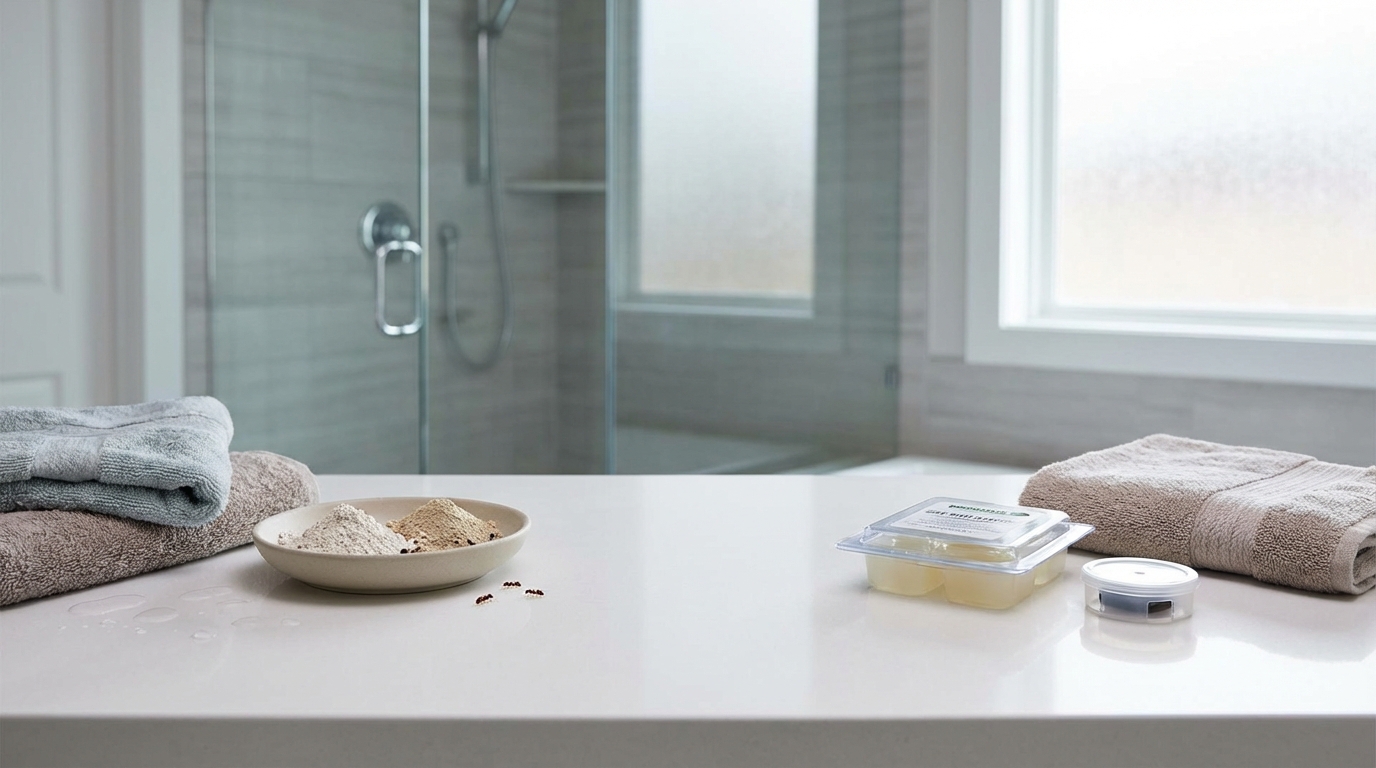
You open the shower curtain one morning, and there it is: a well-organized column of little ants in the bathroom, skirting the silicone seal as if it had always been there. Immediate reflex: crush, rinse, forget. Except that the next day, they're back. And the day after that too. It's not a coincidence, it's biology.
Things to remember
-
This article deciphers the biology behind the invasion (pheromones and humidity) by scientifically comparing home remedies with professional biocidal solutions.
-
We offer entomological expertise to identify the real source of the nest, often hidden in structures.
-
Comparison of the causes of ant attraction
-
Comparative advantages and disadvantages
What most people don't know is that the bathroom combines exactly what an ant colony needs to thrive: constant water, heat, and organic micro-residues that you can't even see. When you have ants in your bathroom, you're not dealing with a whim of nature. You're dealing with a species that has identified your piece of water as a strategic resource, and chemically signaled it to its entire colony via pheromones. In other words, a simple sponge job won't be enough.
In this article, we'll break down the real causes of this ant invasion, make an honest comparison between home remedies and professional solutions, and give you concrete criteria for choosing the right treatment. No miracle recipes, just applied entomology and common sense.
Moisture vs. detritus: comparing the causes of ant attraction
The question comes up all the time: bathroom ant, why? The answer lies in two factors, and they don't weigh the same.
Bathroom humidity is the number one factor. Not second, not just one factor among many: number one. A study published in the Journal of Economic Entomology (2004) has shown that the most common domestic species, in particular Tapinoma sessile (the odorous ant, very common indoors), systematically direct their explorers towards water sources, even before food sources. In dry or hot weather, this behavior intensifies. Your bathroom, with its micro-flakes under the bathtub, condensation on the pipes and oozing shower seal, is an oasis for them.
And that's where the concept of satellite nests comes in. The main anthill may be outside your home, in the garden or under a flagstone. When conditions are right, the colony creates outposts, or satellite nests, closer to resources. Bathroom drains are an ideal corridor: damp, dark and protected. If you live in an apartment and you see ants in your bathroom on the second or third floor, it's almost always via technical ducts and pipes that they arrive. Ants in the drain is not an urban myth. It's a classic.
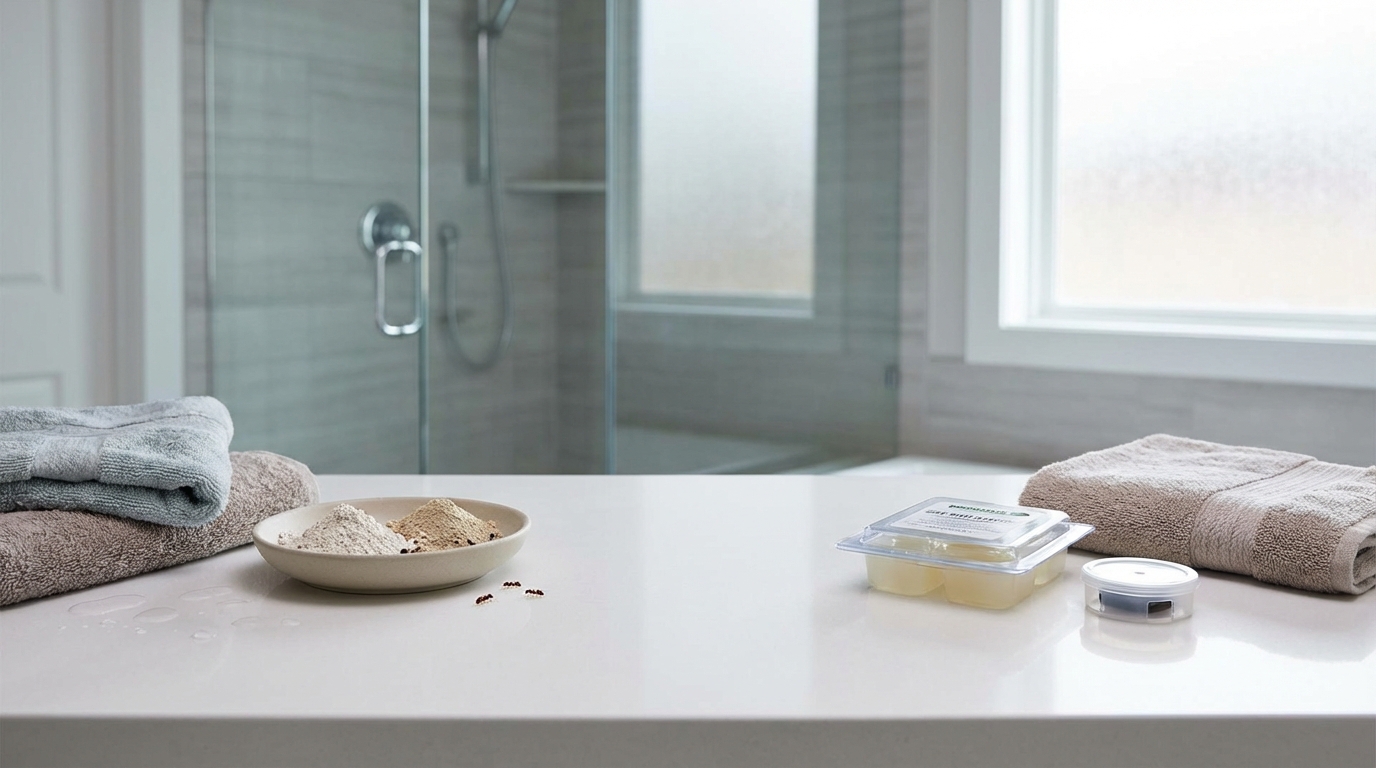
Now for the detritus. We're talking organic matter in the broadest sense here: soap scum, hair mixed with sebum, toothpaste that's fallen behind the sink, skin cells. You can't see them, but ants can. Their antennae detect minute quantities of organic matter. A poorly cleaned bath plug is a buffet. The mini ants you see in the bathroom, often Monomorium pharaonis (pharaoh ant) or Tapinoma, are particularly attracted by these proteinaceous micro-wastes.
So, moisture or detritus? Moisture attracts, organic matter retains. Without accessible water, ants don't settle. Without food, they eventually leave. The two together are the perfect combo for a lasting bathroom ant invasion.
A point often overlooked: flying ants in the bathroom. These are reproducers (males and queens) that appear during the swarming period, usually in summer. Their presence signals a mature colony in the immediate vicinity. If you see any, the nest is not far away, probably in the structure of the building itself or in a pipe.
The most reliable way of finding out where an ant nest is located is by patient observation. Follow the workers' trail backwards. They follow a precise chemical path, marked by pheromones. If the trail disappears into a wall or under a skirting board, you've located the entry point. The satellite nest is just behind.
Natural remedies vs. chemical baits: comparative advantages and disadvantages
When you type «bathroom ants, what to do» into a search engine, you come across two camps. On the one hand, the advocates of white vinegar and lemon. On the other, those who go straight for the chemical artillery. Both approaches have their logic, but they don't play in the same league.
Let's start with white vinegar. Yes, it works, but not the way people think. White vinegar doesn't kill ants. It scrambles pheromone trails. It's a communication disruptor, not an insecticide. When you clean tiles with white vinegar, ants temporarily lose their chemical GPS. They wander, disperse, and you have the impression that the problem is solved. Except that the colony is intact. The workers will retrace their route within a few hours. White vinegar against ants is a brake, not a solution.
Same verdict for essential oils (peppermint, lavender), coffee grounds and cinnamon. These are olfactory repellents. They repel female explorers from a given area, temporarily. None of these methods reaches the queen. And as long as the queen lays her eggs, the colony regenerates.
Boric acid is another matter. This is where we enter the realm of biocide. Boric acid acts by ingestion: the ant consumes it (often mixed with sugar or peanut butter), takes it back to the nest, shares it by trophallaxis (regurgitation between individuals), and gradually poisons the whole colony, queen included. A meta-analysis by Klotz et al. (2000, Journal of Economic Entomology) has confirmed that low-concentration boric acid baits (0.5 to 1%) are among the most effective at eliminating whole colonies of Tapinoma sessile. The trick is dosage: too concentrated and the ant dies before returning to the nest. Too little, and the effect is nil.
Professional ant-proofing gel works on the same principle, with one major advantage: the formulation is calibrated. Commercial pro biocidal gels contain active substances (imidacloprid, fipronil or indoxacarb) in concentrations optimized for a delayed effect. The ant consumes, reports and contaminates. Visible results in 48 to 72 hours, complete elimination in one to two weeks. This method works best when the nest is inaccessible, which is almost always the case in a bathroom.
A quick overview:
-
White vinegar : temporary repellent, zero impact on the colony, harmless, virtually no cost. Useful as a supplement, not as the sole solution.
-
Boric acid (homemade) : effective if properly dosed, slow (1 to 3 weeks), toxic by ingestion for children and animals. Requires rigor.
-
Professional anti-flea gel: most effective on established colonies, targeted application, desired delayed effect. Moderate cost (€8 to €20). Beware of areas accessible to children.
My advice: if you have a few small ants in the bathroom from time to time, a good cleaning with vinegar and the removal of moisture sources may be all you need. If it's a recurring invasion, with organized columns, you need to target the colony. And for that, only time-release baits really work.
Selection criteria and recommendations before buying an extermination kit
Typing «best ant eradicator» on the Internet brings up 45 sponsored results and just as many promises of miracle eradication. Here's how to sort them out.
First and most important criterion: mode of action. You want a delayed-acting bait, not a contact insecticide. Sprays that kill ants on the spot are visually satisfying (you can see the results), but counter-productive. They eliminate the visible workers, which may represent 10% of the colony. The queen continues to lay eggs in peace. Worse still, some sprays contain repellents that disperse the colony and create new satellite nests. You go from one problem to three.
Second criterion: the target species. Not all ants react to the same bait. The Tapinoma sessile prefer sweet baits. Pharaoh ants (Monomorium pharaonis) also accept protein baits. If you see little brown or black ants in your apartment bathroom, chances are it's one of these two species. Professional multi-purpose gels generally cover both food profiles.
Third criterion, crucial if you have pets: safety. Boric acid is toxic to dogs and cats if ingested directly. So are fipronil-based gels. The solution is to use closed baiting stations. These small boxes allow ants to enter (they're small enough to fit through the slots), but prevent a cat or dog from accessing the product. Safety for pets is not an option, it's a mandatory selection criterion.
Fourth point: treating the pipes. If ants arrive via the pipes (and in the bathroom, this is the case in most situations), applying a gel to the tiles alone is not enough. You need to treat the entry points. Apply ant-proofing gel directly around pipe penetrations, behind manhole covers or along baseboards around bathtubs or shower trays. Treatment of the pipes themselves may require a powdered insecticide (such as diatomaceous earth) injected into the service ducts. For ants in deep pipes, a professional with an inspection camera may be required.
Fifth criterion: duration of treatment. Don't expect results within 24 hours. A good elimination protocol takes between 7 and 14 days. If a product promises instant eradication, it's either a contact spray (ineffective on the colony) or just marketing. Effective baits work slowly, which is precisely what makes them effective. Patience is the real insecticide here.
To get rid of ants in the bathroom for good, here's the sequence I recommend:
-
Identify entry points by following the tracks backwards.
-
Eliminate accessible sources of moisture: repair leaks, ventilate, dry surfaces after each shower.
-
Clean with white vinegar to scramble existing pheromones.
-
Place gel baits at entry points and along observed trajectories.
-
Use closed stations if you have children or pets.
-
Wait 10 to 14 days before evaluating results. Do not clean baited areas during this period.
-
If the invasion persists after two weeks of well-managed treatment, call in a professional who can locate the main nest.
A final word on flying ants in the bathroom: their appearance means that the colony is in the reproduction phase. It's a sign that the colony has been established for some time, probably several months. At this stage, home remedies alone may not be enough. A professional gel combined with a drain treatment will be your best option.
Conclusion
The ants in your bathroom aren't there by chance. They've found water, a little organic matter, and discreet access via your pipes or walls. Understanding this is half the battle.
The other half is to act methodically: cut off access to the moisture, place time-release baits in the right places, and give the product time to work its way up to the queen. White vinegar has its place in the protocol, but as a cleaning tool, not as a miracle solution.
If you're in the middle of an invasion and don't know where to start, apply the sequence described above. And if after two weeks nothing has moved, don't hesitate to contact an insect control professional. Some anthills, especially those nesting in building structures, require a diagnosis that no tutorial can replace.
Frequently asked questions
Why do ants choose the bathroom over the kitchen?
Contrary to popular belief, humidity is a more powerful attraction than food for many species. The bathroom offers permanent access to water (condensation, leaking joints, siphon) and organic micro-residues (dead skin, soap) that enable a colony to thrive, often creating satellite nests in partitions or service ducts.
Is white vinegar effective in eliminating ants?
White vinegar is an excellent repellent cleaner, but it doesn't kill the colony. Its acidity scrambles the pheromone trails (the chemical markings left by the workers), temporarily disorientating the invasion. For definitive eradication, it must be complemented by a delayed-acting bait that reaches the queen.
How do you get rid of ants coming out of your pipes?
If ants are using your pipes, the most reliable solution is to apply a professional biocide gel at entry points (around faucet rosettes or bathtub hatches). Avoid conventional insecticide sprays, which simply disperse the nest; instead, use drops of gel that will be carried by the workers to the heart of the anthill.
What does the presence of flying ants in my bathroom mean?
The appearance of winged ants indicates swarming, the sign that a mature colony has settled in the structure of your home (walls, floors or ducts). This reproductive phase confirms that the nest has been present for several months, and that a surface treatment will probably not be enough to solve the underlying problem.
Are ant repellents dangerous for pets?
Some insecticides and boric acid can be toxic if ingested by a dog or cat. To secure your bathroom, use closed bait stations: they allow ants access to the product while protecting your pets from direct contact with the active substance.
 Français de Belgique
  English
  Nederlands (België)