
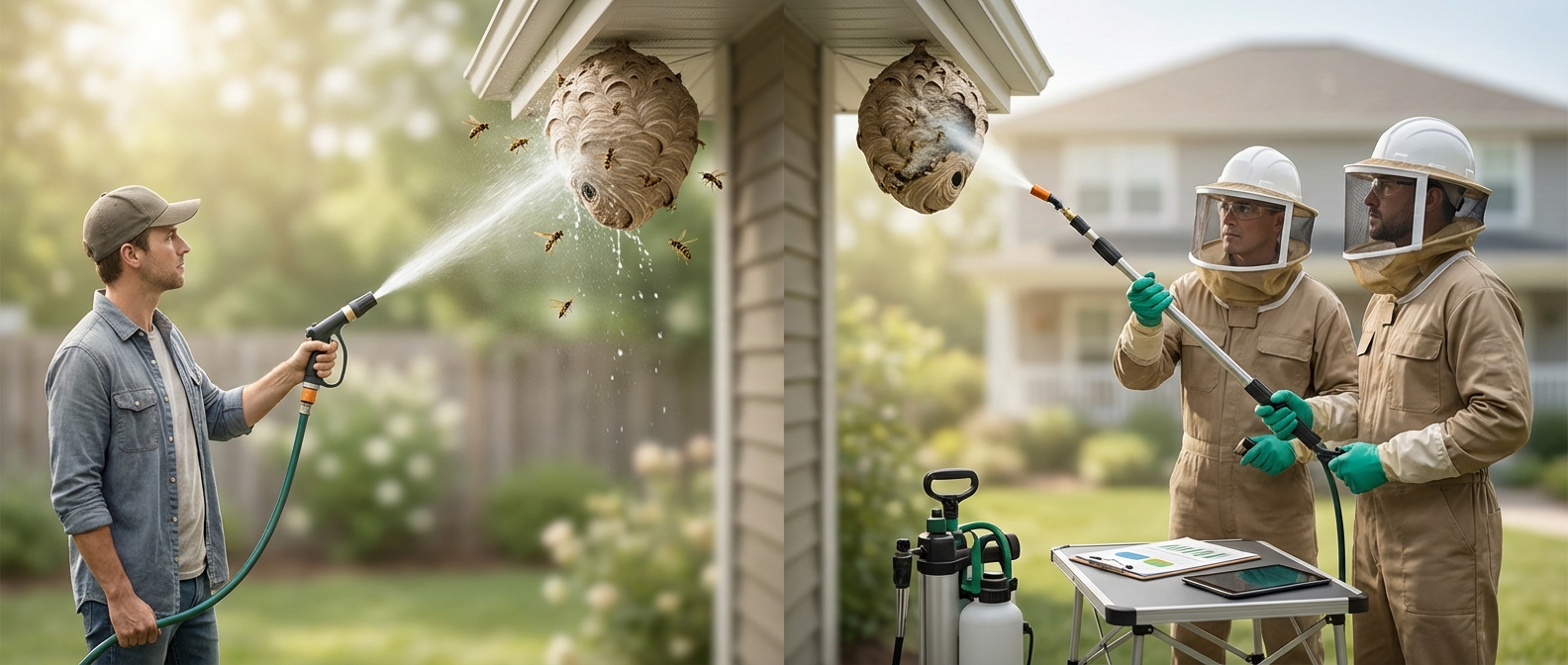
Can a hornet or wasp nest be destroyed with a water jet?
Contents
-
Water jetting vs. professional methods: Comparative risk analysis
-
Why water is ineffective: Nest structure science and aggression
-
Decision criteria and safety: When should you call in an expert?
It's the same story every summer. You spot a wasp nest under the eaves or in a corner of the garden, and your first instinct is to grab the hose. It's logical: water is powerful, it's free and it seems so simple. Except that this idea, however intuitive, is based on a total misunderstanding of what a Hymenoptera nest is and how these insects react when attacked.
Things to remember
-
The article deconstructs the myth of the water jet, based on entomology (water-repellent properties of the nest) and civil security.
-
We offer a comparative analysis between the temptation of DIY and the professional effectiveness of Pest Patrol, citing studies on Hymenoptera aggression in the face of physical threats to assert our authority
-
Comparative risk analysis
-
Compare the different options before deciding.
Together, we'll take a look at why destroying a wasp nest with a water jet is not only ineffective, but potentially very dangerous. We'll draw on scientific evidence, entomology and feedback from civil protection services. And we'll see when it's time to stop playing the hero and call in someone whose job it is.
Spoiler: this moment comes much sooner than you think.
Water jetting vs. professional methods: Comparative risk analysis
Let's start with what everyone imagines. You take your garden hose, aim it at the nest, send out a powerful spray, and the nest falls. The wasps disperse, end of story. Except it's not. Not at all, in fact.
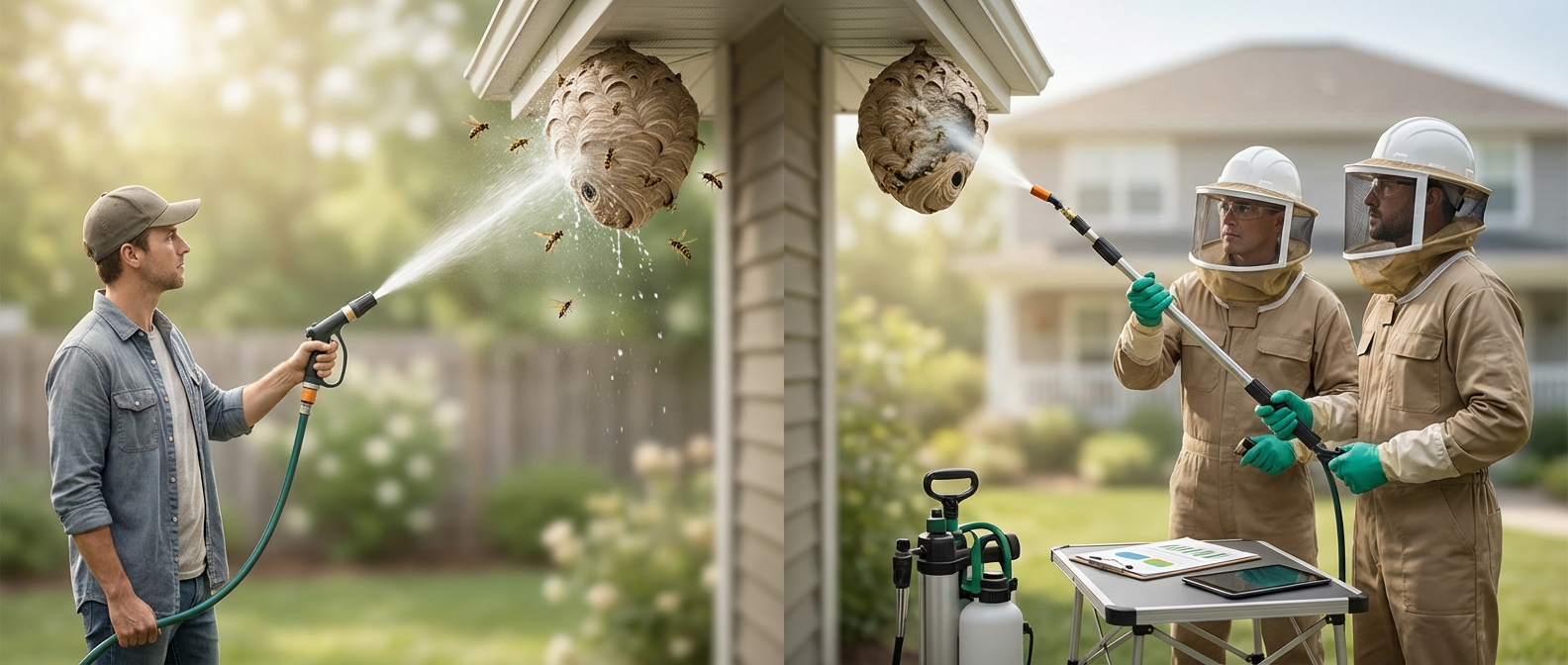
Destroying a wasp nest with a water jet is one of the riskiest scenarios you can attempt. Here's what really happens: the jet hits the surface of the nest, which resists much better than expected (more on that later). The vibrations and impact immediately alert the entire colony. In a matter of seconds, dozens, sometimes hundreds, of workers go into defense mode. They don't flee. They attack. And they attack the source of the threat - you.
The danger of a sting in this situation is extreme. An isolated wasp stings once and then leaves. But an alert colony is a coordinated swarm capable of inflicting multiple stings in a very short space of time. A study published in the Journal of Allergy and Clinical Immunology reminds us that severe systemic reactions (anaphylactic shock) occur in around 3 % of the adult population after a hymenoptera sting. When you take 15 or 20 stings at a time, even without a known allergy, the venom load can cause severe toxic reactions: generalized oedema, drop in blood pressure, kidney failure in the most serious cases.
Now let's take a look at what a professional pest control operator does. He intervenes wearing a full protective suit, mask and thick gloves. He uses specific insecticides (often pyrethroid-based) injected directly into the nest via a telescopic pole or long-range aerosol. The product takes effect in just a few minutes. The insects are neutralized before they can mount a coordinated defensive response. The nest is then removed cleanly.
How effective is DIY with a water jet? Practically zero. You don't eliminate the colony, you don't destroy the nest (it's much stronger than it looks), and you trigger a massive aggressive reaction. The benefit-risk ratio is catastrophic. On the professional side, the success rate in a single intervention exceeds 95 %. Hardly comparable.
A point we often forget: even if by some miracle you manage to unhook the nest, the surviving wasps don't disappear. They remain in the area for hours, even days, extremely agitated. Do you have children playing in the garden? Or pets? The risk doesn't stop when the hose is put away.
Why water is ineffective: Nest structure science and aggression
A wasp's nest looks like fragile paper. Technically, it is paper: the workers chew wood fibres, mix them with their saliva and build up successive layers of this papier-mâché. You'd think a good splash of water would be enough to dissolve it. The reality is more complex.
This papier-mâché has surprising water-repellent properties. The cellulose fibers, once bound by the wasps' salivary secretions, form a surface that partially repels water. Researchers at the University of Florence have analyzed the microstructure of the wasps' nests. Vespa and showed that the outer layers act as a natural waterproof coating. Water runs off, penetrates little, and only superficially damages the structure. Drowning a wasp's nest with a garden hose is a bit like trying to dissolve an umbrella in the rain.
Would boiling water be more effective? It's a question that comes up a lot. In theory, the heat could soften the structure and kill the insects by burning. In practice, pouring boiling water on an aerial nest (under a roof, in a tree) is almost impossible without burning yourself. And for an underground nest, hot water cools down very quickly as it seeps into the ground. You irritate the colony without eliminating it. The result is the same: angry wasps and a still-functioning nest.
Now let's talk about what goes on in the head (well, nervous system) of a wasp when its nest is threatened. Social wasps and hornets have a highly effective chemical alarm system. When a worker perceives a threat, she releases alarm pheromones. These volatile molecules spread instantly, triggering a collective response. The whole colony goes into attack mode.
The aggressiveness of the Asian hornet (Vespa velutina) deserves a special mention. This species, which has been established in France since 2004, defends its nest within a radius of up to 5 to 10 meters. A study by the Muséum national d'Histoire naturelle has documented grouped attacks involving more than 30 individuals simultaneously. The Asian hornet is smaller than the European hornet, but much more aggressive in the face of disturbance. Slinging a jet of water at it will provoke a disproportionate reaction, making you its direct target.
There's another aspect that's often underestimated: persistence. Even if you partially damage the nest, the queen is protected at the heart of the structure. As long as she's alive, the colony rebuilds itself. The workers can repair a damaged nest in a matter of days. You haven't solved anything, just made the insects more wary and reactive to the next disturbance.
Decision criteria and safety: When should you call in an expert?
The real question is not «how can I destroy this nest myself?», but «should I even try?».»
Let's be honest: there are situations where a private individual can manage a small wasp nest in the early stages of formation. A nest the size of a golf ball, in spring, with only the founding queen and a few workers, is still manageable. With a long-range insecticide spray (2 to 3 meters), applied at dusk when the insects have gone home and are less active, the risk is limited. The best time of day to intervene is dusk or dawn, when the colony is complete in the nest and activity is minimal.
But once the nest exceeds the size of a grapefruit, the rules change completely. We're talking about colonies of several hundred individuals, sometimes several thousand at the height of summer. Removing a hornet's nest of this size without professional equipment is like playing Russian roulette. And I weigh my words carefully.
Here are some concrete criteria to help you decide:
-
Nest size : bigger than an orange? Call a professional.
-
Location: high up (under the roof, in a tree), in a wall, in the ground? Difficult access multiplies the risks. For professionals.
-
Species : Asian or European hornet? Their aggressiveness and the size of their colonies systematically justify professional intervention.
-
People at risk in the vicinity : children, the elderly, people allergic to injections? No hesitation.
-
Season : between June and October, colonies are at their peak population. The window for sensible DIY is April-May, no later.
Personal protection is a subject that YouTube tutorials skim over a little too quickly. A standard beekeeping suit isn't always enough against hornets: their stinger is longer than a bee's and can penetrate certain fabrics. Professionals use specific anti-hornet suits, with reinforced layers and watertight seals at wrists and ankles. DIY protection with thick jeans and gardening gloves is insufficient in the face of a coordinated attack.
A pest control company like Pest Patrol has the right equipment, approved products and, above all, experience in the field. Our technicians assess the species, the size of the colony and the accessibility of the nest, and adapt their protocol accordingly. You can't treat a common wasp nest under a gutter in the same way as an Asian hornet nest in a tree 15 meters up. Every situation is different.
The cost of a professional procedure generally ranges from 80 to 200 euros, depending on its complexity. Compare that to the cost of a visit to the emergency room after multiple injections (not to mention the stress, pain and life-threatening risk for allergy sufferers). It's easy to do the math.
One last point: in Belgium, the fire department has not been systematically intervening in wasp or hornet nests for several years now.
Conclusion
Destroying a wasp or hornet's nest with a water jet is a bad idea. Water doesn't seriously damage the water-repellent structure of the nest, it doesn't kill the insects, and it triggers a violent aggressive response. The risks of multiple stings are real, documented and potentially serious.
If you've spotted a nest in your home, resist the temptation to turn on the hose. Observe the size, the location, the species if possible, and ask yourself the honest question: am I equipped to handle this safely? In 9 cases out of 10, the answer is no.
At Pest Patrol, we intervene quickly, safely and with methods that work the first time. One call, one diagnosis, one intervention. Your garden is yours again, with no stings and no nasty surprises.
Frequently asked questions
Is it dangerous to spray a hornet or wasp nest with a hose?
Yes, it's extremely dangerous. Far from drowning the insects, the impact of the water jet triggers a coordinated attack by the colony, which immediately identifies the user of the hose as a target to be killed.
Can water really dissolve the structure of a nest?
No, because the nest has water-repellent properties. Cellulose fibers mixed with the wasps' saliva form an impermeable wall that lets water slide through without damaging the queen's interior.
Why is the water jet ineffective in eliminating a colony?
The water jet does not kill the insects or reach the heart of the nest. Even if the structure falls, the surviving workers will remain in your garden, becoming considerably more aggressive towards humans and pets.
When is it essential to call in a professional?
As soon as the nest exceeds the size of an orange, or in the case of Asian hornets. An expert is equipped with specific protective equipment and certified insecticides to guarantee total and safe eradication.
Is boiling water a viable alternative for a ground nest?
This is a very risky and often ineffective method. The water cools instantly on contact with the soil, irritating the colony without eliminating it, exposing the person to multiple stings on the legs.
 Français de Belgique
  English
  Nederlands (België)