
How to get rid of bed bugs: Complete guide
Contents
-
Mechanical methods vs. natural solutions: which chemical-free treatment is best?
-
Commercial insecticides vs. professional treatments: Analysis of efficacy criteria
-
DIY or call in an expert: Recommendations before buying a pest control service
You've got bites lined up in threes on your arms, little black spots on your mattress, and that nagging doubt: are they bed bugs? If you're reading this article, it's probably because the doubt has been confirmed. Don't panic, but don't waste any time either. Cimex lectularius, which is its scientific name, is an insect that reproduces fast, very fast, and every day that passes makes eradication more complicated.
This guide won't list baseless «grandmother's tricks». We're going to review the methods that really work to kill bed bugs, based on scientific data and the protocols used by pest control professionals. The aim: to give you the keys to understanding how to get rid of bedbugs effectively, whether you decide to act alone or call in a specialist.
Things to remember
-
A rigorous, scientific approach that ranks solutions by proven effectiveness
-
We go beyond simple tricks to compare mechanical and chemical methods according to professional pest control protocols.
-
Which chemical-free treatment is best?
-
Efficiency criteria analysis
We'll prioritize solutions by proven effectiveness. Mechanical methods, natural treatments, insecticides, professional intervention: each option has its strengths and limitations. The bedbug's reproductive cycle (a female lays between 200 and 500 eggs in her lifetime) means that action must be taken at every stage of development. A partial treatment is a failed treatment.
Mechanical methods vs. natural solutions: which chemical-free treatment is best?
First thing to know: chemical-free methods are not «soft» or «second-rate» solutions. Some are among the most effective available. Heat treatment of bedbugs, for example, has been the standard method used by professionals for years. The question is, which ones are really accessible when you do it yourself?.
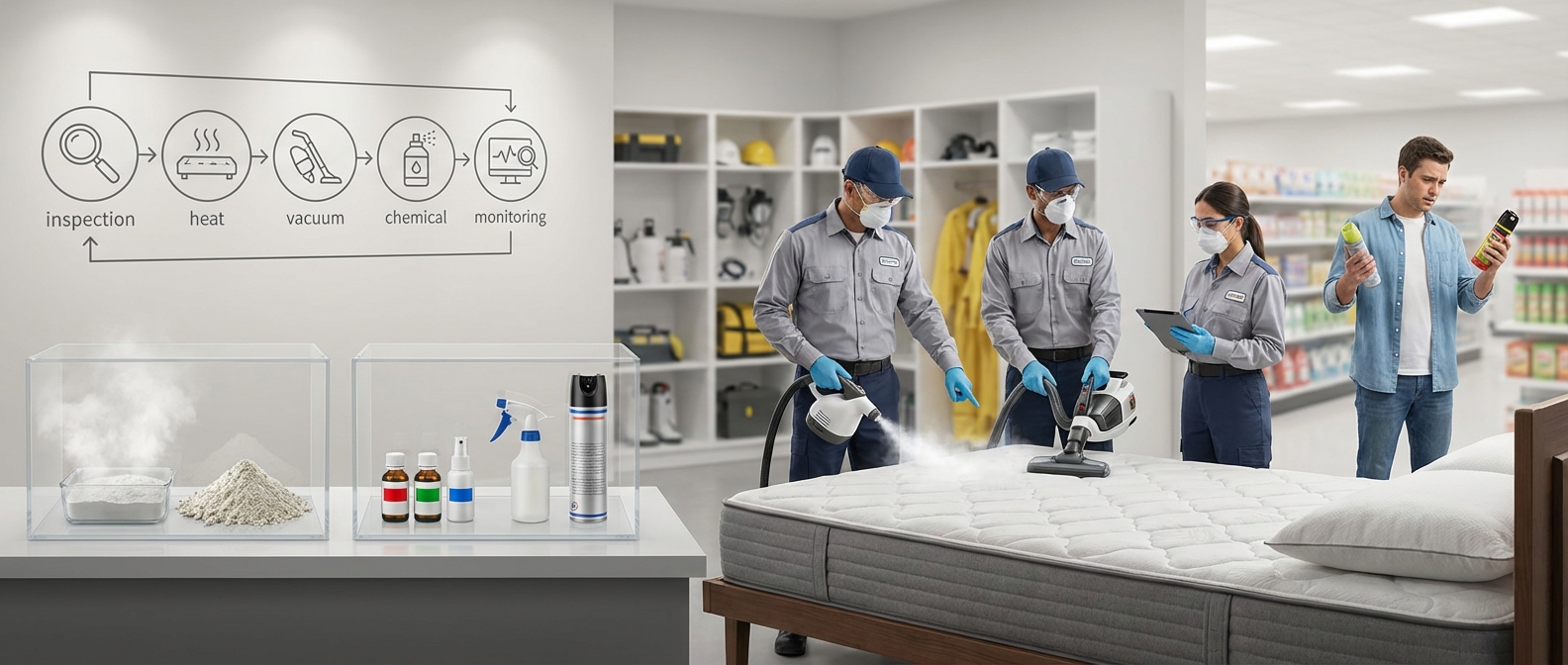
Mechanical suction is the first step to take. Before any other treatment. Vacuum the mattress, box spring, seams, skirting boards, cracks in the parquet, electrical outlets. Everywhere. Use the fine nozzle to pick up insects in nooks and crannies. Caution: the vacuum cleaner bag or bin must be emptied immediately into a sealed plastic bag, then disposed of outside. Otherwise, you're just moving the problem on without solving it. Mechanical vacuuming doesn't kill eggs, but it does drastically reduce the active population. A study by the University of Minnesota showed that careful vacuuming eliminates between 75 and 90 % of visible bedbugs.
The dry steam cleaner is the most formidable weapon at your disposal. Steam at 110-180°C instantly kills bedbugs, nymphs and eggs on contact. It's the only mechanical treatment that acts on all stages of the reproduction cycle. Choose a professional or semi-professional appliance capable of rising above 110°C at the nozzle outlet. Small, entry-level steam cleaners aren't enough: the temperature drops too quickly and doesn't reach the lethal threshold. Steam slowly, very slowly, at a maximum rate of 10 cm per second. Insist on mattress seams, box spring slats and furniture corners.
Visit cold treatment also works, but is more restrictive. Bedbugs die at -18°C maintained for at least 72 hours (some sources even recommend 96 hours to be on the safe side). You can put linen, lint or small objects in the freezer. For larger items, this is obviously impractical at home. Professionals use cryonics (dry ice blasting at -78°C), but that's another budget.
At the same time, high-temperature laundry cleaning is essential. Anything that goes through the washing machine should be washed at 60°C minimum, then tumble-dried at high temperature for 30 minutes. This includes sheets, covers, clothes stored near the bed and curtains. Put clean linen in airtight bags until the treatment is complete. Investing in an integral anti-bedbug cover for mattress and box spring is a simple gesture that prevents the remaining insects from going out to feed and condemns them to starvation (allow 12 to 18 months, as an adult bedbug can survive for a long time without a blood meal).
Let's talk about diatomaceous earth. You'll find recommendations for it all over the Internet. This fossil silica powder works by abrading the insect's waxy cuticle, causing it to dehydrate within a few days. It's proven to work. But there are some nuances. Diatomaceous earth acts slowly (48 to 72 hours to kill an adult) and has no effect on eggs. It's useful as a supplement, not as a sole treatment. Sprinkle it finely along baseboards, around bed legs and in cracks. Thinly, I insist: a thick layer will be skirted by bedbugs. And don't forget to wear a mask when applying it, as the fine particles of silica are not good for the lungs.
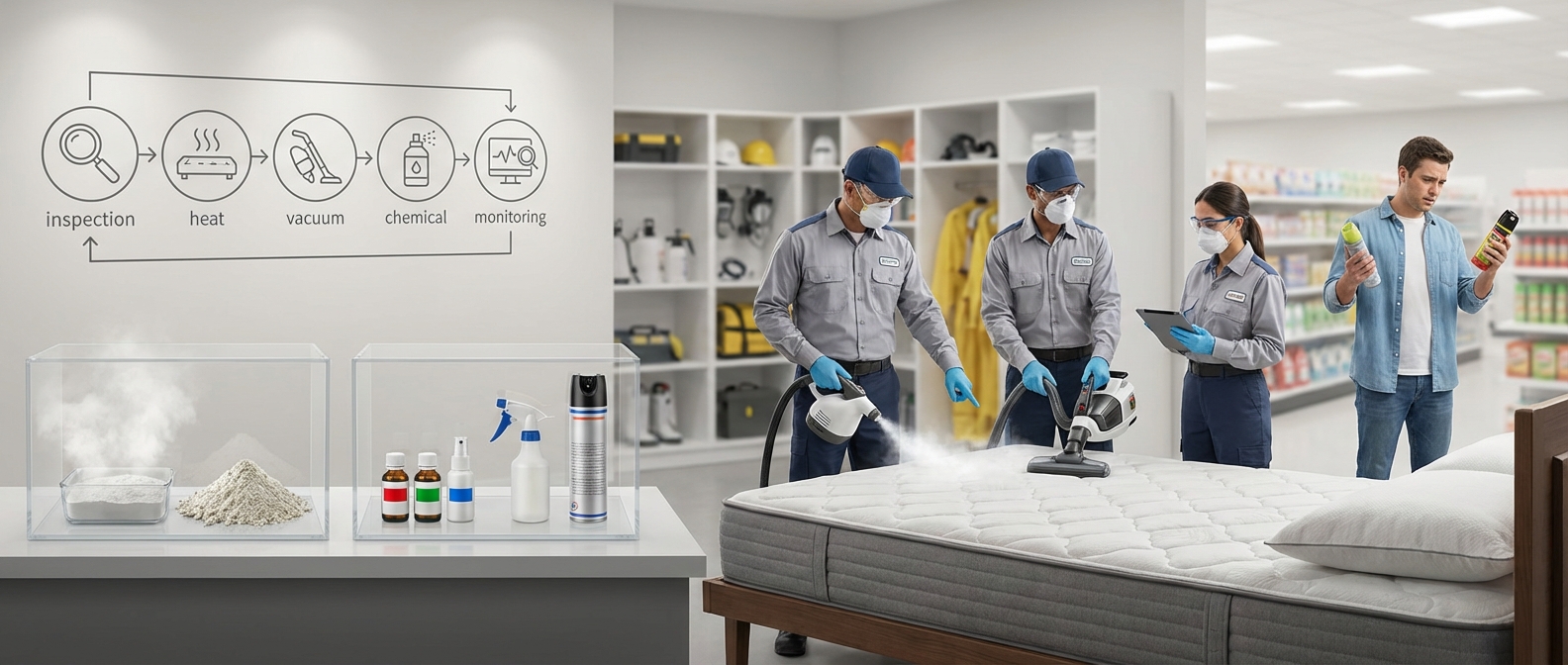
In short, to get rid of bed bugs without chemicals, the winning combination is: rigorous mechanical vacuuming + dry steam cleaning + high-temperature washing + bed bug covers + diatomaceous earth as a barrier. None of these methods is sufficient on its own. It's their combination that makes the difference.
Commercial insecticides vs. professional treatments: Analysis of efficacy criteria
A figure that should make you think: according to a study published in the Journal of Economic Entomology in 2015, more than 90 % of the Cimex lectularius tested in North America are resistant to pyrethroids. Yet these are the active molecules in the vast majority of bedbug repellents sold in supermarkets and drugstores. In other words, that spray you just bought at the supermarket is likely to do nothing at all.
Resistance to pyrethroids (deltamethrin, permethrin, cypermethrin) is a widespread and well-documented phenomenon. Bedbugs have developed genetic mutations, notably in the sodium channels of their nervous system, which render these molecules ineffective. Worse still: an insecticide that doesn't kill bedbugs but disturbs them will cause them to spread to other rooms in your home. You think you're treating, but you're actually making the infestation worse.
So, what's the most effective product for killing bed bugs? If you insist on using a biocidal product yourself, look for formulations based on non-pyrethroid molecules. Chlorfenapyr and synthetic silicon dioxide (not to be confused with natural diatomaceous earth) show good results in the laboratory and in the field. The problem is that consumer products containing these molecules are rare, or even non-existent in some countries. Most truly effective formulations are reserved for licensed professionals.
A residual insecticide, It's a product that remains active for several weeks after application. This is crucial. Bedbugs have a reproductive cycle of about 6 to 8 weeks, from egg to adult. Eggs are protected by a shell that is resistant to most insecticides. The product must therefore still be active when the nymphs hatch. A knock-down spray that kills on contact but leaves no residue is virtually useless against an established infestation. This is a point that many people ignore, and which explains so many failures.
Professional treatments use techniques and products that are inaccessible to the general public. Visit nebulization (or micro-spray) sprays ultra-fine droplets of insecticide into the smallest nooks and crannies: cracks, gaps, electrical sockets, hollow bed frames. A hand-applied spray cannot achieve this level of coverage. Professionals usually combine fogging with a surface spray using a different residual insecticide, to maximize the chances of eradication and bypass resistance.
Professional heat treatment is another approach. Heat guns raise the temperature of the entire room to 55-60°C for several hours. At this temperature, everything dies: adults, nymphs, eggs. No resistance, no chemicals. This is the most reliable method available, with success rates in excess of 95 % in a single intervention, according to NPMA (National Pest Management Association) data. The cost is high, but the results are there.
If you buy a biocidal product in the shops, check three things before you go to the checkout. One: the active molecule (avoid pyrethroids alone). Two: the claimed persistence (minimum 4 to 6 weeks). Three: the AMM (autorisation de mise sur le marché) number, which guarantees that the product has been evaluated by ANSES. A product without AMM has no guarantee of efficacy or safety. And read the instructions. Applying an insecticide any old way means exposing yourself to health risks without solving the problem.
DIY or call in an expert: Recommendations before buying a pest control service
Let's face it: you can get rid of bedbugs yourself. But only if the infestation is detected early (a few individuals, localized around the bed) and if you apply a rigorous protocol over several weeks. Once the infestation has spread to several rooms, and you find bedbugs in electrical outlets, behind baseboards and in living-room furniture, DIY treatment is unlikely to work. The failure rate soars.
How do you know where you stand? Visit canine detection is today the most reliable method of assessing the extent of an infestation. A trained dog detects live bedbugs and eggs with an accuracy of 95 to 97 % (compared with 30 to 40 % for human visual inspection, even by an experienced professional). The cost of canine detection is around €150 to €300 for a standard apartment. It's an investment that can save you hundreds of euros in unsuitable treatments.
If you decide to call in a professional, here's what you need to check. Visit price of disinsectisation varies considerably: from €200 for a chemically treated studio to over €2,000 for heat treatment of a large apartment. Beware of abnormally low prices. A serious treatment requires at least two passes spaced 10 to 15 days apart (to cover the egg hatching cycle). A service provider who promises eradication in a single chemical pass is either lying to you, or doesn't know his business.
Visit performance guarantee is a decisive criterion. A serious professional will offer a 2 to 3 month guarantee, including additional passes in the event of reinfestation. Ask for it in writing. If the service provider refuses to commit to a result, don't bother. Also check that he or she holds the Certibiocide certificate, which has been compulsory in France since 2015 for anyone using biocidal products in a professional capacity.
Visit preparation protocol is as important as the treatment itself. A good professional will send you a precise list of what you need to do before he comes: de-clutter rooms, wash and bag all laundry at 60°C, empty drawers and cupboards, remove skirting boards if possible, vacuum thoroughly. If the service provider doesn't give you any preparation instructions, it's a bad sign. Even a professional treatment cannot work in an unprepared home. Bedbugs hide in places that the product won't reach if everything is still in place.
A few questions to ask before signing a quotation. What method do you use? Which molecules? How many passes are planned? What is your guarantee? Are you registered with the biocide closed circuit? Do you have professional liability insurance? A competent professional will answer all these questions without hesitation. If the answers are vague, run away.
For those who want to try the treatment themselves, here's a realistic protocol. Week 1: complete vacuuming, dry steam cleaning of all infested areas, high-temperature washing of all textiles, fitting of anti-bedbug covers, application of diatomaceous earth as a barrier. Week 2: second steaming, new vacuuming. Weeks 3 to 6: daily monitoring with interception traps under the foot of the bed. If you still find live bedbugs after 6 weeks of this protocol, it's time to call a professional. At least you'll have reduced the population, which will make his job easier.
A final point often overlooked: after treatment, whether DIY or professional, vigilance must last. Keep bedbug covers in place for at least 18 months. Maintain interception traps. Inspect mattress seams regularly. A single fertilized female that has survived can re-launch a complete infestation in a matter of weeks, thanks to a particularly efficient reproductive cycle.
Conclusion
Getting rid of bedbugs takes method, discipline and patience. No miracle solution in two days, whatever you may read elsewhere. Mechanical methods (steam, suction, heat) are your best allies for immediate action. Insecticides can complete the treatment, provided you choose the right molecules and forget conventional pyrethroids. And if the infestation goes beyond the localized stage, a registered professional with a real guarantee of results, such as https://punaisedelitbruxelles.be/, remains the safest option.
Act fast. Every week of hesitation means another generation of bedbugs. Start with vacuuming and steaming today, and then assess whether you need reinforcements. Your mattress, your sleep and your peace of mind depend on it.
Frequently asked questions
How do you get rid of bedbugs yourself?
For those who want to try the treatment themselves, here's a realistic protocol. Week 1: complete vacuuming, dry steam cleaning of all infested areas, high-temperature washing of all textiles, fitting of anti-bedbug covers, application of diatomaceous earth as a barrier. Week 2: second steaming, new vacuuming. Weeks 3 to 6: daily monitoring with interception traps under the foot of the bed. If you still find live bedbugs after 6 weeks of this protocol, it's time to call a professional.
What's the most effective product for killing bedbugs?
Diatomaceous earth. This fossil silica powder works by abrading the insect's waxy cuticle, causing it to dehydrate within a few days. Proven to work.
How do you get rid of bedbugs?
There are a number of methods available, such as mechanical suction, heat treatment, freezing, etc.
Where do bedbugs nest?
They hide on mattresses and box springs, close to the person they're going to bite while they sleep. As soon as the infestation becomes more serious, bedbugs can disperse and hide elsewhere in the bedroom.
 Français de Belgique
  English
  Nederlands (België)