
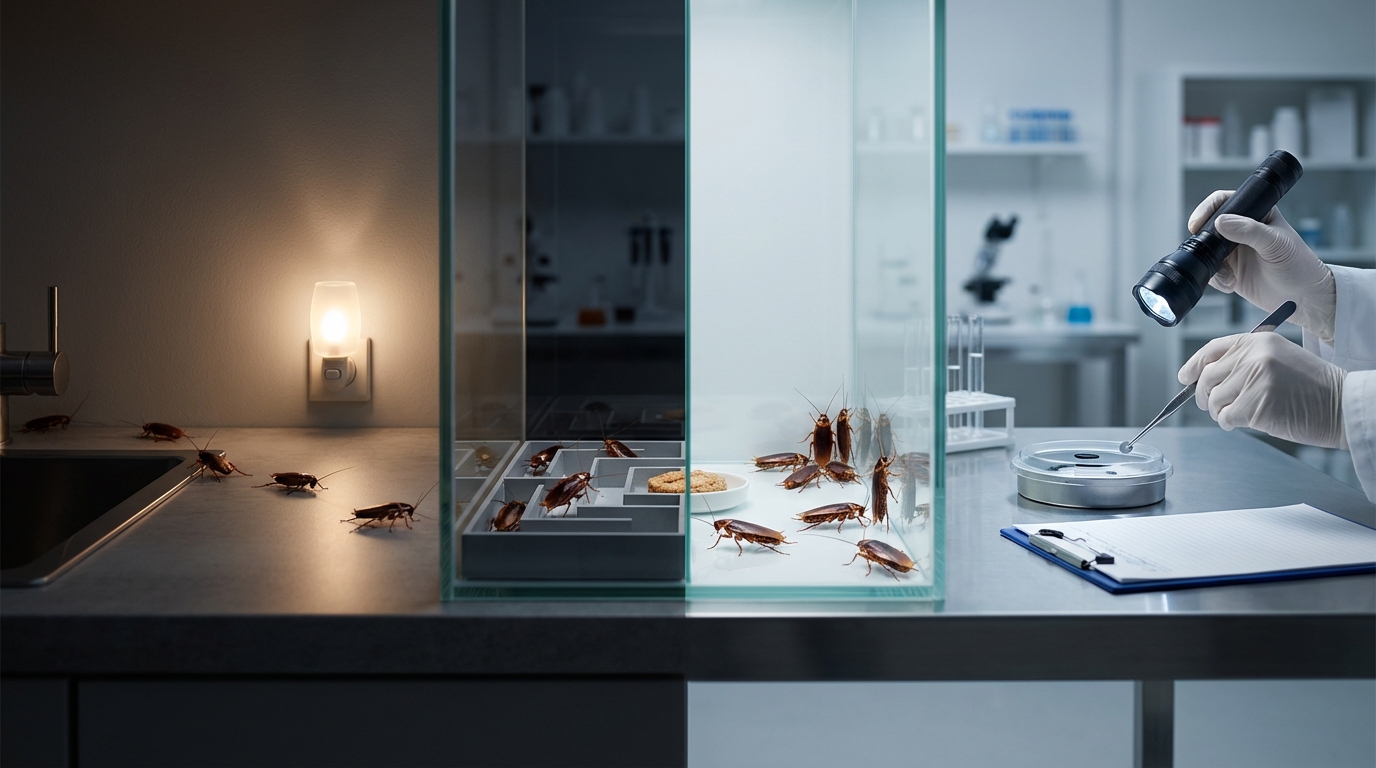
Cockroaches and light: why do they come out in the dark?
Contents
-
Survival instinct vs Photophobia: Why does light scare cockroaches away?
-
Light on all night : Advantages and disadvantages of this method
-
Selection criteria and recommendations: Which treatment to buy according to infestation?
You turn on the kitchen light at 2 a.m. and see them scurrying about. This almost instantaneous flight reflex gives the impression that light is their worst enemy. Many people draw a logical conclusion from this: «If I leave the light on, they won't come.» But it's more complicated than that, and science explains why.
Things to remember
-
Based on entomology (scototaxis and circadian rhythms), this article explains scientifically why darkness triggers cockroach activity.
-
It deconstructs the myth of light as a lasting solution and proposes an expert methodology for assessing the infestation before choosing a professional treatment.
-
Why does light scare cockroaches away?
-
Advantages and disadvantages of this method
Cockroaches and light have a relationship that entomology has been deciphering for decades. Behind this seemingly simple behavior lie precise biological mechanisms: scototaxis, circadian rhythms, aggregation pheromones. A bit technical words, but we'll break it all down together. The aim here is to give you the keys to understanding why cockroaches come out at night, and above all to help you make the right decisions if you suspect a cockroach infestation in your home.
Because no, leaving the light on is not a cockroach-proof plan. Let's find out why, and what really works.
Survival instinct vs Photophobia: Why does light scare cockroaches away?
A cockroach that shuns the light is not a matter of preference. It's a survival reflex that's been ingrained in its nervous system for millions of years. The scientific term is scototaxis an active attraction to dark areas. This is not exactly the same as photophobia (a simple aversion to light). Scototaxis is oriented behavior. The cockroach doesn't just run away from light, it deliberately heads for the dark. A study published in the Journal of Experimental Biology has shown that German cockroaches (Blattella germanica) systematically choose the darkest areas of an environment, even when the difference in brightness is small.
Why this behavior? For a firefly like the cockroach, light means danger. Light = exposure = predators. Birds, lizards, spiders: they all hunt by sight. Hiding in the dark is the number one strategy for staying alive. Cockroaches that didn't follow this rule were eaten. Classic natural selection.
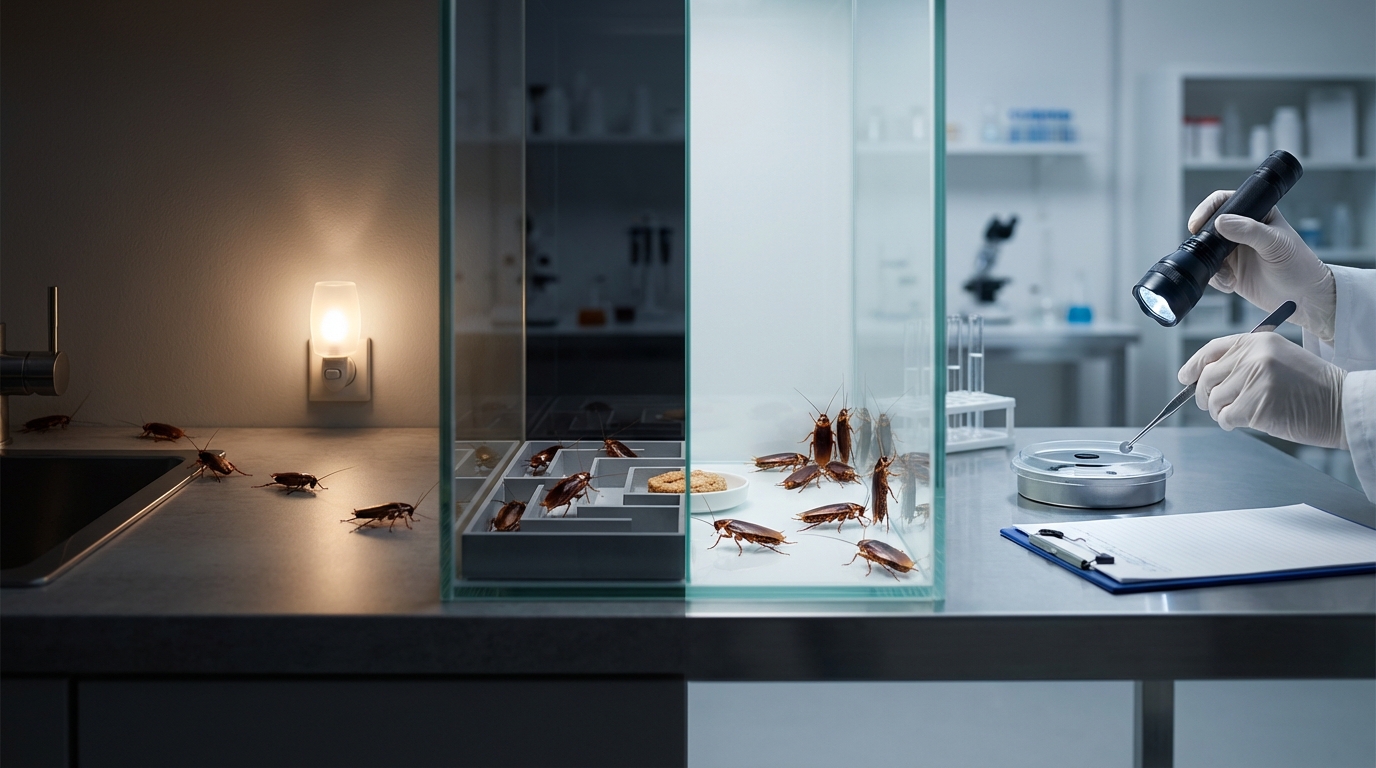
And then there's the circadian rhythm. Like us, cockroaches have an internal biological clock. Researchers at Vanderbilt University have identified that the locomotor activity of American cockroaches (Periplaneta americana) follows a very regular cycle, with peak activity starting just after dusk and decreasing before dawn. This circadian rhythm is so robust that it persists even in constant total darkness. The cockroach «knows» when it's night, even without any external light cues. Its brain contains pacemaker neurons, located in the optic lobes, which regulate this cycle over approximately 24 hours.
Are cockroaches only active at night? Not exactly. Under normal conditions, yes, 80 to 90 % of their activity is concentrated during the dark hours. But when a colony becomes too dense, competition for food pushes some individuals out into the daylight. This is a major warning signal: if you see cockroaches during the day, with the lights on, the population is probably already very large.
Another element plays a fundamental role in this nocturnal behaviour: the aggregation pheromones. Cockroaches produce chemical signals that attract other cockroaches to common havens. These pheromones are deposited in droppings and on surfaces where they congregate. At nightfall, when the internal clock gives the signal, they leave these collective refuges in search of food and water, then return to hide before daybreak. A well-oiled system that works independently of the artificial light in your kitchen.
So yes, light does scare cockroaches away, in the sense that it triggers their flight reflex. But it doesn't keep them away for long. It just makes them run faster to their hiding places. The nuance is important.
Light on all night : Advantages and disadvantages of this method
We often get this question: does light keep cockroaches away if you leave it on all night? On paper, it seems logical. In practice, it's a false good idea, and here's why.
First problem: adaptation. Cockroaches are adaptive machines. Research carried out at the University of Florida has shown that after a few days of continuous exposure to light, cockroaches start to go out again normally. Their nocturnal behavior readjusts. The circadian rhythm eventually takes over from the light stimulus. Basically, you bother them for 48 to 72 hours, then they don't care.
Second problem: you're just moving the problem. Using light as a repellent pushes cockroaches to other areas of your home. Is the kitchen permanently lit? They'll migrate to the bathroom, the bedrooms, behind the skirting boards in the hallway. You haven't solved anything, you've just extended the infestation zone. This is exactly the opposite of what we want.
Third, and this one's rarely mentioned, constant light disrupts your own sleep. Ironically, cockroaches adapt to constant light much faster than your body. You accumulate fatigue. They return to their normal habits in just a few nights.
Is there an advantage? Only one, and it's indirect. Light can be used as a night-time detection. Suddenly switch on the kitchen light at 1 a.m.: if you see cockroaches, you've got your answer. It's a simple, free test to confirm a suspected infestation. The number of individuals you see even gives a rough indication of the size of the colony. One or two cockroaches scurrying about: infestation probably just beginning. Ten or more, some not even hiding immediately: a well-established colony.
Is a cockroach attracted to light in certain cases? Yes, it happens. Some tropical species, such as the brown-banded cockroach (Supella longipalpa), show a higher tolerance to light and may even be attracted to warm light sources at night, rather like moths. But the most common species in France, the German cockroach and the Oriental cockroach, remain firmly lucifugic.
To sum up this point clearly: light is not a reliable cockroach repellent. It's a diagnostic tool, not a treatment. Leave it off, do your spot test once in a while, and concentrate your efforts on what really works.
Selection criteria and recommendations: Which treatment to buy according to infestation?
97 % of urban cockroach infestations in France involve the German cockroach. This figure from CNEV (Centre National d'Expertise sur les Vecteurs) sets the tone: we're talking about a specific insect, with specific weaknesses. And that's what we need to focus on, not light.
Before choosing an insecticide, you need to assess the situation. Visit signs of infestation are clear:
-
Excrement Small black dots, like coffee grounds, along baseboards, in drawers, behind the fridge.
-
Mortgages Egg sacs: brown, oblong egg sacs, about 8 mm long. If you find any, reproduction is underway.
-
Odor A pungent, musky odor due to aggregation pheromones. The stronger the smell, the denser the colony.
-
Direct observations Live cockroaches at night (normal) or during the day (sign of overpopulation).
Once you've estimated the level of infestation, here's how to choose your approach.
Light infestation (a few individuals, no visible oothecae): Glue traps with attractants are your first reflex. They won't kill the colony, but they will confirm the infestation and pinpoint areas of activity. Place them under the sink, behind the fridge or near drains. Count catches after 48 hours. If you catch more than 10 beetles per trap, move on to the next level.
Moderate infestation (frequent excrements, a few oothecae): it's time to choose an insecticide gel. Gels based on fipronil or imidacloprid are the most effective on Blattella germanica. The principle is formidable: the cockroach eats the gel, returns to the nest, dies, and its fellow cockroaches consume its corpse (coprophagy and necrophagy), in turn ingesting the active substance. A domino effect that affects the entire colony. Apply the gel in small drops (the size of a pinhead) every 20 to 30 cm in identified areas. Don't apply large quantities: it repels rather than attracts.
Severe infestation (cockroaches visible during the day, persistent odour, multiple oothecae): Let's face it, amateur treatment has its limits. A professional has molecules and application techniques (nebulization, treatment of building voids) to which you don't have access. The weak point of cockroaches is their gregarious behavior: a professional knows how to exploit aggregation pheromones and movement patterns to maximize exposure to the product. Expect to pay between €150 and €300 for a treatment in an apartment, generally involving two passes.
Some classic mistakes to avoid when choosing an insecticide:
-
Aerosol cans They kill the visible cockroaches, but disperse the colony. Survivors take refuge in the walls of neighbors' homes, only to return a few weeks later. Worse still, they contaminate gels already applied, making them repellent.
-
Natural« products on their own diatomaceous earth, boric acid and essential oils. They may be effective as supplements, but not as the main treatment for an established infestation. Boric acid, for example, is slow-acting and loses its effectiveness in humid environments, i.e. exactly where cockroaches live.
-
Treatment without sanitation If cockroaches have access to food and water, no treatment will last. Dripping taps, crumbs under the toaster, pet bowls left out at night: these are permanent invitations.
The real effective protocol combines three simultaneous actions: sanitation (removal of water and food sources), targeted chemical treatment (insecticide gel in strategic areas), and monitoring (sticky traps to track progress). This integrated approach, known as IPM (Integrated Pest Management), which gives the best results according to the scientific literature.
Conclusion
Cockroaches flee light for survival, not out of fragility. Their scototaxis and circadian rhythm are solid biological mechanisms, shaped by millions of years of evolution. To believe that leaving the light on will solve the problem is to confuse an escape reflex with a lasting solution.
Use light for what it's good at: detecting. Turn it on suddenly, observe, count. Then act with the right tools. Sticky traps for diagnosis, insecticide gel for light to moderate infestations, professional for serious cases. And in all cases, cut off access to food and water.
If you're in any doubt about the level of infestation in your home, don't waste time with approximate methods. Set traps tonight, check in 48 hours, and you'll know exactly where you stand.
Frequently asked questions
Why do cockroaches only come out when it's dark?
Cockroaches are lucifugic insects, with an instinct called scototaxis that drives them to actively seek out darkness to survive. This nocturnal behavior, regulated by their circadian rhythm (biological clock), enables them to avoid predators and search for food and water in complete safety.
Does leaving the light on all night scare away cockroaches?
No, that's a common misconception. Although light triggers an immediate flight reflex, cockroaches eventually get used to it within a few days if they have no other choice for feeding. Light does not solve the infestation; it simply risks moving the colony to other dark rooms in your home, such as bedrooms or bathrooms.
What does it mean to have cockroaches in my kitchen in broad daylight?
Seeing cockroaches active in daylight is a major warning signal. This usually indicates overpopulation within the colony: dark hiding places are saturated and competition for food forces some individuals to brave the light. In this case, the infestation is probably already severe.
What's the most effective treatment for German cockroaches?
For long-lasting effectiveness, professional insecticide gel (fipronil or imidacloprid-based) is the benchmark solution. Unlike sprays, which disperse the colony, gel uses the gregarious behavior of cockroaches: the insect consumes the product, returns to the nest and contaminates its fellow insects by domino effect.
How do I know if I have a lot of cockroaches in my home?
The simplest test is to turn on your kitchen light suddenly at around 2 a.m.. For a more accurate diagnosis, place sticky pheromone traps behind the fridge and under the sink. If you capture more than 10 individuals in 48 hours, or if you find oothecae (egg sacs), a shock treatment is required.
 Français de Belgique
  English
  Nederlands (België)