
How to get rid of mice: The complete guide
Contents
-
Natural methods vs. conventional traps: Performance analysis
-
Chemicals and ultrasound: Selection criteria and real-life limits
Heard scratching in the walls at night. Found little black droppings behind the fridge. Maybe you even saw a shadow creeping under the kitchen cabinet. And then you did what everyone else does: you Googled «how to get rid of mice» and came across fifty articles recommending peppermint and white vinegar. You tried it. It didn't work.
Things to remember
-
We deconstruct the effectiveness of DIY solutions by contrasting natural remedies with the complex biological reality of rodents.
-
The aim is to scientifically demonstrate that only professional expertise such as that provided by Pest Patrol can guarantee sustainable eradication.
-
Performance analysis
-
Compare the different options before deciding.
We've written this guide for people who've been there, done that. Those who have already tried the «natural tricks», set two or three traps, and still find themselves with a mouse infestation that gets worse week after week. We're going to break down each method, from grandma's remedies to rat poison and ultrasound, based on what science actually says. Not what some lifestyle blog tells you in between smoothie recipes.
And let's be honest from the outset: most DIY solutions don't work on an established infestation. We'll explain why, with data to back it up, and what you really need to do to eliminate mice from your home for good.
Natural methods vs. conventional traps: Performance analysis
A number to start with. A female mouse can give birth to 5 to 10 litters a year, with 6 to 8 young each time. Do the math: one pair of mice can produce a colony of over 200 individuals in just a few months. When you understand that, you'll also understand why peppermint-soaked absorbent cotton behind the kitchen door isn't going to solve your problem.
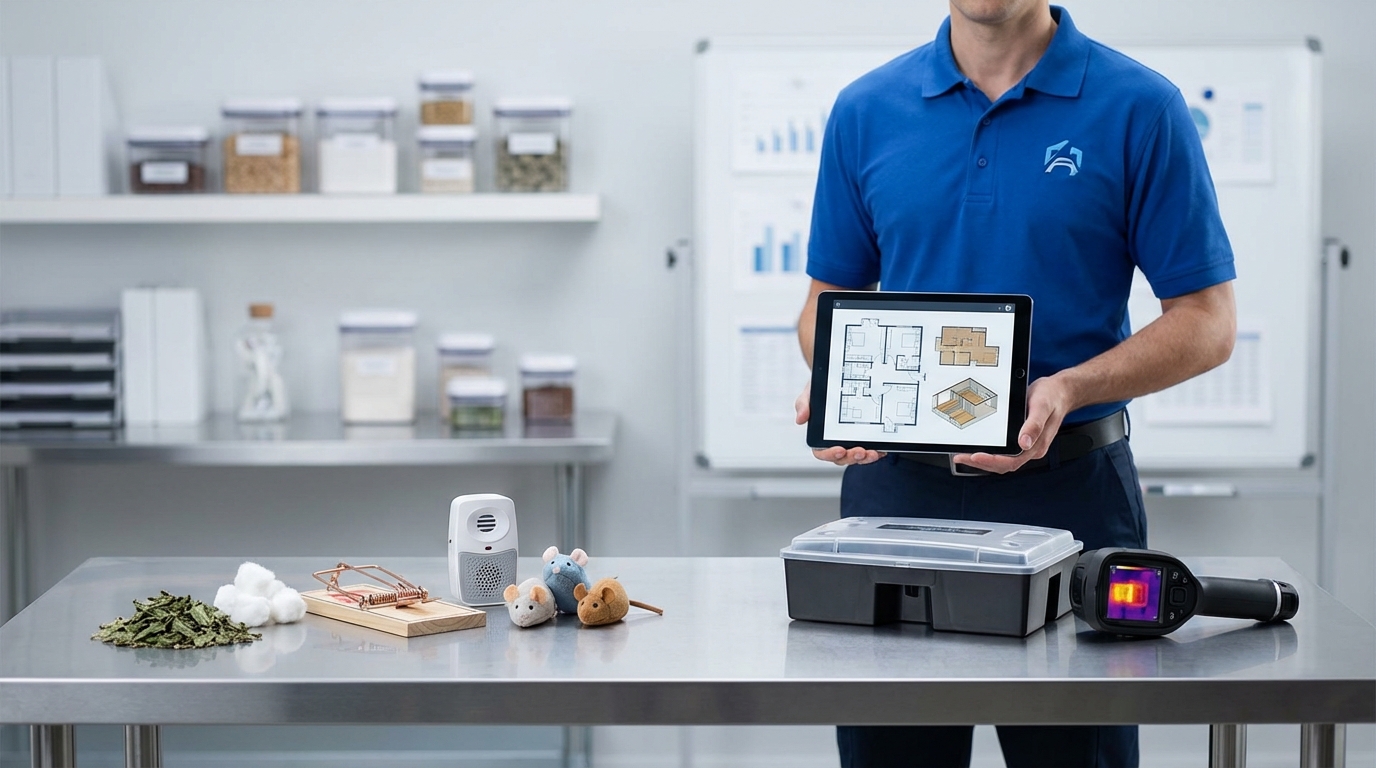
Let's take the «natural solutions» one by one.
Peppermint. It's the star of the «mice in the house, 9 tips to get rid of them» articles. The idea: mice hate the smell. In fact, a study published in the Journal of Pest Management Science shows that essential oils, including mint, have only a temporary and very localized repellent effect. Mice get used to them within a few days. They go around the area, that's all. If you have a mouse in the walls, it's not going to move because it smells of mint in the living room.
White vinegar. Same logic. White vinegar has many household virtues, but permanently repelling rodents isn't one of them. The smell dissipates in a few hours, and the mice come back. There is no serious scientific data to support this method as a means of rodent control.
Baking soda. This is one we're seeing more and more. The supposed principle: the mouse ingests the baking soda, can't get rid of the gas produced, and dies. On paper, it sounds logical. In practice, mice are neophobic animals, which means they're suspicious of any new food. They taste tiny quantities, wait, and if they feel the slightest discomfort, they won't touch it again. Baking soda mixed with flour? They probably won't even consume enough of it to have any effect.
So what do mice hate most? Honestly, what they hate most is not having access to food and warm shelter. As long as your home offers both, there's no smell that will make them leave on their own. Mice don't leave on their own once they've found a good spot. This is a behavioral fact documented by the National Pest Management Association (NPMA).
Let's move on to mouse traps, the good old mousetrap. Here, we're on to something more concrete. The mousetrap works, mechanically speaking. It kills any mouse that wanders into it. The problem isn't the tool, it's the scale. If you have two or three exploratory mice, a few well-placed faggots with suitable bait (peanut butter, not cheese, contrary to myth) may suffice. But when faced with an established colony, you're bound to catch a few while the others are quietly reproducing behind your partitions.
Where do mice hide during the day? In walls, under floors, behind household appliances, in false ceilings and service ducts. Places where your traps will never go. That's precisely what makes amateur trapping so limited: you're only dealing with the visible part of the problem.
Glue traps, on the other hand, pose an obvious ethical problem (mice agonize for hours) and are banned or regulated in several European countries. They are no more effective than faggots in managing a real infestation.
The verdict on natural methods and conventional traps is quite simple: they can work for prevention, or for an isolated, curious mouse. For an established infestation, however, it's not enough. You're wasting time, and in the meantime, the colony is growing.
Chemicals and ultrasound: Selection criteria and real-life limits
When essential oils and mouse swatters have failed, the next step for many people is rat poison or the ultrasonic box purchased from a supermarket. We're going up a notch in terms of means. But are we going up in effectiveness?
Rodenticides: effective but dangerous, and not so simple.
There is such a thing as an effective rat poison. Second-generation anticoagulants (bromadialone, brodifacoum) are the most widely used by professionals. They cause internal hemorrhaging within a few days. The mouse consumes them, returns to its nest and dies. The problem is that these products are extremely toxic. And not just for mice.
France's Anses (Agence nationale de sécurité sanitaire) has published several reports warning of the risks of anticoagulant rodenticides for children, pets and wildlife. A cat that eats a poisoned mouse can itself be poisoned. This is what we call secondary poisoning, and it's a real problem for domestic safety. In France, poison control centers record hundreds of cases of accidental poisoning linked to domestic rat poison every year.
There's also the question of placement. Bait must be placed in secure baiting stations, in the right places, in the right quantities. Too little, and the mice won't eat enough. Too much, and you create a health hazard. Without training, it's a balancing act. And since 2018, European regulations have restricted public access to the most powerful rodenticides. This is no coincidence.
Ultrasonic devices: the wrong idea.
The concept is attractive. You plug in a box, it emits high-frequency sounds inaudible to humans, and the mice run away. Clean, chemical-free, trap-free. Except that scientific research is categorical on the subject.
A meta-analysis published in the Journal of Wildlife Management reviewed several decades of studies on ultrasonic repellents. The conclusion: no significant, lasting effect on rodent behavior. Mice may be disturbed for the first few hours, sometimes for the first few days. Then they get used to it. Some don't react at all. The Federal Trade Commission (FTC) in the USA has sanctioned several manufacturers for misleading advertising of this type of product.
Is it bad to have mice in the house? Yes, and that's why false solutions are a real problem. Mice contaminate surfaces with their urine and droppings. They can transmit leptospirosis, salmonellosis and hantavirus. They gnaw through electrical cables (a documented cause of domestic fires), damage insulation and soil food supplies. Every week lost with an ineffective ultrasonic device means another week of damage and increased health risks.
If you insist on using a rat poison, do so in a secure environment: bait stations must be locked, out of reach of children and animals, and checked regularly. But keep in mind that without sealing entry points and understanding the dynamics of the infestation, you're only managing the symptoms. Mice that die will be replaced by others if conditions remain favorable.
Basically, the problem with self-service solutions, whether chemical or electronic, is that they treat the rodent as a one-off problem. But a mouse infestation is a system: entry points, food sources, nesting areas, regular routes. Eliminating a few individuals without tackling the system is like emptying a bathtub with a spoon while the tap is running.
Why Pest Patrol is the only sustainable solution
Three weeks. That's the average time our customers spent trying out home-made solutions before calling us. Three weeks of peppermint, faggots, sometimes store-bought rat poison. And by the time we arrive, the infestation has often doubled.
The difference between a professional exterminator and an individual armed with traps isn't just access to more powerful products. It's the method. At Pest Patrol, every intervention begins with a complete infestation diagnosis. We don't set traps at random. The entire building is inspected: attics, crawl spaces, service shafts, potential points of entry (a mouse fits through a hole 6 mm in diameter, the size of a pen). We identify the routes taken thanks to grease marks, footprints and poop accumulations. Estimate colony size.
This diagnosis is the basis of everything. Without it, you're shooting blind.
Then comes the rodent eradication plan, adapted to each situation. This may involve a combination of techniques: professional trapping targeted at identified areas of passage, reasoned use of rodenticides in secure stations (with strict monitoring to limit the risk of secondary poisoning), and above all, sealing off entry points. This last step is the most important and the most neglected by homeowners. You can kill all the mice in your house: if the entry points aren't blocked, more will come. It's a mechanical process.
A study by British Pest Control Association (BPCA) shows that professional interventions including physical exclusion (plugging accesses) have a success rate of over 95% over 12 months. DIY solutions without exclusion? Less than 30% long-term success. The gap is enormous.
Pest Patrol also works on prevention. We tell you exactly what attracts mice to your home: unsuitable food storage, accessible garbage cans, vegetation too close to the walls, structural defects in the building. We don't just get rid of the mice in your home, we make sure they don't come back.
The question of cost often comes up. «A professional is expensive. Let's compare. The average homeowner spends between 50 and 150 euros on traps, repellents, ultrasound and rat poison before deciding to call in a professional. With no lasting results. Add to this the material damage caused during the weeks of untreated infestation: gnawed cables, destroyed insulation, food contamination. The real cost of »doing it myself« often exceeds that of professional intervention from the outset.
We work all over Belgium, with trained and certified technicians. Every intervention is documented, every follow-up planned. We don't set a trap and disappear. We come back to check, adjust if necessary, and make sure the eradication is complete. It's this follow-up that makes the difference between a temporary solution and a permanent one.
Rodent control, when done properly, is a methodical, scientific process, adapted to each individual situation. It's not a miracle recipe found on the Internet.
Conclusion
To summarize. Natural methods (peppermint, white vinegar, baking soda) have no proven effect on an established infestation. Conventional traps work on a small scale, but are insufficient to deal with a colony. Rodenticides are effective but dangerous without expertise, and ultrasonic devices simply don't work.
If you've got mice in your home and homemade solutions haven't worked, that's okay. You haven't failed, you've just used the wrong tools for a problem that's beyond the scope of DIY.
Contact Pest Patrol for a free diagnosis. We'll assess the situation, propose a concrete plan of action and solve the problem. For good.
Frequently asked questions
Is it serious to have mice in the house?
Yes, mice carry diseases, contaminate food and damage cables and insulation.
What do mice hate most?
Lack of access to food and shelter.
Where do mice hide during the day?
Mice are nocturnal rodents and generally sleep or hide during the day in their burrows, which they build underground or between walls and ceilings. But if food is scarce, they also come out during the day.
Can a mouse go off on its own?
Yes, it is possible for a mouse to leave your home alone, but this depends on a number of factors. Mice are curious animals and can explore new environments in search of food and shelter.
 Français de Belgique
  English
  Nederlands (België)