
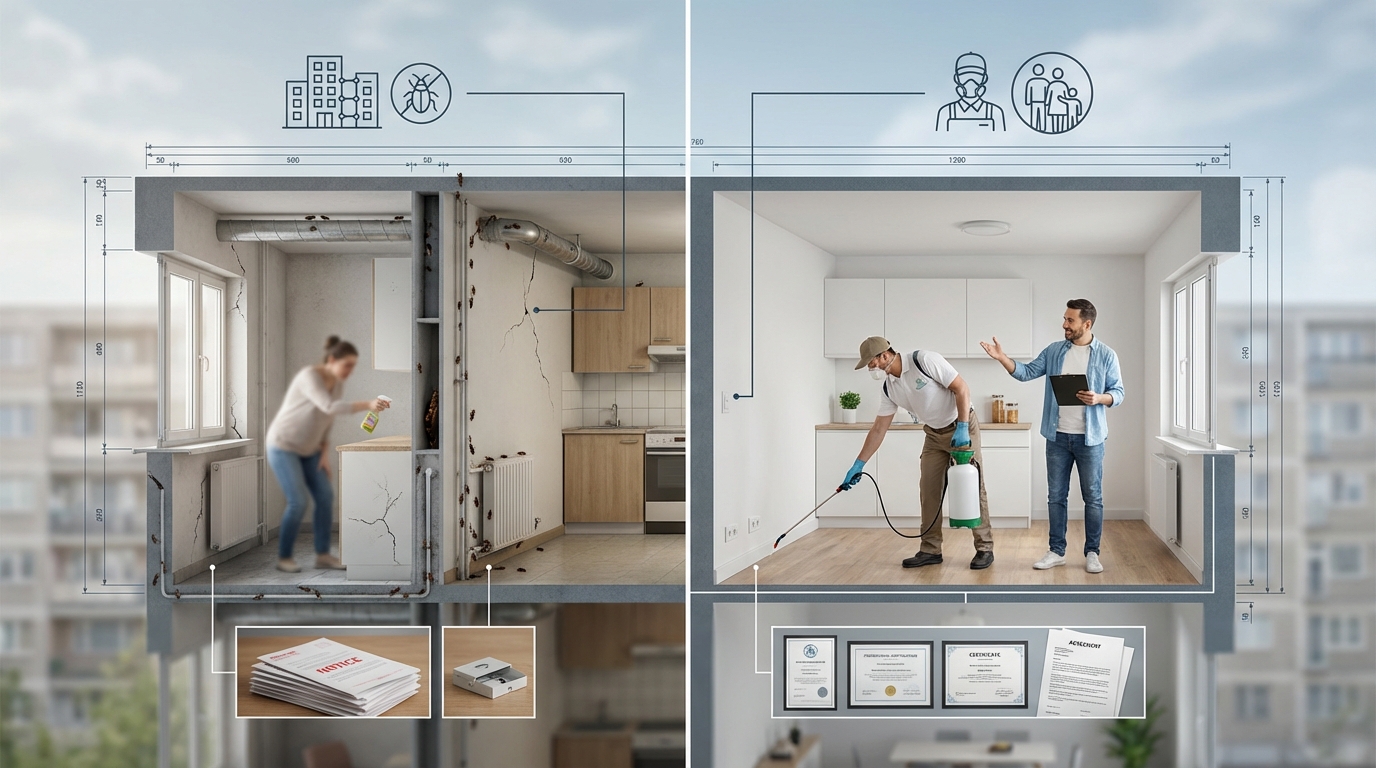
Why do cockroaches invade social housing?
Contents
-
Cockroach propagation: Multi-family housing vs. single-family homes
-
Treatment by the social landlord vs DIY solution: Advantages and limitations
-
Choosing a pest control company: Criteria for social housing
You turned on the kitchen light at 2 a.m. and there they were, on the worktop, scurrying away to hide behind the fridge. It's no coincidence that you're living in social housing. Cockroaches in social housing are a structural problem, not a personal hygiene one. And this distinction changes everything: it changes your rights, your recourse, and the way you go about getting rid of them.
Things to remember
-
Explain the systemic dynamics of infestation in social environments (thermal bridges, communal ducts), while comparing legal remedies and the effectiveness of pro vs. domestic treatments to empower tenants.
-
Multi-family vs. single-family housing
-
Advantages and limitations
-
Criteria for social housing
Cockroach infestation in low-income housing follows a precise logic. Cockroaches don't just fall from the sky. They circulate, they reproduce, they exploit every loophole in the building. A block of apartments, with dozens of apartments connected by ducts, conduits and garbage chutes, is a perfect playground for them. Understanding this dynamic is the first step to regaining control.
In this article, we'll take a look at why it spreads so quickly in collective housing, what your landlord should do (and often doesn't), and how to choose a professional who will really do the job. No false promises, no white vinegar miracle recipes: just facts, rights and practical solutions.
Cockroach propagation: Multi-family housing vs. single-family homes
A cockroach in a single-family home is often an isolated incident. A box brought home from the supermarket, an overnight bag put in the wrong place. It's treated and dealt with. In apartment buildings, the problem is quite different. The spread of insects in a building follows invisible paths that no-one suspects at first.
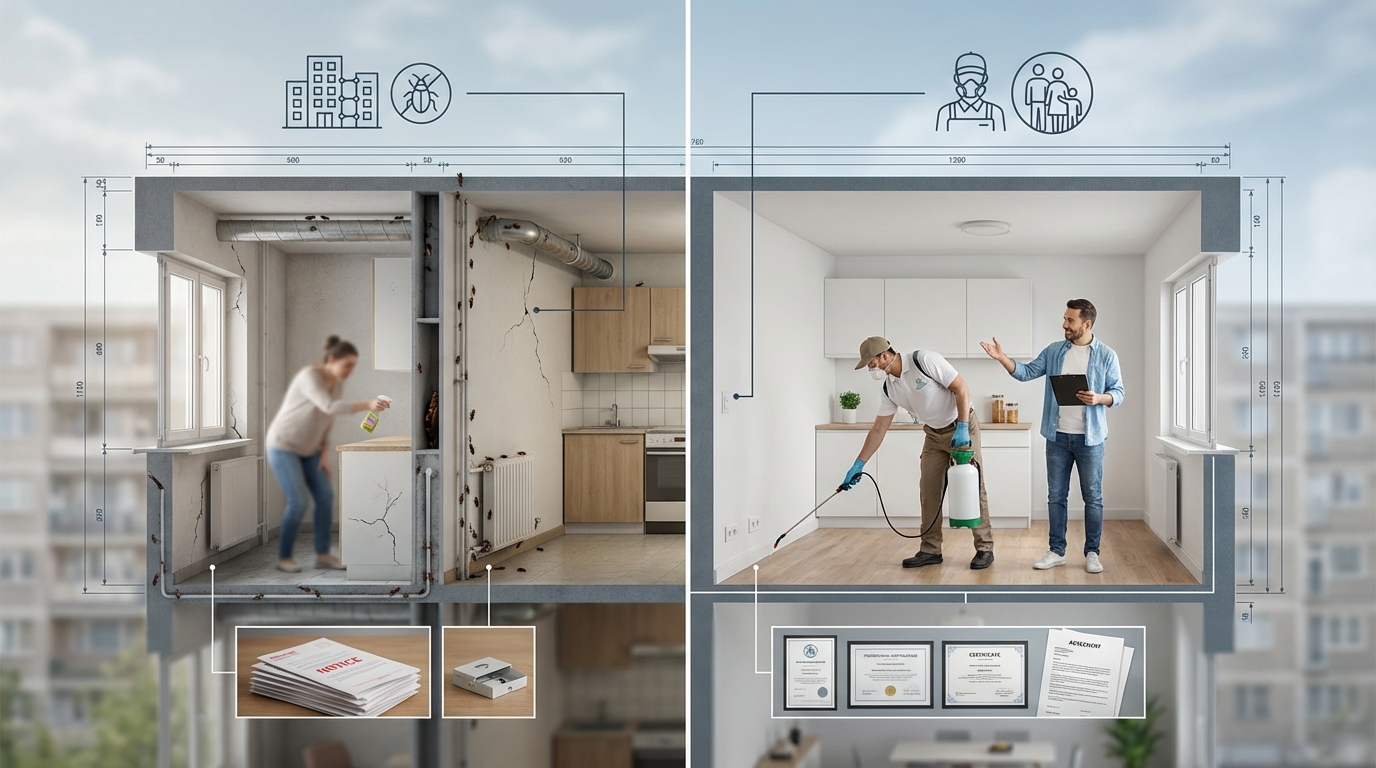
Technical ducts are the cockroaches' highway network. Every low-income building has vertical columns running through every floor: electrical ducts, water pipes, ventilation ducts, garbage chutes. These passages link each apartment to the others. And they offer cockroaches exactly what they're looking for: darkness, warmth and humidity. A cockroach nest on the third floor can colonize the fifth in a matter of weeks, simply by climbing up a ventilation shaft.
Why are there so many cockroaches in a building? Because the very structure of the building protects them. Thermal bridges, where insulation fails, create pockets of condensation in the walls. Moisture accumulates. Cockroaches love it. In many social housing units built in the 60s and 70s, insulation in these areas has never been seriously upgraded. As a result, walls sweat, and cockroaches thrive.
Group housing also poses a coordination problem. In a single-family home, you treat the problem at home and that's the end of it. In low-income housing, you can spend 200 euros on products, cleaning from top to bottom, sealing every crack: if your downstairs neighbor does nothing, the cockroaches will come back. It's mathematical. A female German cockroach lays an egg capsule containing 30 to 40 eggs, and can produce several in her lifetime. In three months, a pair of cockroaches can generate hundreds of offspring. When the infestation is established in several apartments, treating a single dwelling is like bailing out a boat without plugging the waterway.
Where are cockroach nests to be found in a building? Behind built-in hobs, under sinks, in service ducts, around hot-water pipes, in electrical boxes, behind loose baseboards. Wherever it's warm, dark and a little damp. Garbage rooms and garbage chutes are classic breeding grounds. In some buildings, cellars also serve as permanent reservoirs. The hygiene of social housing as a whole, including common areas, plays a decisive role.
The fundamental difference between individual and collective housing is this: in individual housing, the problem is local. In collective housing, it's systemic. And a systemic problem requires a systemic response. It's not a case of one tenant fighting alone with a can of insecticide.
Treatment by the social landlord vs DIY solution: Advantages and limitations
The first thing you need to know, and many tenants are unaware of this, is that the landlord's obligation in terms of pests is enshrined in law. Regional housing codes require landlords to provide decent accommodation, free from any pest infestation. Your social landlord must act. It's not a favor, it's a legal obligation.
What does this mean in practice? If you report cockroaches in your social housing unit, the landlord must mandate a collective treatment. Not just in your home: in the common areas, in the shafts, and ideally in all the affected units in the building. Collective treatment is the only approach that works in a building over the long term. Treating an apartment without treating the common areas is like putting a band-aid on an open fracture.
But let's be honest: there's often a gulf between legal obligation and reality. Many social landlords are slow to react, sending out a technician for a one-off inspection, or simply spraying a product in the entrance hall. But that's not enough. If your landlord doesn't react within a reasonable time (allow two to four weeks after written notification), you can take your case to the justice of the peace if necessary. Always keep a written record: registered letter, dated photos, testimonials from neighbors.
And DIY solutions in the meantime? Anti-cockroach gel sold in syringes (based on fipronil or imidaclopride) is the most effective over-the-counter product. The effectiveness of this treatment is real: the cockroaches eat the gel, return to the nest, die, and the others consume the contaminated corpses. A domino effect. It's much smarter than an aerosol can, which simply disperses the colony in the walls without killing it.
A few rules if you opt for gel: apply micro-droplets (the size of a pinhead) every 20 centimetres along identified passages. Under the sink, behind the stove, along kitchen and bathroom baseboards and around pipes. Don't clean the gel until it's dry. Above all, never combine gel with insecticide spray: the spray repels cockroaches and keeps them away from the gel. You cancel out the effect of one with the other.
The limits of DIY are clear: you can't treat service ducts, communal areas, garbage rooms or neighboring apartments. You treat your perimeter, period. For an infestation in the building, this will slow down colonization at home, but it won't get to the root of the problem. Cockroach gel is a management tool, not a definitive solution when the infestation is collective.
The landlord's obligation to deal with pests is not limited to curative treatment. He must also seal up the passageways: plug holes around pipes, repair faulty joints, maintain garbage chutes. If this work isn't done, the cockroaches will come back after each treatment. This is a point you need to stress in your letters to the landlord.
Choosing a pest control company: Criteria for social housing
Not all pest control companies are created equal. Far from it. And when it comes to social housing with dozens of units, extensive common areas and complex technical ducts, the choice of service provider makes all the difference between a problem solved and one that returns three months later.
First non-negotiable criterion: biocide registration. Since 2015, any company using biocidal products on a professional basis must be registered with the restricted biocide circuit. This is proof that technicians have been trained in product handling, dosage and health risks. An unregistered pest control expert is like an unregistered electrician: you're taking a risk. Ask for the registration number. If he hesitates, walk away.
Second point: specific experience in pest control in common areas and apartment buildings. Treating an 80 m² bungalow is not the same as treating a 60-unit building. A serious professional will start with a complete diagnosis, including inspection of service ducts, garbage rooms, cellars and risers. He'll identify the species present (German cockroach, Oriental cockroach, both?), estimate the level of infestation and propose an appropriate protocol. Beware of anyone who gives a price over the phone without having seen the building.
Treatment protocol is the sinews of war. For a social building, a single pass is almost never enough. A good supplier will suggest at least two passes, spaced 15 to 21 days apart, to allow the eggs still protected in the oothecae to hatch and the new generation to be eliminated in its turn. Three passes are even better for severe infestation. If you're promised a definitive result in a single pass, that's marketing, not insect control.
Communal areas must be disinsected systematically. Entrance halls, stairwells, garbage rooms, technical rooms, cellars, underground parking lots: everything must be treated at the same time as the apartments. This is where the role of the landlord is central, because only the landlord can organize access to the entire building and coordinate work in all units. A well-managed collective treatment is one where all apartments are treated at the same time, including common areas. Not a three-week schedule where cockroaches migrate from a treated floor to a floor not yet treated.
Look also at the products used. A serious pest expert will prefer professional insecticide gel (more concentrated dosages than consumer versions) combined with diatomaceous earth powder in electrical ducts and boxes. Spraying may be useful in some cases, but it should not be the only method. Ask about the products to be used, their safety data sheets, and the precautions to be taken for children and pets. A professional who is transparent about these matters inspires confidence.
Last but not least: a guarantee of results. A company that commits to post-treatment follow-up, with free check-ups in the event of reappearance, is a company that believes in its work. You've already heard of those who disappear after cashing the cheque. Insist on a written contract specifying the number of passes, the areas treated, the products used and the warranty conditions. This is your best protection, whether you're a tenant holding your landlord to account, or a landlord looking for a reliable service provider.
Conclusion
Cockroaches in social buildings are not inevitable. It's a technical problem, with identifiable causes and solutions that work, provided you act at the right level. A single tenant with a can of insecticide will never solve a building infestation. Treatment must be collective, coordinated by the landlord, and carried out by certified professionals.
If you find yourself in this situation, start by notifying your landlord in writing. Include a registered letter, photos and dates. Talk to your neighbors, because there's a good chance they're experiencing the same thing. At the same time, use cockroach gel at home to limit the population in your apartment. And if the landlord doesn't budge, don't hesitate to take the matter to the appropriate authorities: you're within your rights, and the law is on your side.
Cockroaches in social housing are a collective battle. And it's a fight that can be won.
Frequently asked questions
Why are there so many cockroaches in my social building?
Infestation in multi-family housing is often structural. Cockroaches use technical ducts (ventilation, electrical columns, garbage chutes) as highways to circulate between apartments. Older buildings also feature thermal bridges and dampness behind partitions, creating an ideal environment for their rapid reproduction.
Who pays for insect control in social housing?
This is a legal obligation for landlords. The law requires the landlord to provide decent, pest-free accommodation. The social landlord must cover the cost of treatment in common areas, and coordinate the intervention in all affected apartments. If the infestation affects the whole building, the tenant does not have to pay alone.
What should I do if my social landlord refuses to take action against cockroaches?
Written notice: Send a formal notice by registered mail with acknowledgement of receipt.
Evidence: Attach photos of the insects and, if possible, testimonials from neighbors.
Recourse: If no action is taken within 2 to 4 weeks, you can contact your local sanitation department or refer the matter to the Justice of the Peace (or competent court) to force the work to be carried out.
How do you carry out effective insect control in social housing?
A serious intervention requires at least two passes spaced 15 to 21 days apart to eliminate eggs that hatch after the first treatment. The professional must treat :
Infested apartments.
Service ducts and risers.
Garbage rooms, cellars and common areas.
 Français de Belgique
  English
  Nederlands (België)