
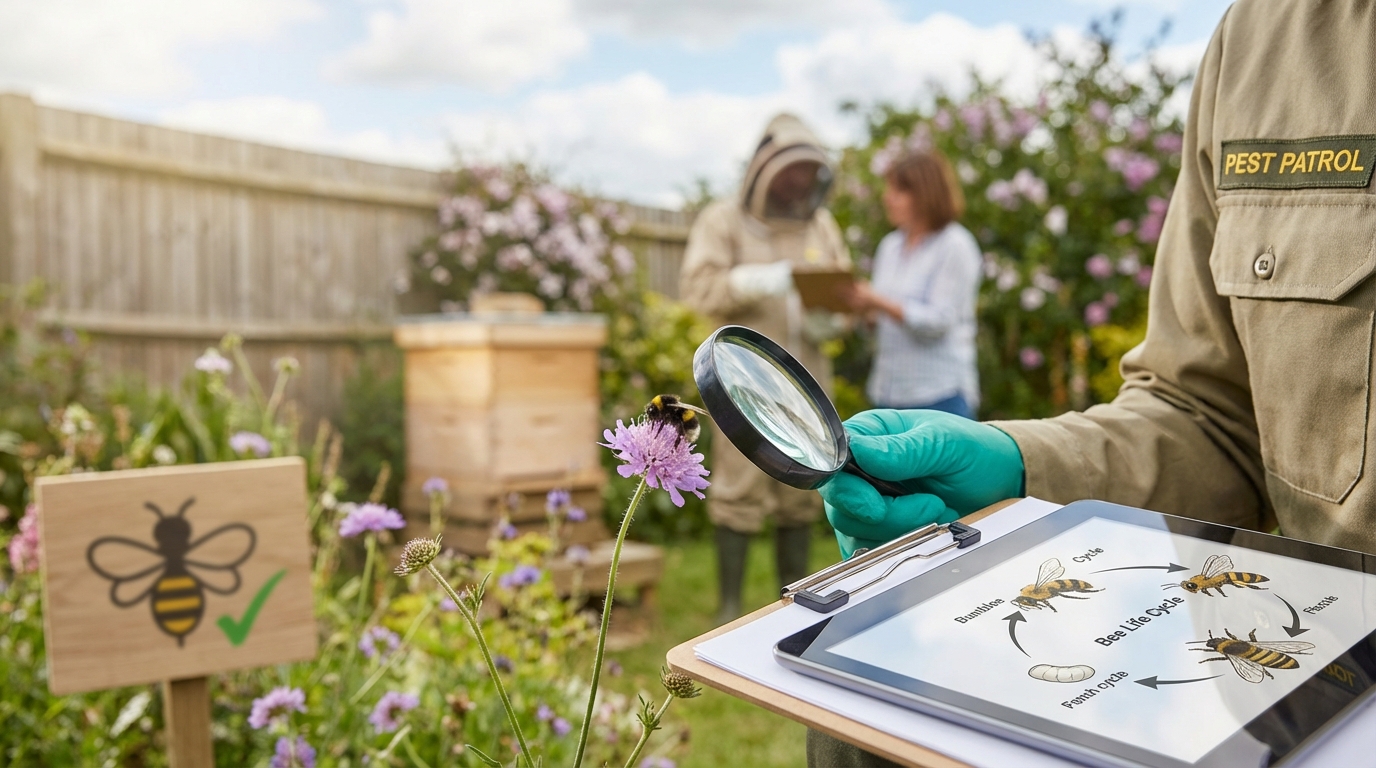
Bumblebee season 2026: Understanding their cycle and the rules of cohabitation
Contents
-
Queen awakening: understanding the bumblebee life cycle for the 2026 season
-
Pest Patrol service requests: why do bumblebees move into your home?
-
Regulations and protection: why not destroy a bumblebee nest?
A word of clarification before going any further: if you've arrived here looking for news of Didier Bourdon and a possible season 3 of Le Daron, or Anthony Bourdon's Supercross calendar, this isn't quite the right place. Here at Pest Patrol, we're talking about another bumblebee. The one that's been flying, foraging and causing a wave of calls to our customers since the early spring of 2026. A bumblebee. The pollinating insect.
And this is a very special season. Spring emergence was early, February's mild temperatures accelerated the queens' awakening, and nests are appearing earlier than usual in gardens, garden sheds and under terraces. As a result, many owners are contacting us, sometimes a little panicked, to find out what to do. Should we intervene? Is it legal to destroy a bumblebee nest? What is the legal framework?
Things to remember
-
Pest Patrol takes stock of the insect
-
We analyze the early emergence of the 2026 season, the biological cycle of pollinators and the legal rules that govern our interventions to protect biodiversity.
-
Understanding the bumblebee's life cycle for the 2026 season
-
Why do bumblebees move into your home?
Let's break it all down together. The life cycle of the bumblebee, the reasons why it settles in your home, and above all the rules governing cohabitation with this wild fauna. Because spoiler: you're not allowed to do just anything.
Queen awakening: understanding the bumblebee life cycle for the 2026 season
Every year, it's the same scenario. As soon as temperatures regularly rise above 6-8°C, queen bumblebees emerge from hibernation. They have spent the winter buried in the ground, sometimes just a few centimetres below the surface, in a state of diapause. With their bodies slowed to a crawl, the fat reserves accumulated in autumn enable them to go several months without eating.
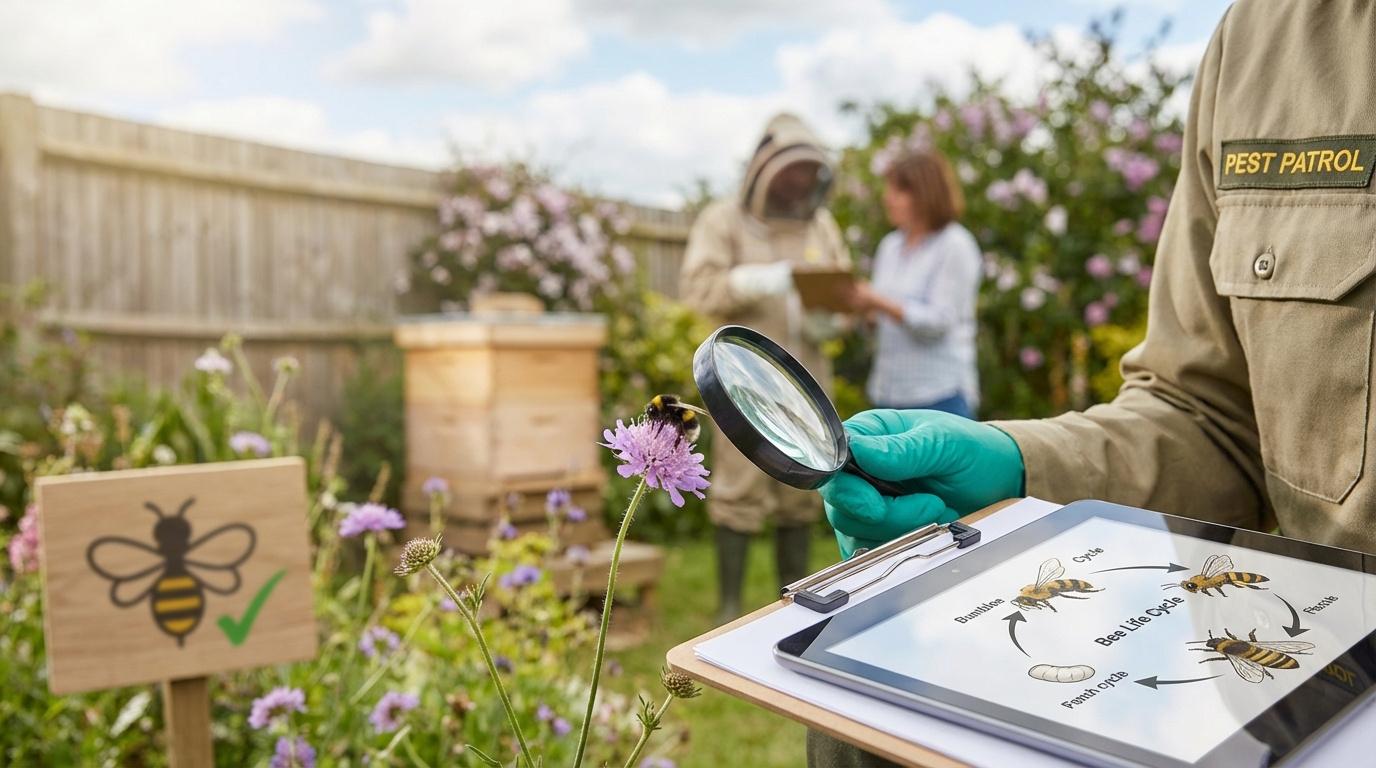
The bumblebee's biological cycle really begins at this precise moment. The queen bumblebee emerges, hungry, and her first mission is to find nectar. The first flowers - crocuses, dandelions, willows - are vital to her. Without this resource, no colony. No offspring. Nothing.
What's striking about this year's phenomenon is its earliness. Entomologist colleagues observed active queens as early as mid-February in southern France, and early March in the Paris Basin. A study published in Global Change Biology (Kerr et al., 2015) had already documented the link between global warming and changes in bumblebee spring emergence periods. We're right in the middle of it.
Once fed, the queen looks for a nesting site. This is a critical moment. She explores the ground, cavities, old rodent nests and piles of dead leaves. She tests and hesitates, sometimes returning to the same spot several days in a row before making up her mind. When the site suits her, she builds a small wax cell, lays her first eggs and starts incubating them. Literally: she sits on them to warm them up, vibrating her thoracic muscles to produce heat. Fascinating stuff.
The first workers are born around three to four weeks later. They are small, often smaller than the queen, and immediately take over the task of collecting food. The queen now devotes herself exclusively to laying eggs. The colony grows rapidly: 50, 100, sometimes 200 individuals, depending on the species. The Bombus terrestris, the terrestrial bumblebee most commonly found in France, can reach colonies of 300 to 400 workers under the right conditions.
Towards the end of summer, the colony produces males and new queens. The males leave the nest, never to return, and their only role is to mate. The young, fertilized queens seek shelter for the winter. And then the colony dies. The whole colony. The old queen, the workers, the males: everyone disappears in autumn. Only the new queens survive, buried in the ground, ready to start the cycle all over again the following year.
This is an annual cycle, unlike that of honeybees, which maintain their colony from one year to the next. This distinction is important because it means something very concrete: a bumblebee nest is temporary. It will be empty within a few months. We'll come back to that.
Pest Patrol service requests: why do bumblebees move into your home?
Since March, our teams have received an average of 40 % more calls about bumblebee nests than at the same time last year. People find a bumblebee nest under their wooden deck, in a roller shutter box, in an old birdhouse, sometimes even in an upturned flowerpot. And the reaction is often the same: «That's got to go.»
The concern is understandable. Seeing dozens of buzzing insects buzzing in and out of a hole 50 centimetres from where your children are playing is not easy. Bumblebee behavior can seem threatening when you're not familiar with them. This big, hairy insect flies heavily, circling around you, sometimes very closely.
Except that the bumblebee is probably the least aggressive insect you'll come across in your garden. A study by the University of Exeter (Sheridan et al., 2019) showed that bumblebees only sting in extreme situations: when you crush them, violently shake their nest, or block the entrance to the colony. Other than that, they ignore you. Completely.
So why exactly are they moving into your home? There are several reasons. Firstly, your garden offers them what they're looking for: loose soil or cavities to nest in, and flowers nearby to feed on. A slightly «wild» garden with unmown areas, compost and woodpiles is paradise for a queen in search of a nesting site. Highly manicured gardens, mowed low and without nooks and crannies, are much less attractive to bumblebees.
Urbanization also plays a role. Bumblebees' natural habitats - meadows, forest edges, grassy slopes - are disappearing. Bumblebees adapt and colonize peri-urban areas. Your garden shed replaces the field mouse burrow. Your lavender hedge replaces the flower meadow. It's a transfer of habitat, documented by the SPIPOLL participatory science program of the Muséum national d'Histoire naturelle.
At Pest Patrol, when a customer calls us to deal with a bumblebee nest, our first instinct isn't to send out a technician with an insecticide spray. We start by asking questions. Where exactly is the nest? Is anyone in the household allergic to hymenoptera stings? Does the nest really get in the way of daily passage? In 80 % of cases, we recommend doing nothing. Let the colony live out its season, which naturally ends between August and October.
When the nest is really problematic, located in a load-bearing wall, in a child's bedroom or inside a ventilation duct, relocation can be considered. Not destruction. Relocation, carried out in the evening when the whole colony has returned, to a suitable site. It's tricky, requires equipment and experience, but it can be done. And it's the only approach Pest Patrol advocates for this type of situation.
Regulations and protection: why not destroy a bumblebee nest?
Here's something many people don't know: destroying a bumblebee nest is not legally trivial. In Belgium, nature protection is a regional competence, but the principle remains the same: bumblebees benefit from a strict protection status.
-
The legal framework: In Wallonia and Brussels, species protection is governed by the Law on Nature Conservation. It formally prohibits the intentional disturbance, injury or destruction of the nests and habitats of protected species.
-
The critical situation: Several bumblebee species are on the Red List of wild bees in Belgium. The decline is marked: almost one bumblebee species in two is threatened or has already disappeared from our regions.
-
Concrete examples: Bombus distinguendus (Distinguished Bumblebee) is considered probably extinct in Belgium, while Bombus humilis (Field Bumblebee) and Bombus sylvarum (Wood Bumblebee) are receiving particular attention due to their severe rarity.
In concrete terms, even more common species such as the Bombus terrestris are indirectly protected by regional legislation and European regulations on pollinators. Deliberately destroying a nest without justification can expose you to penalties. We're not talking about symbolic fines: Visit Wallonia: Under the Walloon Environment Code (and the decree on nature conservation), «category 2» offenses (such as the destruction of protected species) can result in administrative fines of up to 100,000 euros and prison sentences.
Does this happen often? No. But the legal framework exists, and it's getting tougher. The regulatory trend is clear: pollinator protection has become a political priority at European level, particularly since the EU Pollinator Action Plan launched in 2018 and revised in 2023.
Beyond the law, there's a question of common sense. The ecological usefulness of bumblebees is massive. These pollinating insects are responsible for pollinating thousands of plant species, including many agricultural crops. Tomatoes, peppers, eggplants, blueberries: all these plants depend to a large extent on vibration pollination, a technique that only bumblebees have truly mastered. The honey bee doesn't know how. The bumblebee grabs the flower and vibrates its body at a precise frequency, releasing the pollen. It's an irreplaceable ecosystem service.
A meta-analysis published in Nature Communications (Garibaldi et al., 2013) estimated that wild pollinators, led by bumblebees, contribute 35 % of global food production. Thirty-five percent. When you destroy a bumblebee nest in your garden, you remove hundreds of pollinators that would have visited tens of thousands of flowers over the course of the season.
You have to learn to live with wildlife. And it starts with accepting that your garden is not a sterile space. It's part of an ecosystem. The bumblebees that settle there are not intruders: they're a sign that your environment is still alive, still capable of supporting biodiversity.
Our position at Pest Patrol is clear: we don't destroy bumblebee nests. Period. If a customer insists, we refuse the service and direct them to a local beekeeper or nature protection association who can help. This is not militancy, it's professionalism. A good pest management technician knows the difference between a pest and an auxiliary. Bumblebees are beneficials. And always.
Conclusion
The bumblebee season is in full swing, and all signs point to a long and active one. The queens are out early, the colonies are developing well, and the calls to Pest Patrol continue unabated. We respond to every one of them with the same message: observe, inform yourself, and in the vast majority of cases, let nature take its course.
If a bumblebee nest poses a real safety problem, a confirmed allergy or a location incompatible with your daily routine, contact us. We'll assess the situation and find a solution that respects both the regulations and these essential pollinators. No destruction, no chemicals. Just common sense and know-how.
Spotted a nest and don't know what to do? Call Pest Patrol or send us a photo via our online form. We'll get back to you within 24 hours.
Frequently asked questions
Is it allowed to destroy a bumblebee nest in Belgium?
No, destroying a nest is strictly forbidden by the Law on Nature Conservation in Wallonia and Brussels. Bumblebees are a protected species, and any infringement can result in administrative fines of up to 100,000 euros.
Why are there so many bumblebees in my garden in March 2026?
The spring of 2026 is marked by an early awakening of the queens from mid-February onwards, thanks to mild temperatures. Bumblebees settle in your home because they find ideal nesting sites (terraces, cavities, nesting boxes) and floral resources essential to their colony.
What to do if a bumblebee nest is badly placed or dangerous?
Bumblebees are not very aggressive; if the nest does not represent an immediate risk (severe allergy), it is advisable to leave it in place until autumn. In the event of a major problem, contact experts like Pest Patrol to consider ethical removal rather than illegal extermination.
How long does a bumblebee nest last?
Unlike bees, bumblebee colonies are temporary and annual. The nest will naturally be abandoned in late summer or early autumn, once the new queens have left to hibernate in the ground.
 Français de Belgique
  English
  Nederlands (België)