
Does light really attract mosquitoes?
Contents
-
Prices and offers: Comparison of the best mosquito repellent lamps
-
Buying guide: Steps to choosing efficient LED or UV technology
-
Where to get your solution and take action for a sting-free summer
You've probably seen it all before: a swarm of insects circling a lamppost in summer. And you've drawn the logical conclusion, the one everyone draws. Mosquitoes are attracted to light. Except that's not true. Well, not completely false, but reality is much more twisted than that, and understanding this nuance changes everything when you want to buy a trap that really works.
Things to remember
-
We deconstruct the myth of light attraction using entomology to guide users towards truly effective UV and LED technologies.
-
A unique combination of scientific rigor and a pragmatic buying guide to help you avoid the wrong traps.
-
Comparison of the best mosquito repellent lamps
-
Compare options and take action.
Mosquitoes don't work like moths. What guides them to you at night is primarily the CO2 you exhale, your body heat and certain molecules in your sweat. Light plays a role, yes, but not the one we think. Studies published in the Journal of Medical Entomology show that certain wavelengths effectively attract certain species of mosquito, while others leave them completely indifferent. This phenomenon has a name: phototaxis. And it's precisely by understanding phototaxis that we can choose an anti-mosquito lamp that isn't just a luminous gadget placed on the terrace.
The aim of this article is simple: to give you the scientific keys to stop being fooled by marketing, and then guide you towards an intelligent purchase. We're going to talk price, technology, light spectra and, above all, real efficiency. Because there's a gulf between a 15-euro lamp that roasts gnats and a UV trap coupled with CO2 that really targets mosquitoes.
Prices and offers: Comparison of the best mosquito repellent lamps
The first instinct when looking for a solution is to look at the price of an anti-mosquito lamp. That's normal. The problem is that the range goes from 12 euros to over 300 euros, and price alone says nothing about effectiveness. A 20-euro lamp with a basic UV tube will attract flying insects, yes. Mosquitoes? Very few. A study by the University of Notre Dame (Indiana) showed that conventional UV light electric traps caught an average of less than 5 % of mosquitoes among all the insects trapped. The rest were butterflies, beetles and flies. Insects that are often useful, by the way.
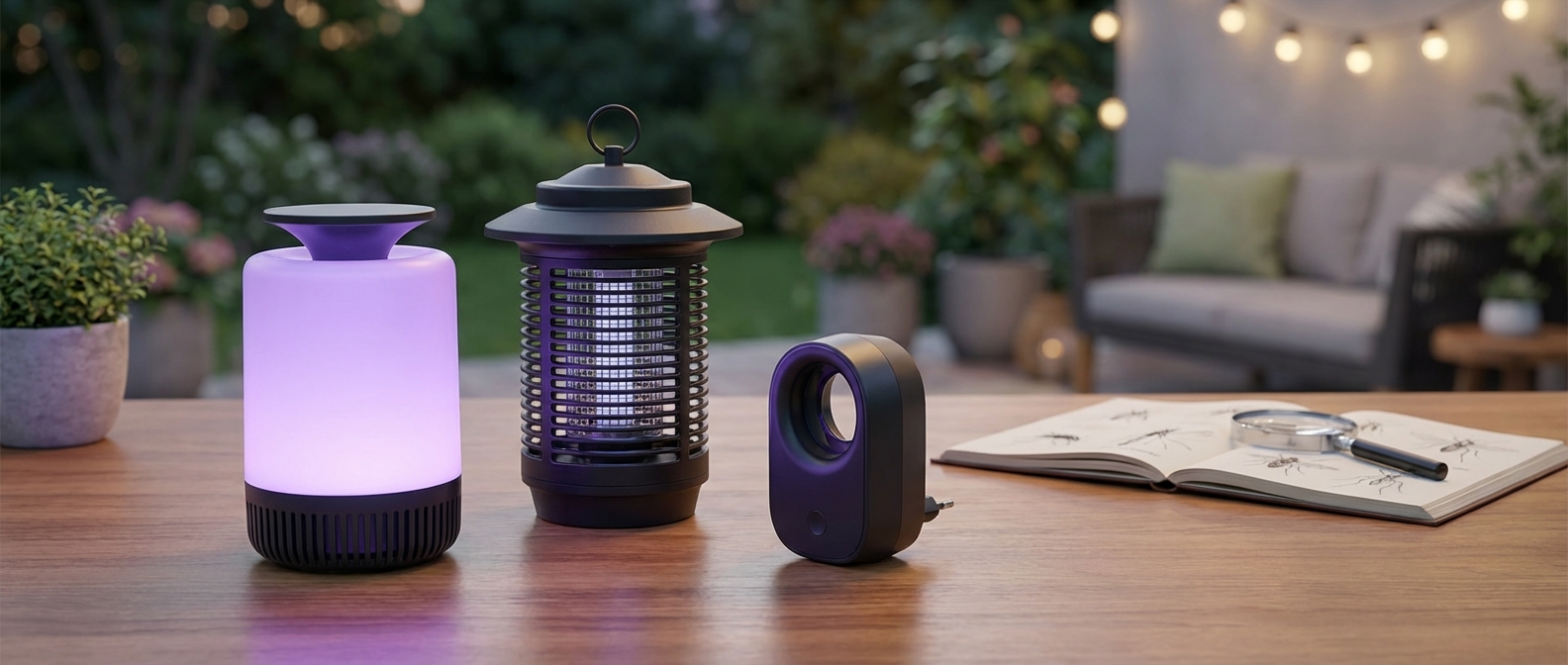
Here's what's on the market, with an honest look at the best value for money:
-
UV lamps with electrified grid (15 to 40 euros) : the most common. They emit ultraviolet light which attracts insects by phototaxis. The trouble is, mosquitoes don't respond very well. You'll hear «clicks» all night long, but they won't be mosquitoes. For indoor use against flies, it's defensible. Against mosquitoes, it's not enough.
-
UV traps combined with CO2 or octenol (80 to 200 euros): Now we're getting serious. These devices imitate human respiration by diffusing CO2, sometimes coupled with a chemical lure. UV light is used as a complementary attractant, not the main one. Studies show efficacy 3 to 5 times greater than simple UV screens. The price goes up, but the investment is justified if you live in a mosquito-dense area.
-
Spectrum-specific LED lamps (30 to 80 euros): Some brands offer LEDs calibrated to specific wavelengths (between 365 and 395 nm). This is more focused than a broad-spectrum UV tube. Effectiveness varies from model to model, but value for money is often attractive for outdoor home use.
-
Professional vacuum systems (150 to 350 euros): a fan draws in mosquitoes attracted by the light + CO2 combination. They dehydrate in a net. This is the most effective category, according to comparative tests published by the Journal of the American Mosquito Control Association. The price is high, but over a whole season, it's cheaper than buying repellent sprays every week.
When you look at offers on mosquitoes, beware of lamps sold as «blue light mosquito repellent» or «ultraviolet mosquito repellent» for less than 20 euros. There is such a thing as anti-mosquito blue light, but at that price you don't get the right spectrum or power. An effective UV mosquito trap starts at around 50 euros for well-calibrated LED models, and around 100 euros for CO2 combination models.
A final point often overlooked: the cost of consumables. CO2 traps require refills (cartridges or octenol) which cost between 5 and 15 euros a month. UV grid lamps require tube replacement every 12 to 18 months (10 to 20 euros). Factor this into your calculation before comparing gross prices.
Buying guide: Steps to choosing efficient LED or UV technology
82 % of mosquito lamp buyers say they're disappointed with their purchase, according to a UFC-Que Choisir survey from 2023. This figure doesn't surprise me at all. Most people buy a lamp thinking that «light attracts mosquitoes», period. But the relationship between mosquitoes and light is far more complex.
Let's go back to basics. Does a light on attract mosquitoes? Yes and no. Mosquitoes perceive certain wavelengths, notably in the ultraviolet and blue (between 350 and 420 nm). A conventional white light bulb emits a broad spectrum that attracts many insects, but mosquitoes are less sensitive to it than to other stimuli. On the other hand, a light spectrum centered on 365 nm, in the UV-A range, is measurably attractive to several species of mosquito.’Aedes and Culex, These are the genres that bite us the most in Belgium.
Here are the steps to follow so you don't make a mistake:
-
Identify your use. Indoors (bedroom, living room) or outdoors (terrace, garden)? Indoors, a UV spectrum LED lamp is often sufficient, as the space is confined and mosquitoes have few alternatives. Outdoors, you need a more powerful trap, ideally combined with CO2, because you're competing with all the other sources of attraction (you, your guests, the barbecue).
-
Check the light spectrum. This is the most important technical criterion, and the one that 90 % of buyers ignore. The effectiveness of an LED mosquito lamp depends directly on the wavelength emitted. Look for models that clearly state «365 nm» or «UV-A». If the product data sheet doesn't mention a specific wavelength, don't bother.
-
Evaluate the surface covered. Manufacturers often advertise optimistic coverage areas: «effective on 80 m²» for a 25-euro lamp is fantasy. In real-life conditions, with wind and competing CO2 sources, count on 15 to 20 m² for a UV lamp alone, and 40 to 60 m² for a combined trap.
-
Look at the capture mode. Electrified grille or fan extraction? Suction is quieter and more effective on mosquitoes, which are light insects. The grid works better on larger insects (flies, wasps). To target mosquitoes specifically, opt for suction.
-
Think of the noise. Some UV lamps with fans emit a constant hum of 35 to 45 dB. If you plan to use it in a bedroom, check the noise level. Newer LED models are often quieter than older fluorescent tubes.
What about yellow light? We often hear that the yellow spectrum repels mosquitoes. It's not exactly a repellent in the strict sense. Yellow or orange bulbs (above 550 nm) simply attract far fewer flying insects than white or bluish bulbs. If you want to light your terrace without turning your dinner into a mosquito buffet, replace your white bulbs with yellow ones. It's not a miracle solution, but it significantly reduces overall light attraction. A 2016 study in Insects confirmed that warm-tint LEDs (2700K and below) attracted 40 to 60 % fewer insects than cool white LEDs.
Does leaving the light on keep the mosquitoes away? No. Turning off the light won't scare them away either. What really repels them are repellents (DEET, icaridin, IR3535) or devices that disrupt their CO2 detection. Light, whether on or off, is only a secondary factor in their host-seeking behavior.
Where to get your solution and take action for a sting-free summer
Now you know that mosquitoes are attracted to light, but not just any light, and that light alone is not enough to trap them effectively. The practical question remains: where can you buy a high-performance mosquito trap without getting ripped off?
Three main channels, each with its own advantages:
-
Garden centers and DIY stores (Leroy Merlin, Castorama, Brico): you can see and touch the product, read the specs on the box, ask for advice. The offer is often limited to consumer models between 20 and 80 euros. For a basic UV trap or a specific spectrum LED lamp, that's enough. The advantage: if it doesn't work, you can return it to the store.
-
Specialized pest control websites: This is where you'll find combined UV + CO2 traps, top-of-the-range vacuum models, and above all detailed technical data sheets with wavelengths, CO2 flow rates and test results. Prices are often higher, but so is quality. Look for sites that quote their scientific sources and detail the light spectrum of their products.
-
Marketplaces (Amazon, Cdiscount): There's a huge choice, and prices are competitive, but the jungle of products makes it hard to sort through. My advice: filter by verified reviews (minimum 4 stars out of 100+ reviews), and above all read the negative reviews. If several buyers say «it catches everything but mosquitoes», believe them. It's a sign of a generic UV trap with no optimized spectrum.
A few brands that regularly appear in independent tests and entomologist recommendations: Biogents (BG-Mosquitaire model, the benchmark for scientific studies), Mosquito Magnet (propane + CO2 traps, very effective outdoors on large surfaces), and Aspectek or Moel for reasonably-priced indoor UV grilles.
Before placing an order, ask yourself three questions:
-
Is my problem really related to mosquitoes, or am I confusing it with gnats or crane flies? (This happens more often than you'd think).
-
Have I treated the sources of stagnant water around my home? No trap, however effective, can compensate for a blocked gutter or a flowerpot filled with water where hundreds of larvae are developing.
-
Am I ready to combine several approaches? The most effective solution is never a single device. It's a high-performance outdoor mosquito trap, window screens, a body repellent for evenings out, and the elimination of breeding grounds. Each layer reduces the number of bites.
If you're looking for a light-based mosquito repellent that really works, consider a UV trap coupled with a CO2 attractant, positioned away from your living area (to attract mosquitoes away from you, not towards you). Place it about 5 to 10 meters from your terrace, in a shady spot sheltered from the wind. Mosquitoes fly low, often less than a metre from the ground: position the trap accordingly, not high up on a wall.
One point no one ever mentions in buying guides: patience. A mosquito trap takes 2 to 4 weeks to significantly reduce the local population. It captures the females before they lay their eggs, thus breaking the breeding cycle. For the first few days, it won't seem to make any difference. Give it time to do its job. The results add up exponentially: fewer egg-laying females this week means hundreds fewer mosquitoes in three weeks' time.
Act now, before the season peaks. Mosquito populations explode between June and September in Belgium. Setting up your trap in May or early June means getting ahead of the breeding cycle. Waiting until July to set your trap means chasing the problem instead of preventing it.
Conclusion
Does light attract mosquitoes? Yes, certain wavelengths attract them, notably UV-A around 365 nm. But light alone is a weak attractant compared to CO2, body heat and the chemical compounds in our skin. Mosquito repellent lamps that rely solely on light capture mainly insects that don't bite you.
For a peaceful summer, choose a trap that combines an optimized light spectrum with a CO2 attractant, eliminate stagnant water, and use a body repellent for direct exposure. Don't throw 20 euros at a generic UV lamp and hope for a miracle. Invest in a solution that really targets mosquitoes, place it correctly, and give it time to work. Your summer evenings depend on it.
Frequently asked questions
Does light really attract mosquitoes?
Yes, but not just any light. Mosquitoes are sensitive to phototaxis, mainly attracted by UV-A wavelengths around 365 nm; conventional white light attracts them much less than CO2 or human heat.
What's the difference between a conventional UV lamp and a suction trap?
The UV grid lamp strikes all insects at random, often with no real effect on mosquitoes. The suction trap is more targeted: it often combines light with a fan or CO2 to specifically capture mosquitoes without electrocution noise.
What's the budget for an effective mosquito lamp?
For a truly calibrated LED or UV model, expect to pay between €30 and €80. For high-performance outdoor protection including a CO2 attractant, the investment is generally between €100 and €300.
Why doesn't my mosquito lamp seem to be working?
Effectiveness depends on placement: a lamp should be placed 5-10 meters from your living area and in the shade. If it's too close to you, the mosquito will always prefer your CO2 and body heat to the light from the device.
Does yellow light keep mosquitoes away?
Yellow light is not a repellent, but it is «invisible» to most mosquitoes. Replacing your outdoor bulbs with yellow LEDs (2700K or less) will illuminate your patio without attracting swarms of unwanted insects.
 Français de Belgique
  English
  Nederlands (België)