
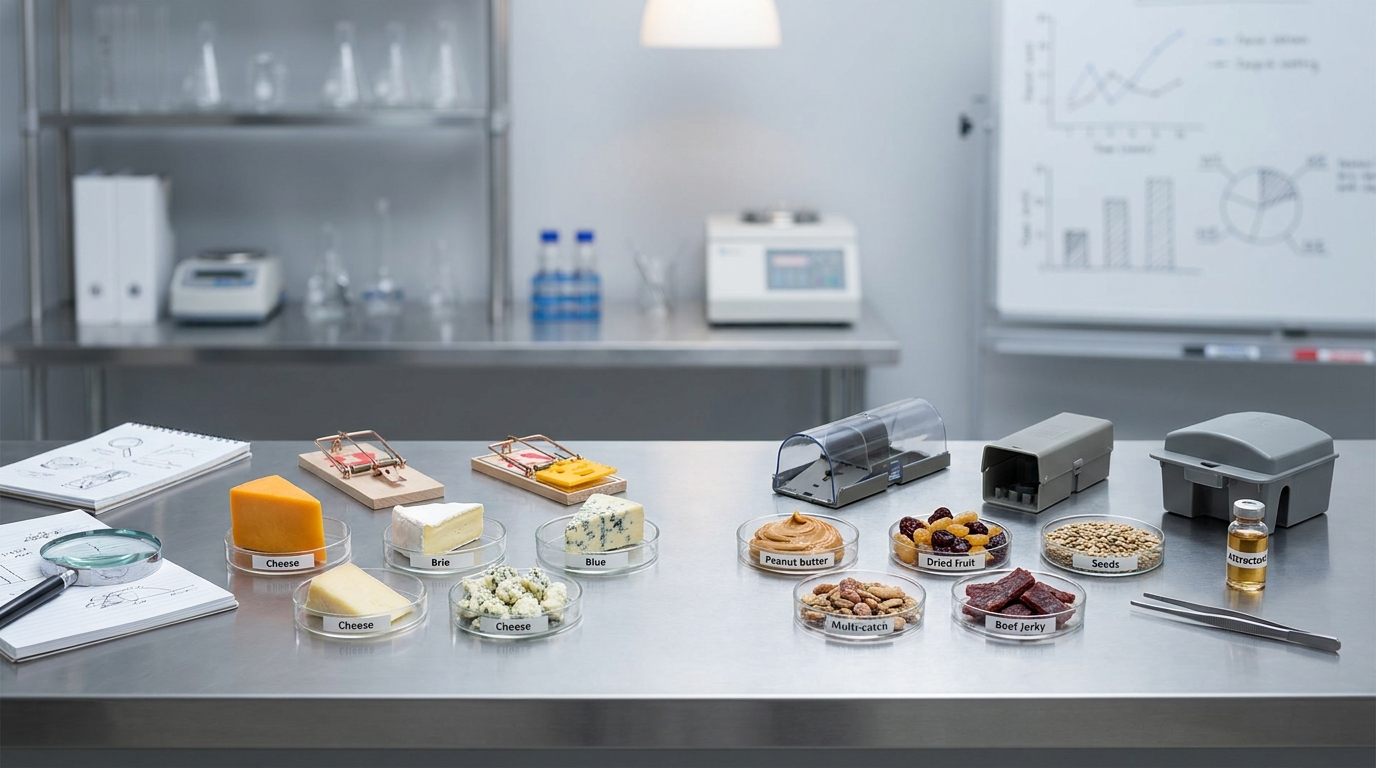
Cheese and mice: a guide to choosing the best bait
Contents
-
Advantages and disadvantages of different types of cheese for mice
-
Selection criteria and pre-purchase recommendations for effective baits
Tom and Jerry lied to us. For decades, we've seen this little rodent pounce on a piece of Gruyère cheese as if it were the Holy Grail. The result: as soon as a mouse appears in your home, your first instinct is to run to the fridge, cut off a piece of cheese and stick it on the trap. Except that doesn't work so well.
Things to remember
-
Deconstructing the myth of cheese as universal bait based on rodent biology
-
We compare the efficacy of different types of cheese against high-protein alternatives, while citing behavioral studies to optimize your catches.
-
Is cheese good bait? Myth versus reality
-
Advantages and disadvantages of different types of cheese for mice
The reality is that mice's behavior towards food is far more nuanced than cartoons would have us believe. Scientific studies, notably by Dr. David Holmes of the University of Manchester, have shown that rodents greatly prefer sweet, high-calorie foods to dairy products. So yes, a hungry mouse will eat cheese. It will also eat cardboard. It's not a criterion.
In this article, we'll sort out what really works and what's just folklore. We'll be talking cheese, of course, but also alternatives that far surpass the good old camembert when it comes to trapping a mouse effectively. With data, concrete comparisons and recommendations you can apply tonight.
Is cheese good bait? Myth versus reality
Where did the idea that mice love cheese come from? Probably from the Middle Ages. In those days, pantries contained mainly cereals, dried meat and cheese. Cereals were stored in closed containers, while meat was hung high. Cheese remained accessible on shelves. Mice nibbled what they could reach, not what they preferred. The cheese myth was born of an observational bias, nothing more.
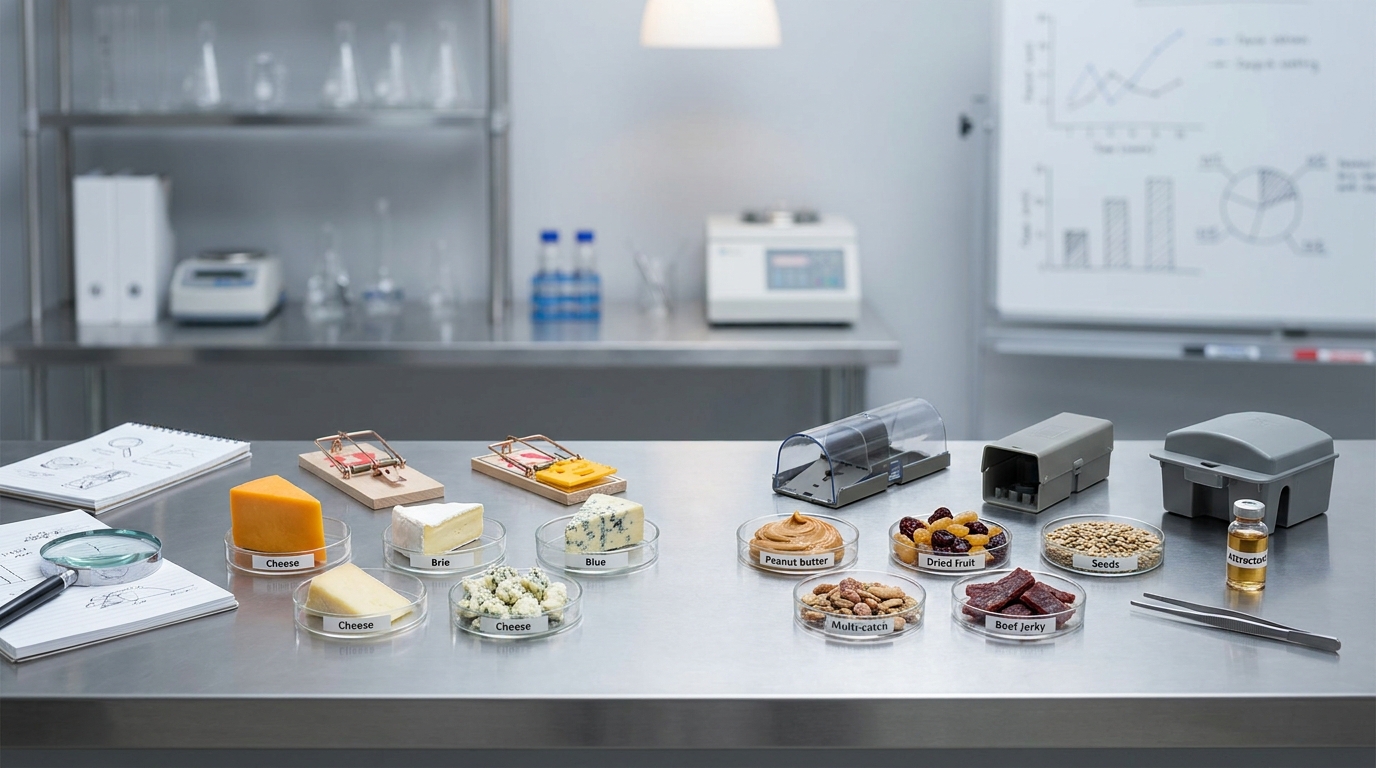
In 2006, Dr David Holmes, a specialist in animal behavior at Manchester Metropolitan University, conducted a series of tests on the food preferences of house mice. His conclusions were clear: mice are naturally attracted to foods with a high sugar and carbohydrate content. Fruits, cereals, peanut butter, chocolate. Cheese is a distant second.
Why is that? Because the olfactory system of rodents is highly developed. A mouse has around 1,200 olfactory receptor genes (compared with 400 in humans). They can detect a food source from several meters away. And what attracts them in the first place is a strong smell combined with a high caloric promise. A well-made piece of reblochon might interest her thanks to its powerful smell, but a fresh cheese without character? She'll pass it by.
There's also the question of bait texture. A good mouse trap bait should stick, adhere to the mechanism. A cube of hard cheese, such as Comté or Morbier, is easy to detach. The mouse chews it up without triggering the trap. It's frustrating, and that's exactly what happens in 30 to 40 % of attempts, according to feedback from pest control professionals.
Another point often overlooked: cheese dries quickly. In just a few hours, a piece exposed to the air loses its moisture and much of its aroma. Its attractiveness drops drastically. If you set your trap in the evening and mice come by at 3 a.m., chances are they won't even be interested.
So, is cheese completely useless bait? No. Some types of cheese work better than others, and we'll talk about those next. But if you're looking for the best mouse bait, cheese is objectively not your first choice. Scientific studies are clear on this, and field experience confirms it.
Advantages and disadvantages of different types of cheese for mice
Not all cheeses are created equal when faced with a rodent. If you absolutely must use cheese (because it's what you have on hand, or out of personal conviction, to each his own), you might as well choose the right one.
Let's start with what works best: strong-smelling cheeses. A piece of cancoillotte, for example, ticks several boxes. It's pasty, so it adheres well to the trap. It has a powerful smell, which attracts mice from afar. And the protein content is just right. Chaource, with its bloomy rind and creamy center, offers a similar profile. These soft cheeses are far more effective than pressed cheeses.
Vacherin and Mont d'Or (the kind you put in the oven, yes) are also good candidates, thanks to their sticky texture and pronounced aroma. Brillat-Savarin, a well-aged triple-cream cheese, has a smell that carries a long way. For a trap, that's exactly what we're looking for.
Conversely, avoid dry, hard cheeses. A cube of raclette cheese? Too easy for the mouse to get hold of. Grated Gruyère? It falls out of the trap before it even gets there. Cottage cheese or petit-suisse? Not enough smell, and it drips everywhere.
Here's a summary to help you make sense of it all:
-
Effective cheeses : cancoillotte, chaource, vacherin, brillat-savarin, époisses, munster. Common features: soft or runny paste, strong odor, good adherence.
-
Medium cheeses : fresh goat's cheese, soft sheep's cheese, reblochon. Odor is fine, but texture can be a problem, depending on the type of trap.
-
Cheeses to avoid : comté, sliced raclette, cubed morbier, plain fromage frais, petit-suisse. Too dry, too bland or too runny.
A detail that counts: quantity. There's no need to put down a big chunk. A hazelnut is enough. Too much cheese allows the mouse to nibble the edges without getting near the release mechanism. Think small, think sticky, think fragrant.
Then there's the question of storage. A strong-smelling cheese is also a cheese that turns quickly. In summer, your bait can become repulsive in a matter of hours (even to a mouse, and they're not fussy). Change it every 24 hours if you haven't had a catch. This is restrictive, and is one of the real disadvantages of cheese as bait compared with the alternatives.
Let's talk nutrition, too, as this is what really motivates the rodent. A mouse needs around 3 to 5 grams of food a day, with a marked preference for lipids and fast carbohydrates. The protein content of cheese is interesting, but not as much as the fat combined with sugar found in peanut butter or chocolate. Cheese is an acceptable compromise, never the optimal option.
Selection criteria and pre-purchase recommendations for effective baits
Forget the cheese department for a second. If your goal is to capture a mouse, not win a gourmet contest, you need to think like a rodent. What attracts it? Three things: a strong odor that carries far, a high caloric reward, and a texture that forces it to stay on the trap to eat.
The best mouse bait, as recommended by the majority of pest control professionals and confirmed by behavioral studies, is peanut butter. Period. It's not an opinion, it's a consensus. The National Pest Management Association in the USA consistently puts it at the top. Why is that? It's fatty (50 % lipids), it sticks to the trap, its roasted peanut smell is irresistible to rodents, and it's impossible to take away without triggering the mechanism.
Peanut butter vs. cheese, the comparison is quickly made:
-
Adhesion : peanut butter wins hands down. It spreads directly onto the trap paddle. No risk of the mouse getting it.
-
Odor : strong and stable over time. Where cheese dries out and loses its aroma, peanut butter remains attractive for 48 to 72 hours.
-
Caloric attractiveness : 588 kcal/100g for peanut butter versus 300-350 kcal/100g for most cheeses. For an animal that optimizes each feed intake, the calculation is simple.
-
Cost and availability : a 3 euro jar lasts for months. Cheaper than a piece of brillat-savarin, and more effective.
Other rodent attractants are worth mentioning. Chocolate (preferably milk, not dark) works very well thanks to its sugar-fat combination. Sunflower seeds, nuts and dried fruit are also good options. Some professional rat removers even use a mixture of peanut butter and oatmeal to create an ultra-sticky, ultra-attractive paste.
Before you buy anything, ask yourself these questions:
-
What type of trap do you use? Conventional toggle traps require a sticky bait. Glue traps do not require food bait. Live-capture traps work best with a scented bait placed at the bottom.
-
Where's the trap? In a damp environment (cellar, garage), cheese will go mouldy in a few hours. Peanut butter holds up better. In a hot, dry environment, both degrade, but peanut butter retains its aroma longer.
-
How long has the mouse been there? A rodent that has been around for several weeks knows its environment. It's wary. Change the bait every two days if it's not biting, and alternate between peanut butter, chocolate and strong-smelling cheese.
One last tip that makes all the difference: bait size. Use less than you think you need. An amount equivalent to a pea is enough. The aim is not to feed the mouse, but to force it to press the mechanism to reach the food. Too much bait, and he'll nibble around the edges without taking any risks. This is the number-one mistake made by beginners.
If you want to maximize your chances, here's the combination that works best in the field: a thin layer of peanut butter on the trap paddle, with a few crumbs of strong-smelling cheese (such as cancoillotte or munster) on top. You combine the stickiness of the peanut butter with the olfactory range of the cheese. It's frighteningly effective.
Conclusion
Cheese as bait can work. But only if you choose the right type: soft, strong-smelling, sticky texture. A piece of cancoillotte or chaource will always be more effective than a cube of Gruyère.
However, if you're looking for maximum effectiveness in trapping a mouse, turn to peanut butter. The data is in, the pros confirm it, and your wallet will thank you. Set your traps at night along the walls (mice always run along the walls), put in a tiny amount of bait, and check every morning. With the right method, the problem can be solved in a matter of days.
Frequently asked questions
Is cheese really the best bait for mice?
Contrary to myth, cheese is not a mouse's favorite food. They are naturally more attracted to foods rich in sugar and carbohydrates, such as cereals, fruit or peanut butter.
What type of cheese should I use to attract a mouse?
If you use cheese, opt for soft, strong-smelling cheeses such as cancoillotte, munster or époisses. Their sticky texture forces the rodent to handle the trap, increasing your chances of capture.
Why is peanut butter more effective than cheese?
Peanut butter is a professional favorite because it combines a strong odor, high caloric content and a sticky texture. Unlike hard cheese, mice can't carry it away without triggering the trap mechanism.
How much bait should I put on a trap?
The golden rule is to use very little, about the size of a pea. Too much and mice will nibble the edges of the bait without ever activating the trap.
Why doesn't my mouse trap work with cheese?
Cheese dries quickly and loses its attractiveness within a few hours. What's more, pieces that are too dry (such as Comté) are easy for an agile mouse to steal without vibrating the trigger.
 Français de Belgique
  English
  Nederlands (België)