
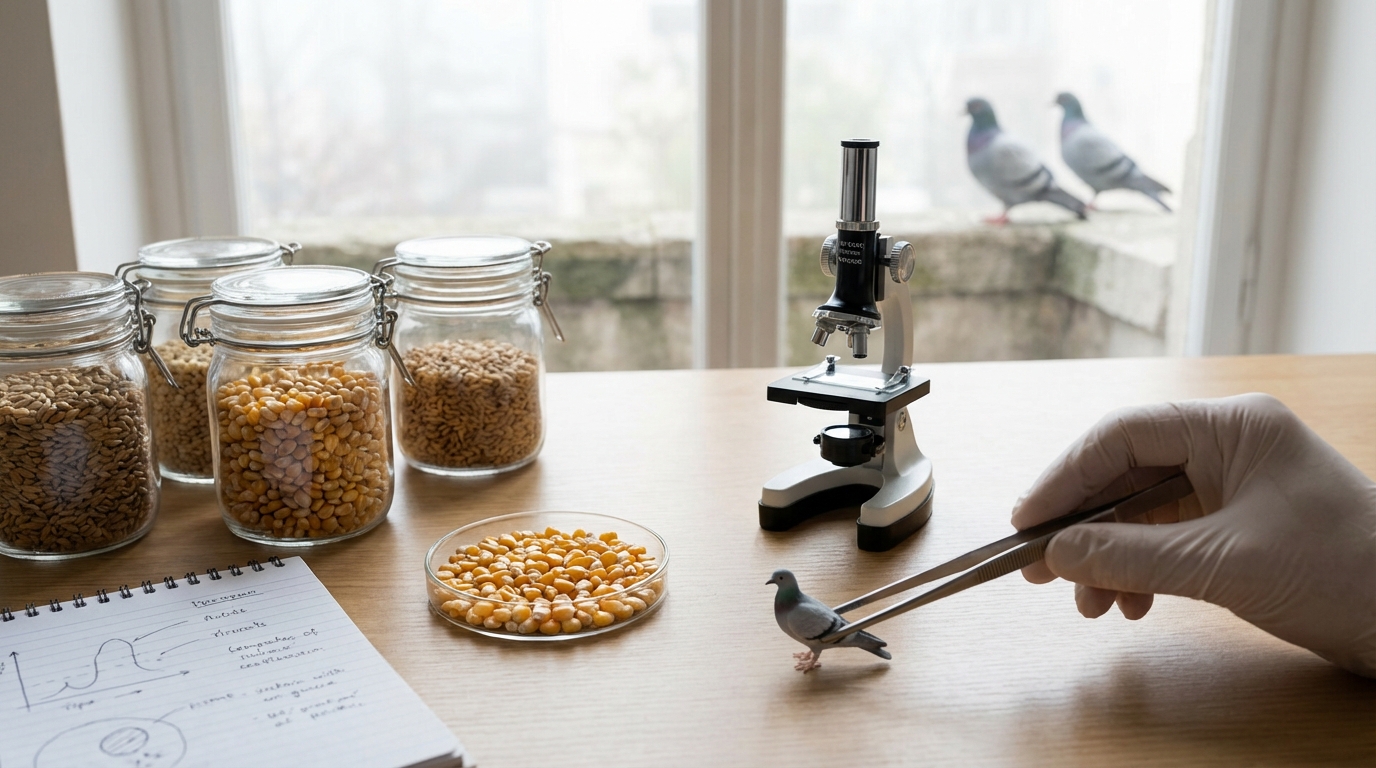
Sterilizing pigeons with food: the complete analysis
Contents
-
How oral contraception works: the science behind contraceptive corn
-
The benefits of food sterilization: an ethical and sustainable approach
-
Limits and contraindications: why sterilizing food is the subject of debate
Every year, local authorities spend hundreds of thousands of euros managing rock pigeon populations. Capture, gassing, anti-perching spikes: conventional methods pose as many problems as they solve. And then one day, a simple idea emerged: what if we simply prevented pigeons from reproducing, without touching them, without killing them, just by changing what they eat?
Things to remember
-
A scientific and ethical analysis of contraceptive corn (Nicarbazine) compared to surgical sterilization
-
The article popularizes ornithological studies to offer an objective trade-off between nuisance reduction and respect for animal welfare, positioning Pest Patrol as the reference authority.
-
The science behind contraceptive corn
-
An ethical and sustainable approach
It's the principle behind dietary contraception for pigeons. Corn coated with a molecule called nicarbazine, distributed in controlled feeders. No surgery, no stress for the animals, no corpses to collect. On paper, it's seductive. But does it really work? And above all, at what cost, for what results, with what risks? That's exactly what we're going to examine here, with the help of scientific studies.
Whether you're a condominium manager fed up with droppings on balconies, a local councillor looking for a sustainable solution, or simply a curious citizen, this article gives you the keys to understanding what sterilizing pigeons with food can (and can't) do.
How oral contraception works: the science behind contraceptive corn
Nicarbazine is a molecule that wasn't invented for pigeons. Originally, it was an anticoccidial used in poultry farming since the 1950s to combat intestinal parasites in chickens. Researchers have noticed an interesting side effect: at certain doses, it drastically reduces avian fertility. Eggs laid by treated hens simply didn't develop. Hence the idea of using it as an avian contraceptive.
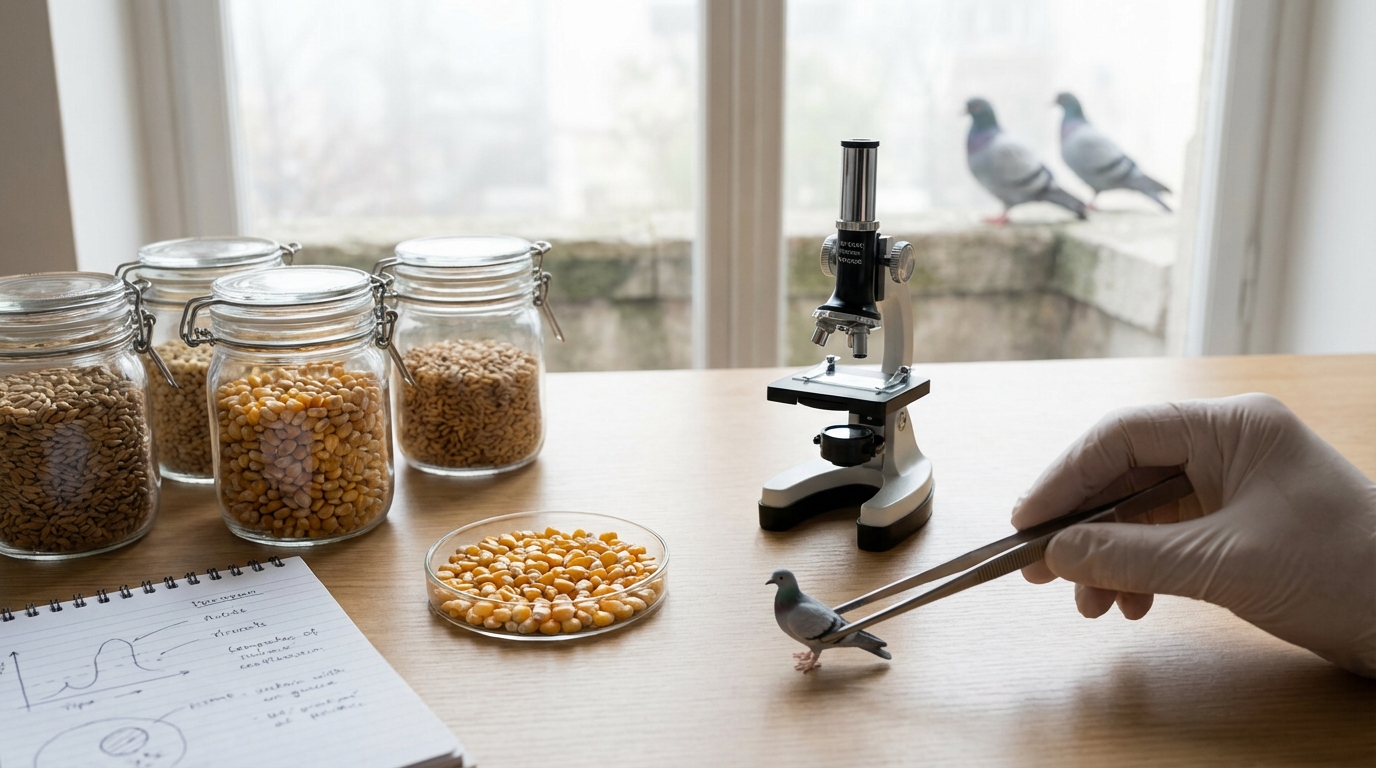
Its mode of action is quite elegant. Nicarbazine interferes with the formation of the egg's vitelline membrane, the thin layer that separates the yolk from the egg white. When this membrane is altered, the embryo cannot develop properly. The egg is laid, looks normal, but is sterile. The pigeon incubates an egg that never hatches. No pain, no visible change in the bird's behavior.
The best-known commercial product is OvoControl-P, developed by the American company Innolytics. It comes in the form of nicarbazine-coated contraceptive corn pellets, distributed daily via automatic feeders installed on rooftops. The pigeons come to feed, ingest the active dose, and their reproductive capacity plummets. According to the manufacturer's data and several field studies (including one carried out in Hollywood, California, published in 2007), the fertility of treated colonies drops by 50 to 70 % from the very first season of treatment.
Crucially, the effect is reversible. If we stop distribution, the pigeons regain their fertility within a few weeks. This is not permanent sterilization, but contraception in the strict sense. The bird is not permanently altered. This changes everything compared with surgical sterilization of birds, which requires anaesthesia, is an invasive veterinary procedure and is irreversible.
Is there another way to sterilize pigeons? Yes. Surgical sterilization does exist, and is practiced by associations such as PAZ (Pigeons Actions Zoopolis). The bird's gonads are removed under anaesthetic. It's effective at 100 % on the treated individual, but each pigeon has to be captured, operated on, kept for convalescence and then released. For a colony of 300 birds, the cost and logistics quickly become prohibitive. Oral contraception, on the other hand, affects the whole colony at once, without individual manipulation.
So the science behind seeds to sterilize pigeons is solid. Nicarbazine has decades of use behind it, its mechanism is well documented, and the field results are measurable. It remains to be seen whether this approach lives up to its promise when we move from theory to the asphalt of a French city.
The benefits of food sterilization: an ethical and sustainable approach
In 2021, the city of Barcelona launched a pilot program for the distribution of contraceptive corn at some 40 sites. The result after two years: a 30 to 40 % reduction in the pigeon population in treated areas, without a single bird killed. These are the kind of figures that make you think.
The first and most obvious advantage is animal welfare. We don't capture, we don't gas, we don't poison. The pigeon eats, lives its life, lands on the same windowsills, but produces no viable offspring. For animal protection associations, this is a non-lethal method that respects the animal's sensitivity. And frankly, when you compare it with the CO2 gassing still practiced in some French communes, the contrast is stark.
Let's talk about gassing. It's fast, it's radical, and it's a long-term failure. Why? Because nature abhors a vacuum. Because nature abhors a vacuum. You eliminate 200 pigeons from a neighborhood, the food resources remain the same, and within a few months, pigeons from elsewhere recolonize the area. Urban ecology studies systematically demonstrate that elimination methods do not work as a sustainable population control tool. Contraception, on the other hand, acts on the birth rate. The colony naturally ages, and numbers gradually decline, with no call for new individuals.
The pigeon-sterilizing seed alternative to gassing has another advantage: social acceptability. Explain to a condominium council that you're going to gas pigeons in the attic, and you'll get opposition. Explain that you're going to put a feeder on the roof that distributes corn to make the eggs sterile, and the discussion is immediately calmer. Local councillors know that urban pigeon control is a sensitive issue, and methods perceived as cruel generate petitions, negative press articles and appeals.
From an operational point of view, sterilizing pigeons by feeding is also simpler to deploy than surgery. There's no need for a specialized veterinarian, no need for capture cages, and no convalescence period to manage. Just install an automatic feeder (such as a programmed dispenser), fill it regularly, and you're ready to go. A study published in Pest Management Science in 2012 showed that pigeons quickly became accustomed to the feeders and returned daily, guaranteeing regular exposure to nicarbazine.
There's also an interesting behavioral effect. Pigeons incubating sterile eggs remain occupied. They don't immediately start a new reproductive cycle, as they would if their eggs were removed (another method is to replace the eggs with decoys). The incubation period for a non-viable egg lasts around 17 to 19 days, during which time the pair does not reproduce. This further slows down the rate of egg-laying over the year.
In a nutshell: less suffering, less controversy, a lasting effect on colony demographics, and lighter logistics. It's for all these reasons that more and more European cities are becoming interested.
Limits and contraindications: why sterilizing food is the subject of debate
All is not rosy, and it would be dishonest to pretend it was. Food-based avian contraception raises legitimate questions, some of which have yet to be answered definitively.
Problem number one, the one that comes up again and again in scientific discussions: non-target species. A rooftop feeder, even with an access system calibrated for pigeons, can attract other birds. Sparrows, starlings, collared doves. If these species eat nicarbazin-treated corn, their fertility will be similarly affected. Yet some of these species are in decline. The house sparrow, for example, has lost 60 % of its numbers in Europe in 30 years, according to LPO data. Unwittingly administering a contraceptive would be an ecological disaster on a local scale.
Manufacturers reply that feeders are designed to limit this access, with appropriately sized openings and feeding times based on pigeons« feeding habits (early morning). This is true. But »limiting« is not the same as »preventing". An Italian study published in Italian Journal of Animal Science in 2008 documented the presence of non-target species on distribution sites, even with anti-intrusion devices. The environmental risk exists, and must be taken seriously.
The second sensitive point is the cost of deployment. The OvoControl-P product costs around 3 to 5 euros per pigeon per year, according to the manufacturer's estimates. Sounds reasonable. Except that you have to add the purchase and maintenance of the automatic feeders (several hundred euros each), staff time for reloading, colony monitoring and coordination over several years. Because that's the key: pigeon contraception is not a one-off treatment. If you stop, the population starts again. It's a long-term commitment, with a minimum of five years to see significant results. For a small municipality with a limited budget, this can be a drain on the budget.
Long-term efficacy is a matter of debate. The figures of 50 to 70 % reduction in fertility are real, but they don't automatically translate into an equivalent drop in population. Rock pigeons have a lifespan of 3 to 5 years in an urban environment. Even without reproduction, you have to wait for the natural renewal of generations to see the numbers drop. And during this time, if abundant food sources persist (markets, open garbage cans, feeding by residents), the colony can be maintained by the immigration of pigeons from untreated areas.
The consensus among urban control specialists is that no single method is sufficient. Sterilizing pigeons by feeding them must be part of an overall plan that includes reducing food sources, installing anti-perching devices on sensitive buildings, and communicating with residents to stop uncontrolled feeding. Without this integrated approach, distributing pigeon sterilization seeds is like emptying a bathtub with a leaky faucet.
One final regulatory point: in Belgium, nicarbazin is not currently authorized for use as an avian contraceptive. Its use in public spaces requires exemptions, prefectoral authorizations and environmental monitoring. Some European cities (Barcelona, several Italian municipalities) have taken the plunge, but the Belgian legal framework remains unclear. Before taking the plunge, all property managers and local authorities should consult the relevant authorities and, ideally, rely on a specialist service provider who is familiar with the legal constraints.
Conclusion
Contraception of pigeons with nicarbazine-treated corn is a scientifically sound, ethically defensible and operationally viable solution, provided it is used correctly. It does not replace other management tools, but complements them. It is one tool among others, probably the most promising for the years to come, but not a magic wand.
If you're faced with a pigeon problem in your condominium or municipality, the first step is not to order pellets online. It's to carry out a serious diagnosis of the colony: size, location of nesting sites, food sources, species present. At Pest Patrol, we do exactly that before recommending anything. Because good pigeon management always starts with a good understanding of the terrain.
Frequently asked questions
How does contraceptive corn work for pigeons?
The corn is coated with nicarbazine, a molecule that alters the egg membrane and prevents embryo development. This is a reversible method of oral contraception: if the bird stops consuming the seeds, it regains its fertility within a few weeks.
Is food sterilization effective in reducing populations?
Yes, studies show a drop in fertility of 50 to 70 % in the first year, leading to a lasting reduction in the colony through natural aging. Unlike gassing, this method avoids the 'draught» effect, where new pigeons immediately replace those eliminated.
What are the risks for other birds (non-target species)?
The main risk is accidental ingestion by protected species such as sparrows. To limit this impact, we use calibrated automatic feeders and precise distribution schedules that correspond to the pigeon's strict feeding habits.
Is nicarbazine dangerous or cruel to animals?
Absolutely not: it's a painless, non-lethal method that respects animal welfare. Unlike surgical sterilization, it requires no capture, anesthesia or invasive procedures, thus avoiding unnecessary stress for the bird.
Can sterilizing corn be used anywhere in France or Belgium?
The use of nicarbazine is subject to strict regulations, and often requires prefectoral or municipal authorizations. It is strongly recommended to use a specialized service provider to guarantee legal compliance and environmental monitoring of the system.
 Français de Belgique
  English
  Nederlands (België)