
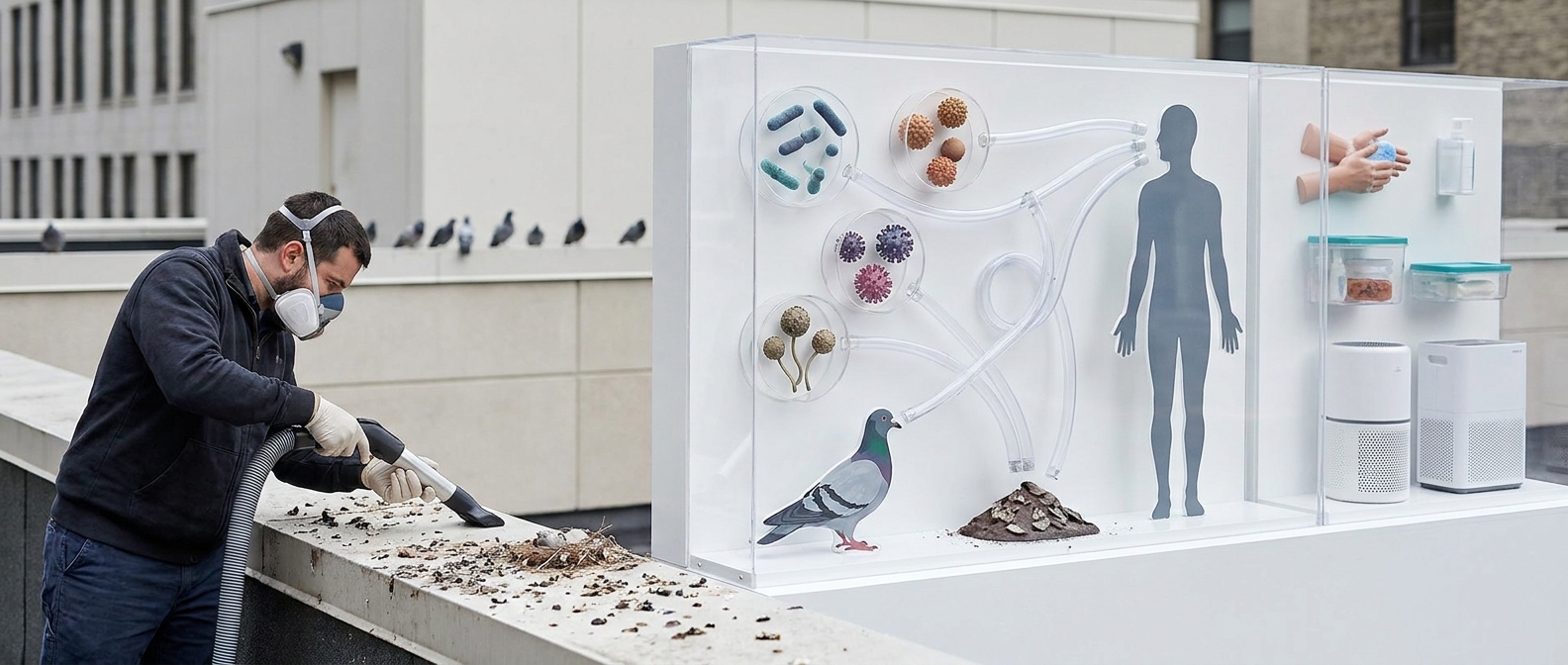
What diseases can you catch from contact with pigeons?
Contents
We see them every day—on windowsills, ledges, balconies, and the roofs of buildings. Urban pigeons are such a common sight that we end up forgetting one thing: they’re reservoirs of pathogens. Not all of them, not all the time, but enough for us to take them seriously.
Things to remember
-
Pest Patrol analyzes the health risks associated with urban pigeons, drawing on scientific sources
-
The article explains the modes of transmission (inhalation of droppings dust, direct contact) in order to turn an irrational fear into rigorous and informed health management.
-
The Main Zoonotic Diseases Transmitted from Pigeons to Humans
-
How Bacteria and Viruses Spread
At Pest Patrol, we regularly receive calls from homeowners or property managers who discover a pile of droppings in a utility room or under a roof. The question always comes up: «Is this a health hazard?» The short answer: yes, it can be. The long answer is in this article. We’ll review the diseases transmitted by pigeons to humans, explain how these pathogens reach us, and, most importantly, give you practical tips on how to protect yourself.
The point isn't to make you panic every time a pigeon lands on your balcony. It's to replace vague fear with a clear understanding of the health risks. Because a risk you understand is a risk you can manage.
The Main Zoonotic Diseases Transmitted from Pigeons to Humans
Pigeons carry disease; this is a well-documented fact. A study published in Emerging Infectious Diseases (CDC, 2004) identified more than 60 pathogens associated with domestic pigeons (Columba livia). Not all of them are dangerous to humans—far from it. But a few are worth taking a closer look at.
Psittacosis (or ornithosis) is probably the pigeon-borne disease in humans best known to healthcare professionals. It is caused by the bacterium Chlamydophila psittaci. The symptoms resemble those of atypical pneumonia: fever, dry cough, severe headaches, and intense fatigue. In severe cases—which are rare but do occur—it can affect the liver and the nervous system. The French National Agency for Food, Environmental and Occupational Health & Safety (ANSES) classifies it as a zoonosis to be monitored in people with occupational exposure to birds.
Salmonellosis is another disease transmitted by pigeons that is often underestimated. People tend to think first of undercooked chicken, not the pigeon on the roof. Yet pigeon droppings frequently contain strains of Salmonella typhimurium. Contamination can occur through accidental ingestion, touching the mouth after contact, or food exposed to contaminated dust: there are many routes of transmission. The classic symptoms—gastroenteritis, diarrhea, and fever—appear within 12 to 72 hours. In older adults or immunocompromised individuals, this can progress to a systemic infection.
Cryptococcosis is the one that worries infectious disease specialists the most. The fungus Cryptococcus neoformans It thrives in accumulations of dry feces. Once inhaled, it can cause a lung infection or even cryptococcal meningitis in people with weakened immune systems (people with HIV, organ transplant recipients, and those taking immunosuppressive drugs). A study published in Clinical Microbiology Reviews (2012) confirmed that pigeon droppings are the main environmental reservoir for this fungus in urban areas.
Newcastle Disease is less well known to the general public. It is a viral infection (avian paramyxovirus type 1) that primarily affects birds, but can also affect humans. Here, it generally presents as mild conjunctivitis, sometimes accompanied by flu-like symptoms. It is not fatal, but it is unpleasant, especially for people who handle sick pigeons without protection.
We could also mention the coryza in pigeons, which weakens flocks and promotes the spread of other infectious agents. Although pigeon coryza is not directly transmissible to humans in the same form, a sick pigeon excretes more pathogens in its droppings, which increases the overall risk.
So, is the urban pigeon a walking hazard? No, not on its own. But a colony that has taken up residence in a building, with kilos of droppings accumulated in a confined space, is a real public health problem. There’s a huge difference between «a pigeon on the sidewalk» and «a hundred pigeons in your attic.».
Modes of Transmission: How Bacteria and Viruses Spread
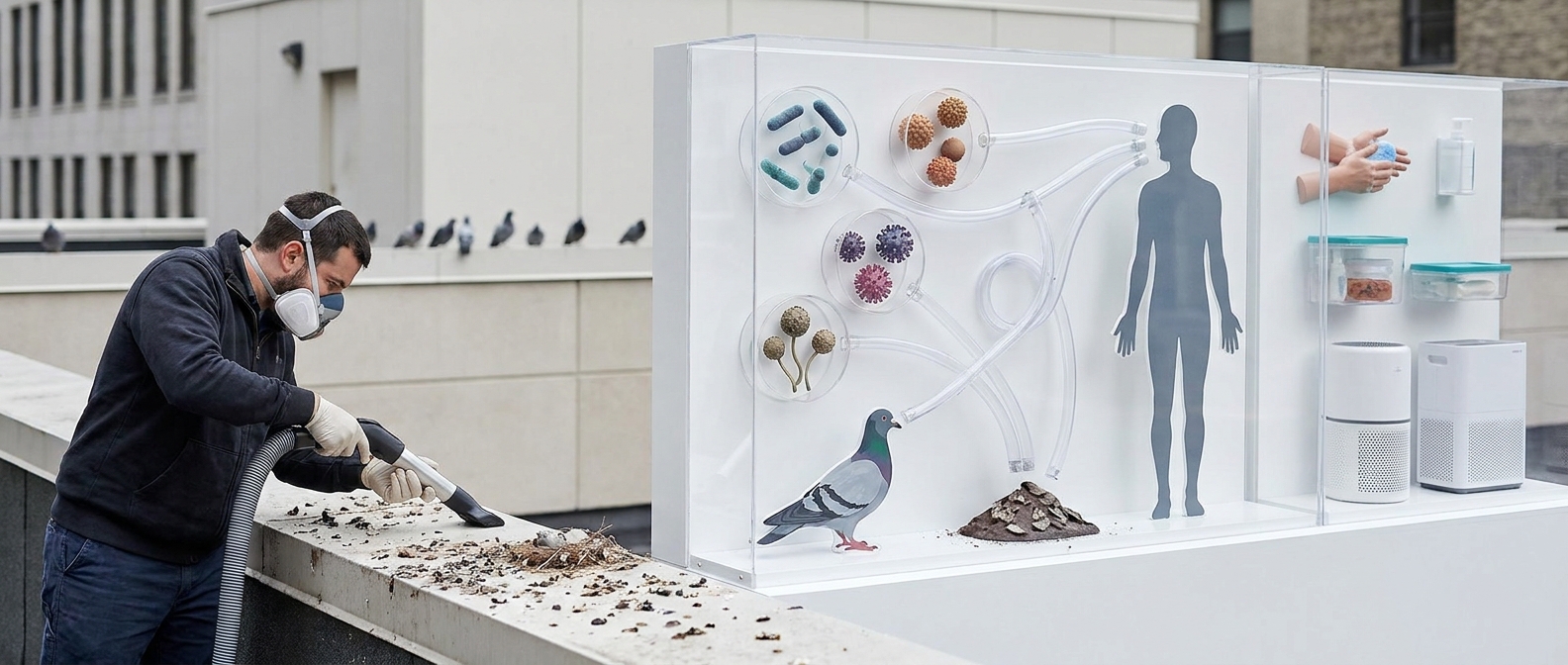
A pigeon flying overhead won’t make you sick. What’s dangerous is the buildup. The buildup of droppings, feathers, and carcasses in areas with poor air circulation. Understanding how pigeon-related diseases are transmitted helps explain why some situations are high-risk and others are completely harmless.
Inhalation of contaminated dust is the primary route of transmission. Pigeon droppings dry out, break down, and form a fine dust that remains suspended in the air. This dust carries fungal spores (Cryptococcus neoformans, Histoplasma capsulatum) and bacteria (Chlamydophila psittaci). When you enter an attic, a utility room, or a crawlspace infested with pigeons and breathe in that dust, you are potentially inhaling these pathogens. This is exactly the scenario that causes most of the cases of pigeon droppings and illness documented in the medical literature.
The problem is that you can’t see anything. The particles in question are just a few micrometers in size. No particular odor, no visible warning signs. You sweep up a pile of dry droppings, kick up a cloud of dust, cough a little, and three days later you have a fever of 39 without knowing why.
Direct contact is less common but not insignificant. Touching a sick pigeon, handling a nest, or cleaning a soiled surface with your bare hands: these are all situations in which bacteria such as Salmonella can be transferred from a contaminated surface to your mucous membranes (mouth, eyes, nose). Children are particularly at risk because they constantly touch their faces with their hands.
Ectoparasites also act as disease vectors—a fact that is all too often overlooked. Pigeons harbor ticks (Argas reflexus), fleas, and red mites. When a colony leaves a site or is dislodged, these parasites seek out a new host. They can bite the occupants of a building and, in some cases, transmit pathogens. The pigeon tick, in particular, causes severe allergic reactions in some people.
Indirect contamination Transmission through water and food is another route that should not be overlooked. Pigeon droppings that accumulate on a roof end up in the gutters and then in rainwater tanks. If this water is used untreated to water vegetable gardens or, worse, for domestic use, there is a real risk of salmonellosis. Studies conducted in urban areas have shown that roofs colonized by pigeons have significantly higher rates of bacterial contamination in runoff water than uncolonized roofs.
To sum up: the pigeon itself is not a biological missile launcher. It is the environment it creates around itself—the droppings, dust, and parasites—that poses the danger. And this danger increases exponentially with the length of time the pigeons have been there and the number of birds. A balcony with three droppings is nothing. A drop ceiling with two years’ worth of buildup is a health hazard.
Prevention Guide: How to Protect Yourself from Health Risks
97 % of documented cases of pigeon-related illness in the workplace could have been prevented with basic protective measures. This figure, taken from a report by the INRS (National Institute for Research and Safety), should be enough to convince us that prevention works. But you still need to know what to do.
Safe cleaning is the foundation. If you need to clean an area contaminated with pigeon droppings, the golden rule is: never sweep it up dry. Never. You’ll stir up the contaminated dust and breathe it in directly. The correct method is to thoroughly wet the droppings before handling them, ideally with a bleach solution diluted to 10 %. Let it sit for about ten minutes, then scoop it up with a dustpan or scraper. Place everything in a tightly sealed trash bag.
Respiratory protection is not optional. A surgical mask is not enough. For work in a confined space with accumulated feces, you need at least an FFP2 mask, or an FFP3 mask if there is a large amount. The spores of Cryptococcus pass right through a simple cloth mask as if nothing were there. Add disposable nitrile gloves and safety goggles. Yes, that’s a lot of gear just to «clean up some pigeon droppings.» But it’s exactly this level of protection that makes the difference between a harmless cleanup and a trip to the hospital.
Keeping pigeons away remains the best long-term strategy. Cleaning without preventing the pigeons from returning is like emptying a bathtub without turning off the faucet. Effective solutions do exist: anti-pigeon nets over openings, spikes on cornices and ledges, and systems of taut wires on flat surfaces. These devices must be installed correctly to work. If a net is not taut enough, pigeons will find a way through. If spikes are spaced too far apart, they’ll land between them. If you’re not sure how to do it, call in a professional.
Everyday Hygiene Measures These steps are simple but make a real difference. Don’t feed the pigeons, even if it’s tempting. Every feeding spot attracts and establishes a colony. Clean window sills and balconies regularly before droppings build up. Wiping them down with a disinfectant once a week is enough for an exposed balcony. Keep your trash cans closed. Cover your rainwater collection containers.
For property managers and building managers, the issue is viewed differently. You have a responsibility toward the residents. A report from the regional inspection agency may be requested if public health conditions warrant it. Professional pigeon control and cleaning services are deductible from condominium fees. And above all, taking action early costs much less than waiting until later. Cleaning out an attic after six months of pigeon occupation costs a few hundred euros. After five years, the cost runs into the thousands, not to mention structural damage (the uric acid in pigeon droppings corrodes zinc, stone, and concrete).
One final point that is often overlooked: if you have cleaned a contaminated area and develop respiratory symptoms in the days that follow (fever, cough, shortness of breath), see a doctor and mention your exposure to pigeon droppings. This is not something to take lightly. Doctors do not immediately think of psittacosis or cryptococcosis unless they are given this information. An early diagnosis makes all the difference in treatment.
Conclusion
The urban pigeon is not public enemy number one. But ignoring the health risks it poses when it takes up permanent residence in a building is tantamount to playing with the occupants’ health. Diseases transmitted from pigeons to humans—such as psittacosis, salmonellosis, and cryptococcosis—are very real, well-documented, and, above all, easily preventable.
The key is to take action before the situation gets out of hand. Prevent colonies from forming, clean thoroughly when necessary, and protect yourself during treatment. It’s not rocket science—just common sense backed by solid knowledge.
Do you have concerns about a situation in your building or home? Contact Pest Patrol. We’ll assess the risk, clearly explain what needs to be done, and take action if necessary. It’s better to call us one too many times than to have one more infestation.
Frequently asked questions
What are the main diseases that can be contracted from pigeons?
Urban pigeons can transmit several zoonotic diseases to humans, including psittacosis (a form of bacterial pneumonia), salmonellosis (which causes severe gastroenteritis), and cryptococcosis. The latter is a fungal infection that affects the lungs and, in the most severe cases among immunocompromised individuals, can lead to meningitis.
How are pigeon diseases transmitted to humans?
The primary mode of transmission is the inhalation of dust from dried droppings that break down in the air and carry bacteria or fungal spores. Direct contact with an infected bird, handling nests without protection, and bites from external parasites (such as pigeon ticks) are other routes of transmission.
What are the risks associated with pigeon droppings on a balcony or roof?
In addition to the property damage caused by their acidity, accumulations of droppings create a reservoir of pathogens that seep into the ambient air or indirectly contaminate rainwater. While mild exposure poses little risk, a large accumulation in a confined space (such as an attic or utility room) becomes a real health hazard.
How can you safely clean up pigeon droppings at home?
Never sweep or vacuum up droppings dry, as this spreads contaminated dust into the air. The proper method is to generously dampen the area with diluted bleach, then clean it up while wearing disposable gloves and an FFP2 or FFP3 respirator mask.
What should you do if you get sick after coming into contact with pigeons?
If you develop symptoms similar to those of severe flu or pneumonia (fever, dry cough, headache, difficulty breathing) after exposure, see a doctor immediately. It is essential to explicitly mention your contact with birds or bird droppings so that the doctor can focus the diagnosis on specific conditions.
 Français de Belgique
  English
  Nederlands (België)