
Are Argentine ants coming to Belgium with the climate?
Contents
-
Understanding the Argentine ant: portrait of an invasive species
-
Global warming: the driving force behind the invasion of Belgium
-
A practical guide to protecting your home from invasive colonies
Ten years ago, talk of Argentine ants in Belgium would have made any entomologist smile. A subtropical species, accustomed to the mild winters of the Mediterranean, that would make its way up to Brussels or Liège? Unthinkable. Except that the climate hasn't read the manual. Belgian winters are warming up at a rate that is changing the game for a whole series of invasive species, and Linepithema humile, the famous Argentine ant, tops the list of candidates for expansion.
At Pest Patrol, we're keeping a close eye on this issue. Not out of academic curiosity: because our customers are starting to ask us some very concrete questions. «I found some tiny ants in single file in my kitchen, and they don't look like anything I've ever seen. We're getting more calls like this than ever before. So we decided to cross-reference recent scientific data with our field experience to give you a clear picture of the situation. Where do we really stand? Should we be worried? And above all, what should you do if these colonies land on your doorstep?
Things to remember
-
This article explores the direct link between global warming in Belgium and the northward advance of the Argentine ant.
-
We cross-reference scientific data on Linepithema humile with field advice from Pest Patrol to offer a unique local perspective, absent from current results focused on Quebec or South America.
-
Portrait of an invasive species
-
Invasion engine in Belgium
Understanding the Argentine ant: portrait of an invasive species
Two and a half millimeters. That's the average size of a female worker. Linepithema humile. Tiny, light brown, almost transparent. You could confuse it with a dozen other local species if you don't know what to look for. Here's what sets it apart: it doesn't sting (contrary to what we sometimes read, Argentine ants are not dangerous stinging insects), it hardly bites, and it gives off a musty smell when you crush it. No pain, no allergic reaction. So what's all the fuss about?
Because the real danger to the Argentine ant is not physical. It's ecological and logistical. This species forms supercolonies. The concept is both fascinating and terrifying: where local ants live in separate colonies that wage war against each other, Linepithema humile has developed a system where millions, sometimes billions, of people cooperate over hundreds of kilometers. A study published in Social Insects (Giraud et al., 2002) has demonstrated that a single supercolony extends over 6,000 km along the European Mediterranean coast. Six thousand kilometers. From Portugal to Italy, a single family.
How is this possible? Argentine ants from introduced populations have lost much of their genetic diversity. As a result, they no longer recognize each other as strangers. No territorial warfare, no energy wasted on fighting. All energy goes into reproduction and expansion. A classic colony of local ants, with a single queen, is no match for a supercolony of hundreds or even thousands.
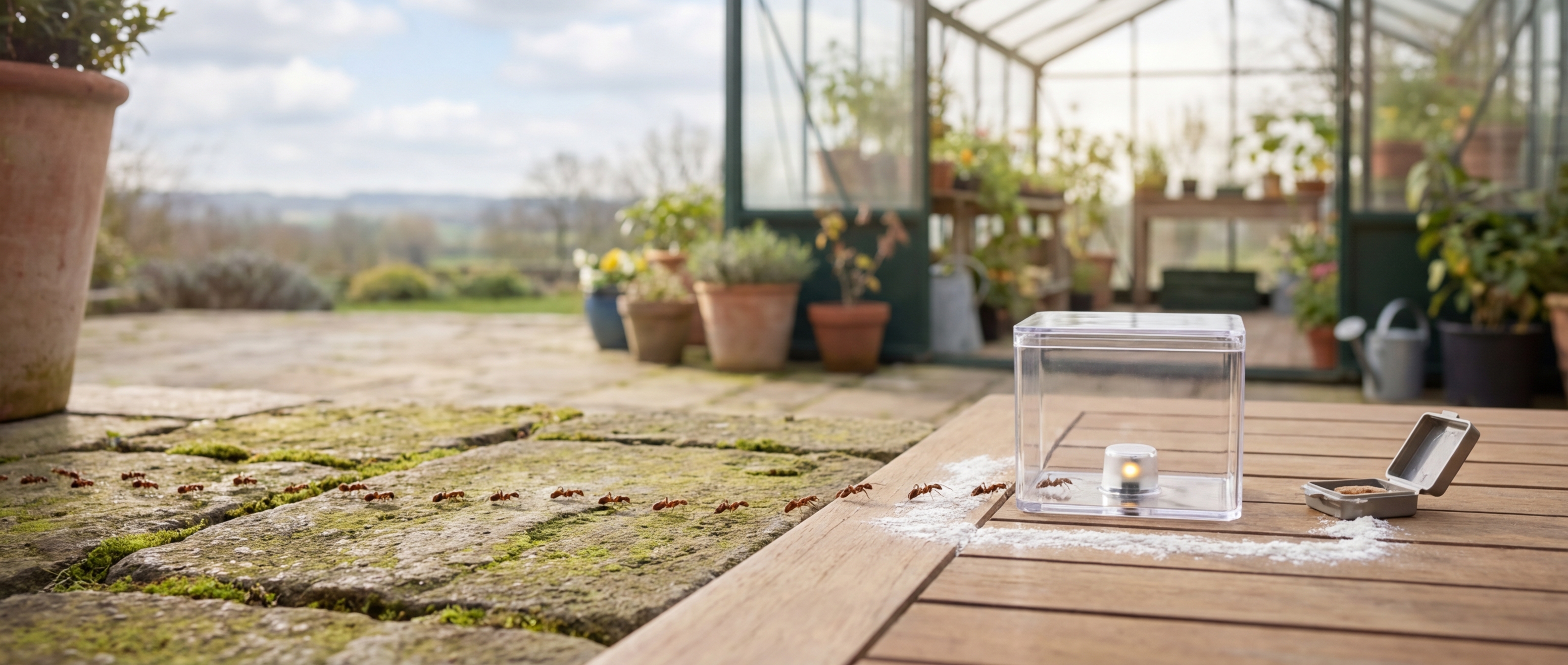
Field identification requires a trained eye. Some reliable clues: worker bees move in very dense, regular rows, often along baseboards, window frames or pipes. They are uniformly small (no larger «soldiers» as in other species). And they're active almost 24 hours a day, weather permitting. If you see a column of tiny, identical ants that never stops, it's a warning sign.
Are Argentine ants a nuisance? The answer is a resounding yes. Not because they bite you or destroy your woodwork. But because they systematically eliminate local ant species through competition. A University of California study (Holway, 1999) showed that in invaded areas, native ant diversity fell by 90 %. They also protect aphids (from which they consume honeydew), exacerbating damage to garden plants and crops. And in the home, they contaminate food, invade electrical appliances and create considerable stress for occupants.
What's the most powerful ant in the world? If we're talking about individual brute force, it's clearly not the Argentine ant. But if we're talking about the ability to conquer territories and eliminate competition on a planetary scale, Linepithema humile is in the top 3. The IUCN (International Union for Conservation of Nature) ranks it among the 100 most harmful invasive species in the world. This is no honorary title.
Global warming: the driving force behind the invasion of Belgium
Minus 3°C. That's about the temperature below which Linepithema humile does not survive for long. For a long time, Belgian winters regularly dipped below this threshold for weeks on end. This prolonged cold formed an impenetrable natural barrier. Data from the IRM (Institut Royal Météorologique) show that this barrier is crumbling. Over the last decade, the number of frost days in Belgium has fallen by 30 % compared with the 1981-2010 average. The winters of 2023-2024 and 2024-2025 were among the mildest on record.
Global warming isn't just making winters milder. It's also lengthening the ants' active season. Linepithema humile starts foraging as soon as the temperature rises above 5°C. With earlier springs and later autumns, the window of activity widens by several weeks each year. More time to search for food, more time to reproduce, more time to colonize new areas.
An article by Roura-Pascual et al (2011), published in Diversity and Distributions, modelled the potential expansion of the Argentine ant in Europe under different climate scenarios. Their conclusion: the coastal regions of northern France and Benelux are gradually becoming compatible with the permanent settlement of the species. We're not talking about the distant future. We're talking about the conditions that are being put in place now.
Does this mean that there are already supercolonies established in Belgium? Not to our knowledge, not in 2026. The closest confirmed reports are from southern France, northern Spain and certain coastal areas of England (where populations have been detected in greenhouses and heated buildings). The most likely scenario for Belgium is an arrival via trade: potted plants, building materials, logistical parcels. Global warming doesn't transport ants, it opens the door for them once they've arrived.
The impact on local biodiversity would be considerable. Belgium is home to around 50 species of native ants, some of which play a key role in seed dispersal, soil aeration and the regulation of other insects. If a supercolony of Argentine ants is established, the domino effect is documented: disappearance of local ants, proliferation of aphids, disruption of food chains (birds and lizards that feed on native ants lose a food source). Invasive species do not replace the ecological functions they destroy.
Winter temperatures remain the main limiting factor. But «limiting» no longer means «blocking». Each additional mild winter pushes the boundary a little further north. And urban environments, with their heat island effect, offer even more favorable microclimates. A heated basement in Antwerp or a greenhouse in Ghent is the perfect refuge for a pioneering colony.
A practical guide to protecting your home from invasive colonies
First thing to understand: getting rid of Argentine ants is not like managing a colony of black garden ants. Conventional methods, such as spraying the line with insecticide, simply don't work. You kill a few workers, the colony sees it as a minor inconvenience and bypasses the obstacle in a matter of hours. With hundreds of queens laying eggs in parallel, the replacement rate is staggering.
Prevention remains your best weapon. Here's how it works in practice:
-
Eliminate entry points. Inspect window joints, pipe penetrations and cracks in foundations. A 2.5 mm ant can pass through openings invisible to the distracted eye. Putting silicone sealant on every crack is basic but highly effective.
-
Remove food sources. Argentine ants love sugar, fats and proteins. Hermetically sealed jars, clean counters, closed garbage cans. Don't leave the cat's bowl lying around all night.
-
Manage humidity. These ants need water. A dripping faucet, a poorly sealed drain, condensation under a sink: these are invitations.
-
Keep an eye on your plants. Flower pots bought in garden centers or imported are a classic vector of introduction. Inspect the root ball before bringing a new pot into your home.
If you still find an infestation, the most successful strategy is to use delayed-release baits. The principle: worker bees take the product back to the nest and share it with the queens and brood by trophallaxis (mouth-to-mouth food exchange). This is the only way to reach the heart of the colony. Fipronil- or imidacloprid-based gels, placed on passageways, are the most widely used by professionals. Patience is required: allow two to four weeks for a significant effect.
What you really mustn't do: spray the rows with contact insecticide. This causes a phenomenon called «budding», the fragmentation of the colony. The queens disperse, form new, separate colonies, and you go from one problem to five. This is the most common mistake we see in the field.
When should you call a professional? As soon as you suspect an invasive species rather than a local ant. Correct identification changes the whole treatment protocol. At Pest Patrol, we always start with a diagnosis: what species, what scale, what entry points. From there, we roll out a tailored treatment plan, with monitoring over several weeks. Eradicating pests such as the Argentine ant requires a methodical approach, not a spray.
A final point often overlooked: coordination with neighbors. If a supercolony moves into a neighborhood, treating a single house is like emptying the ocean with a spoon. The ants will return from adjacent properties. In Mediterranean countries, where the problem has been around for years, treatment campaigns at neighbourhood or commune level are the norm. This is a reflex that should be adopted here too if the species becomes established.
Are Argentine ant bites dangerous? No. Don't worry. Linepithema humile has no functional stinger and its bite is too weak to pierce human skin. The danger, as we have seen, lies elsewhere: food contamination, ecological damage, the psychological nuisance of a massive infestation.
Conclusion
The Argentine ant is not yet established in Belgium. But all the conditions are converging: increasingly mild winters thanks to climate change, trade that multiplies the risk of accidental introduction, and a species whose biology is cut out for invasion. The question is no longer «if», but rather «when» and «how fast».
Staying vigilant is the best service you can do for your home and local biodiversity. If you spot unusual ants, dense columns of identical little workers that don't match anything familiar, don't try to solve it alone with a commercial product. Contact Pest Patrol. We identify, we diagnose, we treat. And if it's good Linepithema humile, we'll know exactly what to do.
Frequently asked questions
How can you tell the Argentine ant from the local species?
The Argentine ant (Linepithema humile) is tiny (around 2.5 mm), light brown in color and moves in extremely dense, uninterrupted Indian queues. Unlike Belgian species, which fight between colonies, Argentine ants collaborate in supercolonies, making their presence massive and constant along baseboards or walls.
Does the Belgian climate really allow this subtropical ant to survive?
With global warming, Belgian winters are becoming milder, crossing less and less the fateful $-3°C$ mark needed to stop this species. Urban heat islands (Brussels, Liège, Antwerp) and our heated homes now offer perfect refuges for these colonies to survive and reproduce all year round.
Why are conventional insecticides ineffective against them?
Spraying a column of Argentine ants with a conventional spray triggers a survival reflex called budding: the queens disperse to create new nests elsewhere. To eradicate them, it's essential to use delayed-effect bait gels, which allow the workers to transport the product to the heart of the colony to eliminate the queens.
Does the Argentine ant pose a danger to humans or buildings?
Unlike termites or carpenter ants, it doesn't damage wood, and unlike the red ant, it doesn't have a sting. Its danger is both ecological and health-related: it invades food stocks, seriously disrupts local biodiversity by driving out our native ants, and can cause short-circuits by settling in electrical appliances.
What should I do if I suspect the presence of a supercolony in my home?
If you observe tiny ants returning despite your clean-ups, don't attempt chemical treatment alone. Contact an expert like Pest Patrol for formal identification; effective control of this invasive species requires a coordinated approach across the building, and even the neighborhood, to avoid reinfestation.
 Français de Belgique
  English
  Nederlands (België)