
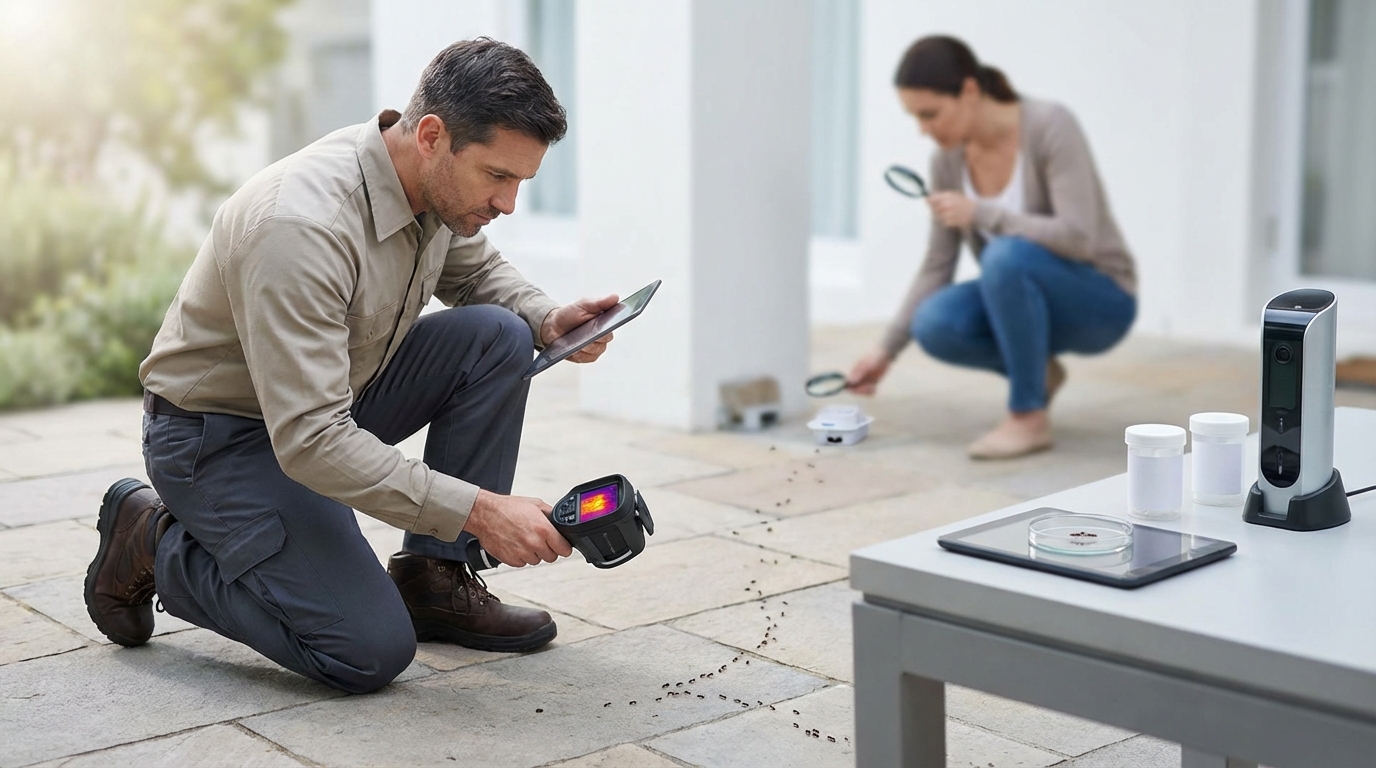
How to find the entrance to an ant nest?
Contents
-
Locating the nest entrance: Manual tracking vs. pro thermal detection
-
Targeting entry: Advantages and disadvantages of baits vs. insecticides
You see a column of ants crossing your kitchen every morning, always on the same route, always heading in the same direction. You crush them, clean them up and complain. The next day, it's the same thing all over again. The problem isn't the column you see: it's what's at the end of it. The entrance to an ant nest, where hundreds of workers pass through, is often just a few meters from where you're looking. Sometimes it's in a wall, sometimes it's under a slab, and if you're dealing with carpenter ants, sometimes it's in the frame.
Things to remember
-
Pest Patrol takes an ethological approach to locating nest entrances by deciphering pheromone trails.
-
We compare amateur detection methods with professional standards to guide users towards the most cost-effective eradication strategy.
-
Manual tracking vs. pro thermal detection
-
Advantages and disadvantages of baits vs. insecticides
At Pest Patrol, we approach this subject from a slightly different angle to the usual guides. We draw on ethology, the study of animal behavior, to understand how ants communicate with each other and plot their routes. Because locating an ant farm is not a random treasure hunt: it's a tracking operation. And depending on whether you do it yourself or call in a professional, the tools and results are not at all the same. Let's break it down together.
Locating the nest entrance: Manual tracking vs. pro thermal detection
An ant alone knows nothing. But an ant that has found food leaves behind a trail of pheromones, a kind of chemical GPS that its fellow workers will follow. That's why you always see the same Indian queues in the same place: the workers are following a chemical signal deposited by the scouts. A study published in Journal of Experimental Biology (Jackson & Ratnieks, 2006) has shown that certain species reinforce their pheromone trail with each passage, making the path increasingly «luminous» for the colony. Good news for you: this behavior is precisely what makes it possible to find your way back to the nest's entry point.
Manual tracking, step by step. This is the method everyone can use, and it works in most cases. Place a small sugar cube or a drop of honey near the spot where you see ants. Wait 15 to 20 minutes. The scouts will help themselves, then head back to the nest. Follow them. There's no need to run - they move at their own pace. What you're looking for is the moment they disappear: a crack in a wall, a loose window seal, a passage under a skirting board, a hole in the patio slab. That's the entrance to an ant nest. Note that ants are often active late in the day or early in the morning, especially in summer. Do your observation at these times, and you'll have much more traffic to follow.
A few tips for keeping track: use a flashlight along baseboards and door frames. Ants love gaps. If the column enters a wall and you can't see anything, gently tap the surface with the back of a screwdriver. A hollow sound may indicate a cavity. For carpenter ants, which burrow into wood, look for fine sawdust (called «rejects») at the foot of beams, window frames or wooden furniture. This sawdust is a reliable clue that the nest is just above or inside.
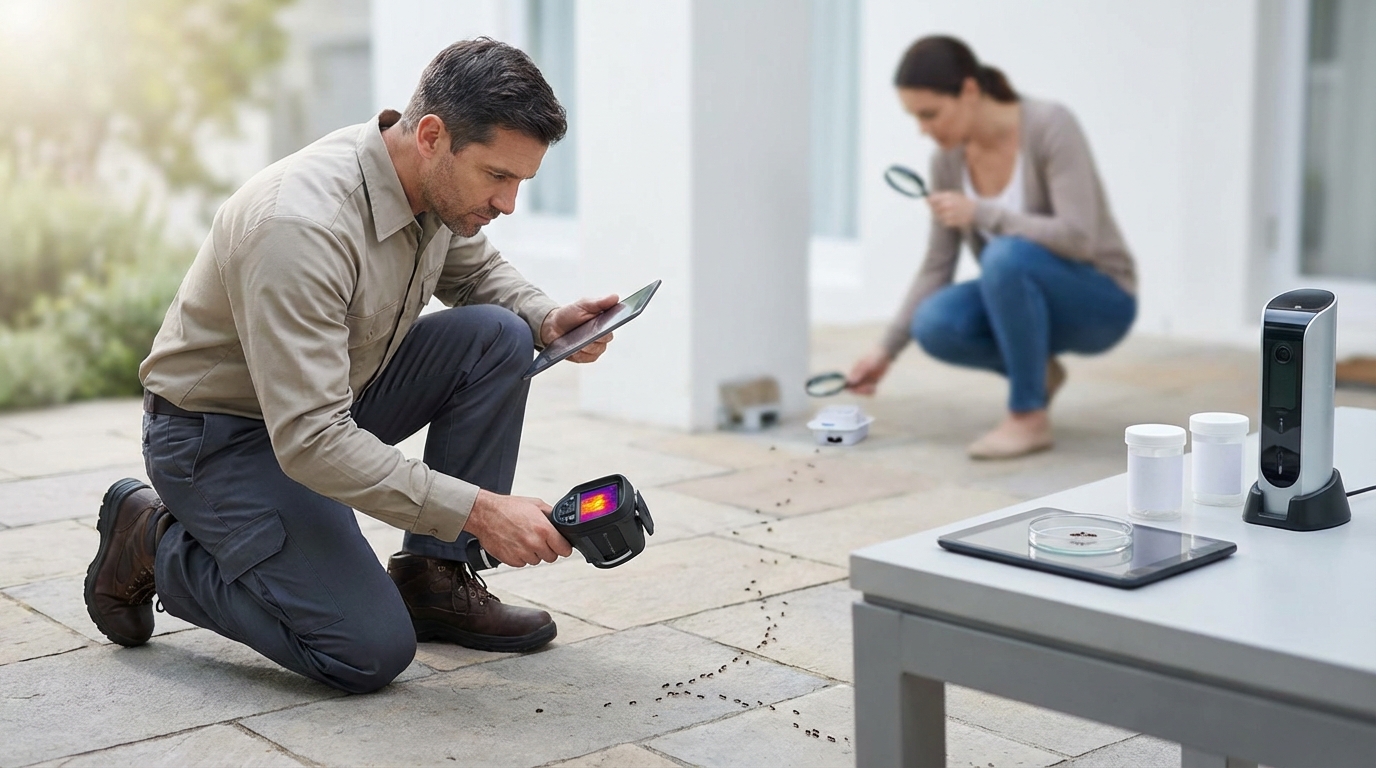
Professional thermal detection is another matter. Technicians use infrared cameras (thermography) to locate areas of abnormal heat in walls and floors. An active colony generates a slight rise in temperature relative to the surrounding structure. This method makes it possible to find an ant nest even when it's deeply buried, in an insulated partition or under a concrete screed. An equipped professional can scan an entire room in less than 30 minutes and identify the point of entry with an accuracy of just a few centimetres.
Does it have to come to that? No, not always. If you can clearly see ants entering and leaving through an identifiable crack, manual tracking will suffice. Thermography becomes useful when the nest is invisible, when the infestation returns despite your treatments, or when you suspect carpenter ants in the building structure. The cost of a professional thermal diagnosis is around 100 to 200 euros, depending on the surface, but it saves weeks of trial and error. To locate an inaccessible anthill, it's often the most cost-effective shortcut.
Targeting entry: Advantages and disadvantages of baits vs. insecticides
Finding the entrance is half the job. The other half is what you do with it. And here, there are two main product families: baits (gels or stations) and contact insecticides. They don't work at all in the same way, and choosing the wrong one can make your problem more complicated than it was.
Bait: the Trojan horse strategy. The principle is simple and highly effective. You place a biocide gel or bait station right next to the nest entry point. The workers mistake it for food, bring it inside and share it with the rest of the colony, including the queen. This is known as trophallaxis: the ants regurgitate the food to feed the larvae and queen. The biocidal gel spreads throughout the nest in just a few days. The colony collapses from the inside.
The advantages are clear. You don't need physical access to the nest. You let the ants do the work for you. Modern biocidal gels (based on fipronil or imidacloprid, depending on the formulation) are designed to act slowly, precisely to give the worker the time to return to the nest before dying. A tube of gel costs between 8 and 25 euros, depending on concentration and brand. For a classic infestation of black garden ants (Lasius niger), that's often enough.
The main drawback? Patience. Allow 7 to 14 days to see results. During this time, you'll continue to see ants, and that can be frustrating. Another trap: if you clean up the pheromone trail between the bait and the nest (by spraying with vinegar, for example), you cut off the circuit. The workers won't find their way back. Leave the trail intact until the bait has taken effect.
Contact insecticides: fast but limited. A residual insecticide sprayed on the entry point kills any ants passing over it. The effect is immediate and visible. The product remains active for several weeks on the treated surface. That's reassuring. Except that it doesn't solve the underlying problem. The queen is still alive inside the nest. If you block one entrance with a residual insecticide, the colony will often open another a few days later, sometimes in an even less accessible location. You're playing cat and mouse.
When does contact insecticide make sense? When you have to deal with an emergency, such as ants in a pantry or near a baby's cot, and you need immediate results while you wait for the bait to do its job. The combination of both, residual insecticide as a barrier on sensitive areas and biocide gel near the nest entrance, is what most professionals do. But insecticide alone, without bait, is like plaster on a broken leg.
An important point: read the labels. All biocides sold in Belgium must carry an AMM (Autorisation de Mise sur le Marché) number. If the product you're buying online doesn't have one, don't bother. It's the law, and above all a question of safety for you, your children and your pets.
Decision criteria: DIY or professional input?
80% ant infestations in a house can be dealt with without calling anyone. A well-placed gel bait and two weeks of patience. End of story. So why do some cases require a professional? Because the remaining 20% can be very expensive if you get it wrong.
First criterion: species identification. Not all ants treat each other the same. The black garden ant that comes in through the kitchen window is benign. Carpenter ants (Camponotus spp.), which burrow into structural wood, are a different matter. They can weaken a load-bearing beam in just a few years. The problem is that many people can't tell them apart. A carpenter ant measures between 6 and 13 mm (much larger than the classic black ant), is often bicolored (black and red), and doesn't eat wood, it digs it. If you find unexplained piles of fine sawdust, have the species identified before treating. A professional can do it in a few minutes. Wrong species means wrong strategy.
Second criterion: nest accessibility. If the entrance to an ant nest is a crack in the facade or a joint in a terrace, you can deal with it on your own. If the nest is in a partition, under a slab or in the roof structure, you may have to open it up, inject pressurized product or use insecticide powder in cavities. These are technical gestures. Poorly executed, they disperse the colony instead of eliminating it, a phenomenon known as «budding» in certain polygynous species (with several queens), where the colony splits up and creates new nests. You had one problem, now you have three.
Third criterion: price. The price of an exterminator for an ant treatment is generally between 80 and 250 euros for a standard intervention, including diagnosis and treatment. For carpenter ants with a nest in the structure, expect to pay between 300 and 500 euros, sometimes more if several visits are required. It's an investment. But compare it to the cost of a botched DIY treatment: products bought for nothing (easily 40 to 60 euros in total), time wasted, and above all potential damage if carpenter ants continue to nibble away at your frame while you fumble.
The rule I recommend is simple. If you see small (3-5 mm), black ants coming from outside and you can easily find their entry point: treat yourself with a bait gel. If the ants are large, if you find sawdust, if the nest seems inaccessible, or if the problem persists after two weeks of treatment: call a professional. Identifying the species alone often justifies the trip.
A final point that's often overlooked: how to find the entry of ants into the house isn't enough if you don't treat the cause. Ants enter because they find food or moisture. Fix leaks, seal cracks, store food in airtight containers. Without this, even the best treatment will be a reprieve.
Conclusion
Finding an ant nest isn't rocket science. It's all about observation. Follow the pheromone trail, identify the point of entry and choose the right product. A well-placed biocidal gel will resolve most situations within two weeks. For more complex cases - carpenter ants, inaccessible nests, colonies that are dividing - a professional with a thermal camera and the right tools will do in an hour what it would take you weeks to attempt.
If you're faced with an infestation and you're not sure what to do, start with manual tracking this evening. Put out sweet bait, follow the workers, noting where they disappear. You'll soon know if it's a problem you can handle on your own, or if it's time to pick up the phone.
Frequently asked questions
How to find the exact entrance to an ant nest?
To locate the entrance, use manual tracking by placing sweet bait (honey or sugar) in their path. Observe the workers' path: they'll lead you straight to the crack, skirting board or joint through which they disappear to rejoin the colony.
Why do ants always follow the same path?
Ants use a complex chemical communication system, depositing trail pheromones along their path. This ground marking serves as a GPS guide for other workers, enabling them to efficiently link the food source to the nest entrance.
What's the best time of day to spot an anthill?
Ant activity is usually at its peak in the early morning or late afternoon, especially during the hot summer months. This is the ideal time for observation, as traffic on the pheromone trails is most dense and visible.
When should you use a thermal camera to detect ants?
Thermal detection is essential when the nest is invisible to the naked eye, for example in an insulated partition or under a concrete slab. It allows you to detect the heat generated by an active colony without having to drill or demolish your walls unnecessarily.
Is it more effective to use bait gel or insecticide spray?
Gel bait is far more effective at eradicating the colony, as the ants carry the poison to the queen. Insecticide sprays kill only the workers visible on the surface, and may cause the colony to move the nest elsewhere in your home.
How to recognize an infestation of carpenter ants?
The most telling sign is the presence of fine sawdust (castings) at the foot of wooden structures or walls. Unlike garden ants, carpenter beetles are larger (6 to 13 mm) and can cause significant structural damage by burrowing into your roof structure.
 Français de Belgique
  English
  Nederlands (België)