
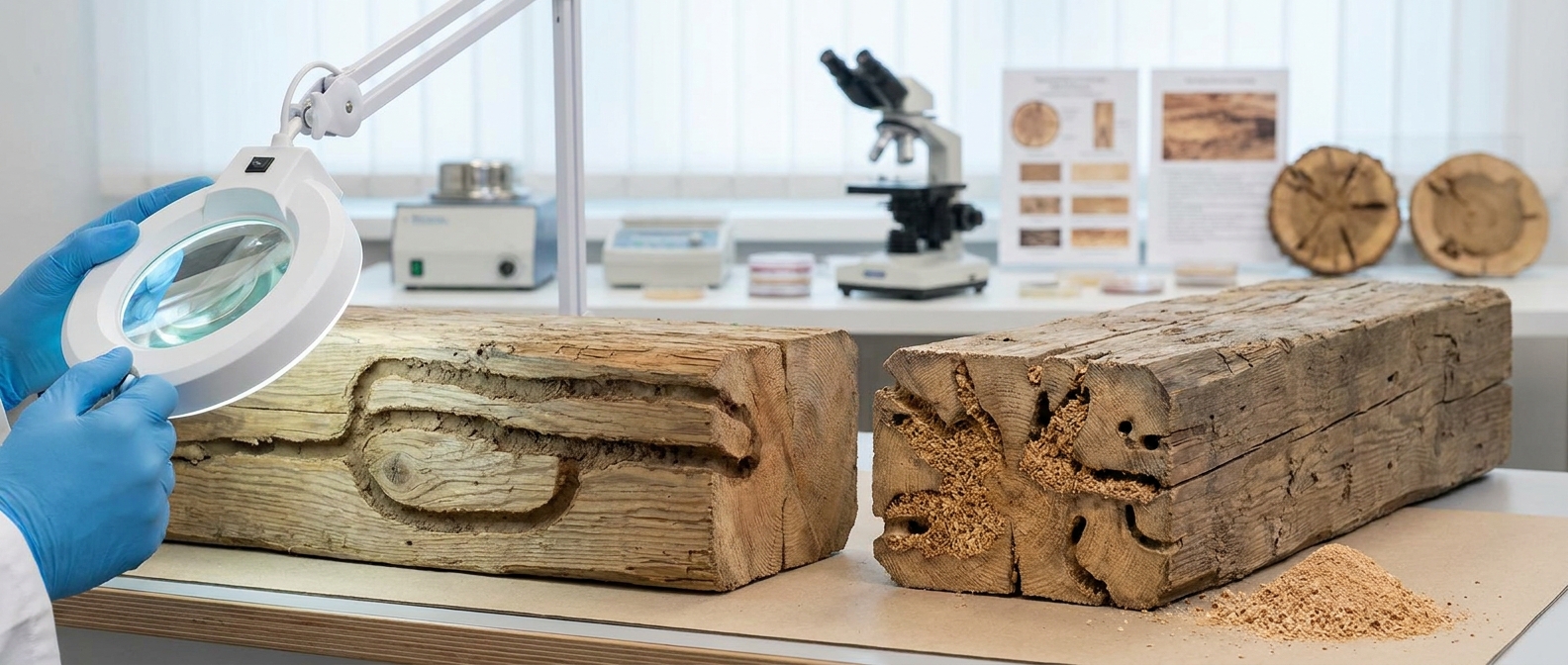
Hollow beam: is it a termite or another insect?
Contents
-
Termites vs. wood-eating insects: Comparison of damage and galleries
-
Diagnostic criteria: How do you know if your beams are really damaged?
-
Pre-treatment recommendations: Choosing the best eradication solution
You tap on a beam and the sound is hollow. The wood sounds like a drum. Inevitably, the first thought that comes to mind is termites. Except that in around 60 % of cases, the culprit isn't a termite. It's another xylophagous insect, just as destructive, but not at all treatable in the same way.
Things to remember
-
Pest Patrol distinguishes itself by offering a scientific method for differentiating between termites and other wood-eating insects (capricorns, beetles, etc.).
-
The angle is based on a technical analysis of the galleries and the absence or presence of sawdust for a precise diagnosis prior to intervention.
-
Comparison of damage and galleries
-
Compare the different options before deciding.
The difference between hollow wood attacked by termites and a beam eaten away by beetles or beetles is not a detail. It's what determines the urgency, the type of treatment and, above all, the budget. If you get the wrong diagnosis, you risk paying twice: once for the wrong treatment, and once for the right one.
At Pest Patrol, we receive panicked homeowners every week who have found a hollow beam in their frame. Their question is always the same: «Is it termites?» This article will give you the keys to answering that question yourself, even before you call in a diagnostician. We'll talk about galleries, sawdust and mud cords, and you'll see that the clues are often right in front of you.
Termites vs. wood-eating insects: Comparison of damage and galleries
Let's start with a few figures: France is home to some 50 species of wood-eating insects that can attack construction wood. Three of them are responsible for most of the damage to timber: the subterranean termite, the house longhorn beetle and the woodworm. And each leaves a very different signature in the wood.
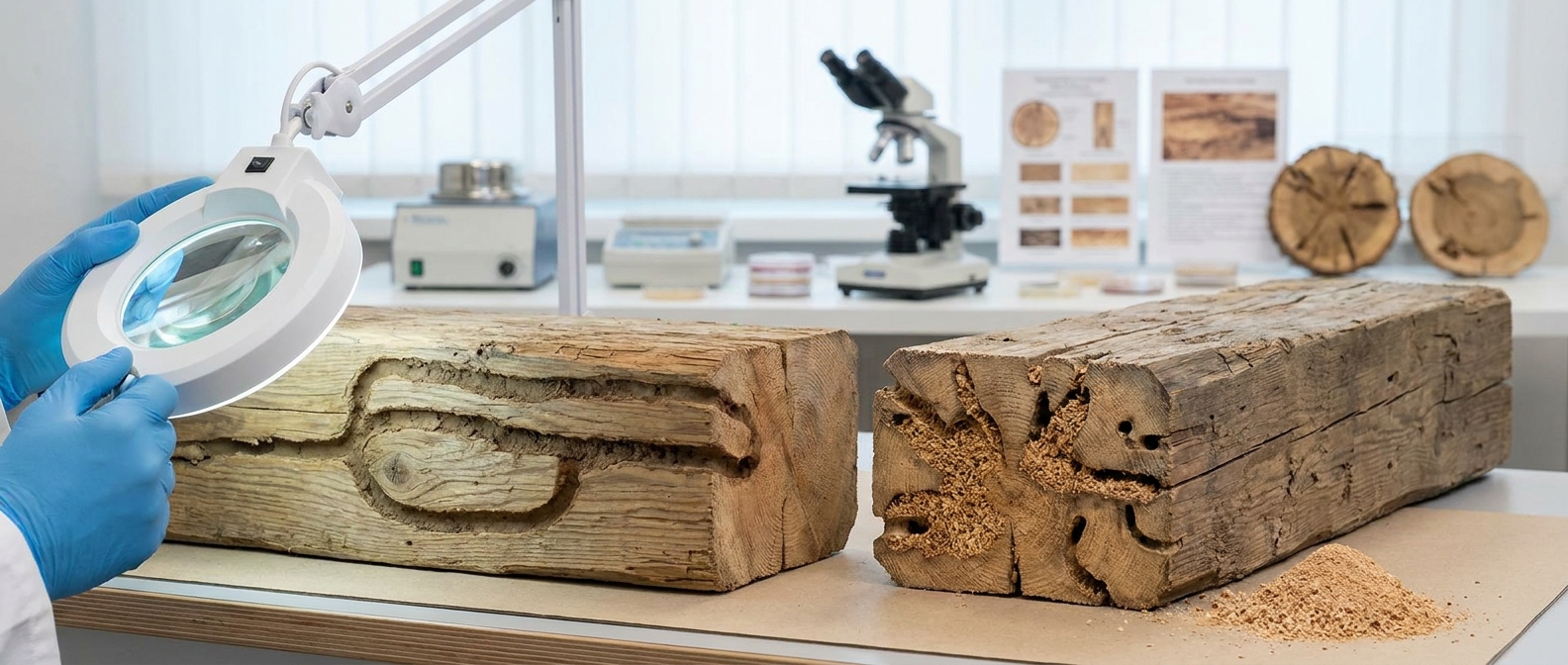
Termites work from the inside out. They burrow into the wood following the soft fibers (spring wood), leaving the hard fibers intact. The result: when you open a beam attacked by termites, you discover a network of laminated galleries, almost like the pages of a book. The wood looks like corrugated cardboard in cross-section. And above all, no sawdust. Termites consume wood, they don't throw it away. What they do leave behind are mud cords: the little tunnels of earth they build along walls or foundations to keep out of the light. If you see mud cords on your walls or beams, there's no doubt about it.
The house beetle is a different story. Its larvae dig wider, oval galleries, often filled with a fine, compacted sawdust called vermoulure. The difference between termite and wood-eating insect can also be seen on the surface of the wood: the capricorn beetle leaves oval exit holes, 6 to 10 mm in diameter, when the adult insect flies away. These holes are characteristic. Termites, on the other hand, never pierce the surface of wood. They never do. This is an absolutely reliable diagnostic criterion. A study by the CTBA (Centre Technique du Bois et de l'Ameublement, now FCBA) confirms that the absence of exit holes combined with the presence of laminated galleries is the most reliable marker of termite attack.
The small but tenacious wood beetle produces much smaller, round exit holes: 1 to 3 mm for the small beetle, 3 to 4 mm for the large one. It leaves a granular worm-like residue, like small marbles. Run your finger over it to feel the texture. Capricorn beetle worms, on the other hand, are more powdery and finer.
Here's a quick summary:
-
Termites : laminated galleries following soft fibres, no visible exit holes, no sawdust, possible presence of mud cords
-
House Capricorn : oval galleries with fine, compacted wormholes, oval exit holes 6 to 10 mm, wood surface sometimes blistered
-
Woodworm : small round holes (1 to 4 mm), worming in small beads, attack often localized to wet areas
A point we often forget: termites live in colonies of several hundred thousand individuals. Their destructive capacity is incommensurable with that of an isolated capricorn beetle. A termite colony can devour several linear meters of wood in just a few months. Capricorn beetles, on the other hand, take several years (3 to 10 years of larval cycle) to cause equivalent damage. This doesn't mean we should take them lightly, but the urgency isn't the same.
Diagnostic criteria: How do you know if your beams are really damaged?
Before you pick up the phone to call a professional, you can make an initial diagnosis yourself. No need for sophisticated equipment. Just a screwdriver, a flashlight, your ears, and a little method.
Probing with a screwdriver is basic. Take a flat-bladed screwdriver and drive it into the wood, perpendicular to the fibres. On healthy wood, the screwdriver barely penetrates. On attacked wood, it sinks in like butter. If the blade penetrates more than 5 mm without effort, you've got a problem. Carry out this test at several points on the beam, paying particular attention to areas close to walls (termites arrive via the floor and masonry) and to the ends of beams, those ends embedded in walls which are most vulnerable to moisture.
Look at the floor under the beams too. Do you see any sawdust? If so, it's probably not termites. Termites don't produce sawdust. This simple observation already eliminates one hypothesis. If you find small piles of fine wormwood under a beam, look for the exit holes above. Their shape and size will tell you whether it's a beetle or a furniture beetle.
Let's talk about nibbling noise. It's an often-quoted but rarely useful clue for termites, which are virtually silent. Capricorn beetle larvae, on the other hand, make a very characteristic noise: a regular crackling sound, like someone nibbling chips inside the wood. It's best heard at night, when the house is quiet. If you put your ear to the beam (or, better still, a stethoscope, even a basic one) and hear this crackling sound, you've got active longhorn beetle larvae. Termites, on the other hand, can produce a very slight tapping sound when they bang their heads against the gallery walls to alert the colony, but it's much more discreet.
How can you tell if your beams are being attacked by termites specifically? Look for mud cords. This is the first and most reliable sign of termite infestation. These pencil-width tunnels of earth run along walls, foundations and sometimes the beams themselves. They're crumbly and grayish-brown in color. If you break one and it's damp inside, the infestation is active. If it's dry and empty, the termites may have left, or found another way in.
A few other clues not to be overlooked:
-
Paint blistering or peeling : termites can burrow just below the painted surface, creating blisters
-
Wood that sounds hollow when tapped : strike with the screwdriver handle, compare the sound with a healthy area of the same beam
-
Visible deformations : a sagging floor, a sagging beam, a doorframe that no longer closes straight
-
Translucent wings: Winged termites lose their wings after swarming, and are often found on windowsills in spring.
A termite diagnosis on your beams is not something to be done lightly. If your screwdriver probe reveals hollow wood, with no sawdust, no exit holes, laminated galleries and traces of soil inside: there's a very good chance it's termites. If you find sawdust, round or oval holes on the surface, and clean galleries with no soil: you're looking for a wood-boring insect such as a capricorn beetle or a furniture beetle. This distinction is fundamental to the next step.
Pre-treatment recommendations: Choosing the best eradication solution
You've identified the culprit, or at least you have a strong suspicion. The temptation is to rush out and buy a product from a supermarket and treat it yourself. Stop. Treatment depends entirely on diagnosis, and a mistake here can be very costly.
For wood-boring insects such as capricorn beetles and furniture beetles, curative treatment follows a well-established protocol. We start by lumbering the wood: removing all degraded parts to reach the healthy wood. Injection holes are then drilled every 30 to 40 cm, staggered along the length of the beam. These holes are then injected with a pressurized insecticide and fungicide. Injecting the product into the wood allows it to penetrate deeply and reach the larvae at the heart of the beam. A surface spray completes the treatment. This curative treatment is effective, well-documented and guaranteed for 10 years by most professionals.
The situation is radically different for termites. Wood injection alone is not enough. Why not? Because termites live in the ground. You can treat every beam in your house, but if the underground colony is still there, they'll be back. The gold standard in termite treatment is the bait trap system (or bait stations). Stations are installed around the house and indoors. They contain a bait based on a growth inhibitor (such as hexaflumuron) which the termites bring back to the colony. Within a few months, the entire colony is eliminated. This is the method recommended by the FCBA, and the only one that guarantees complete eradication.
The price of termite treatment varies considerably according to surface area, accessibility and level of wood infestation. For treatment using bait traps, you should expect to pay between €1,500 and €4,000 for a single-family home, with annual follow-up treatment costing between €300 and €600. Curative treatment using injections costs between €20 and €50 per linear metre of beam treated. These prices include the services of a certified professional.
A few concrete recommendations before you commit yourself:
-
Get an official diagnosis. A professional diagnosis costs between €150 and €300 and will save you from having to treat blindly.
-
Demand certification. This is the only label that guarantees that the professional has mastered treatment protocols and uses approved products. Without this certification, you have no ten-year guarantee on the treatment.
-
Do not mix treatments. An anti-capricorn beetle treatment won't work against termites, and vice versa. Treating a termite infestation with a simple injection product is just throwing money down the drain.
-
Check the residual strength of your beams. If the survey reveals that more than 50 % of a beam's cross-section has been destroyed, treatment alone is not enough. The structural element will have to be reinforced or replaced. A carpenter must intervene before or at the same time as the treatment.
One last point, often overlooked: humidity. Termites and beetles love damp wood. If you have a seepage problem, inadequate ventilation in your attic or a damp crawl space, make this your priority. Treating the wood without correcting the cause of the damp is like putting a band-aid on an infected wound. The problem will return.
And if you're in any doubt about whether termites or other wood-boring insects are present, don't try to guess. The cost of a professional diagnosis is derisory compared with the cost of a poor treatment or, worse, a collapsing frame.
Conclusion
A hollow beam is not necessarily a termite. But it's always a warning sign that should be taken seriously. The key is observation: leafy galleries without sawdust and mud cords point to termites. Exit holes, wormholes and nibbling noises point to capricorn beetles or furniture beetles. This visual diagnosis takes ten minutes and changes everything for the future.
Grab your screwdriver and torch, and go and probe your beams. Make a note of what you see, and take photos. If the signs point to an active infestation, call in a certified professional without delay. At Pest Patrol, we always prefer a homeowner who calls «too early» to one who discovers the problem when the beam has already given way.
Frequently asked questions
My beam is hollow: does it have to be termites?
Not necessarily. If the sound is hollow, this confirms internal deterioration, but in around 60 % of cases, the culprit is another insect such as the capricorn beetle or the beetle. Diagnosis is based on examination of the galleries and the presence or absence of sawdust.
How can you tell the difference between termite damage and capricorn beetle damage?
Termites dig «laminated» galleries without ever piercing the surface or leaving any sawdust behind. In contrast, capricorn beetles leave oval exit holes 6 to 10 mm in diameter, and their galleries are filled with fine, compacted sawdust.
Is sawdust a sign of termites?
No, in fact the opposite is true. Termites consume the wood entirely, and don't throw off any sawdust; if you find wood dust (worms) under your beams, they're more likely to be longhorn beetles or beetles.
What is a «mud string» and why is it evidence of termites?
These are small tunnels of earth built by termites to move around sheltered from light and air. If you observe these earthen tunnels on your walls or beams, termite infestation is confirmed and requires urgent intervention.
Why can't termites be treated like other wood insects?
Injection treatment is sufficient for capricorn beetles, as the larvae are in the wood, but is ineffective against termites, which live in the ground. To eradicate a termite colony, it's essential to use a bait-trap system that eliminates the underground source.
 Français de Belgique
  English
  Nederlands (België)