
Vacuum cleaner fleas: the guide to radical eradication
Contents
-
Price and survival: how to neutralize fleas in your vacuum cleaner?
-
Offers and equipment: how to guarantee the death of sucked-in parasites?
-
Purchasing stages and limits: is vacuum a complete solution?
Your cat scratches itself, your dog won't stop chewing its sides, and you start to feel pins and needles on your ankles. Classic. You get out the vacuum cleaner, give the carpets, cushions and skirting boards a good scrubbing, and tell yourself it's all sorted. But it's not. Fleas have a frighteningly efficient life cycle, and vacuuming without a precise protocol is like bailing out a boat without plugging the breach.
Things to remember
-
Beyond simple cleaning, we analyze the biological survival of fleas in collectors via entomological sources.
-
The article proposes a physical and chemical neutralization protocol, and suggests the purchase of HEPA equipment and specialized accessories.
-
how to neutralize fleas in your vacuum cleaner?
-
Compare options and take action.
This guide won't tell you to «vacuum regularly». You already know that. What we're going to break down here is what really happens inside your collector once the fleas have been vacuumed up, how to prevent them from escaping (yes, it's possible), what equipment really makes the difference, and above all: when vacuuming alone is no longer enough.
We rely on serious entomological data, including work by Ohio University and publications by the Journal of Medical Entomology, to give you a protocol that makes sense. Not folklore, facts.
Price and survival: how to neutralize fleas in your vacuum cleaner?
A study carried out by researchers at Ohio University (Hinkle, Koehler & Patterson) has shown that 96 % of adult fleas die as they pass through the vacuum duct. The turbulence, the bumps against the walls, the rotary brushing: all this physically destroys them. Good news? Yes, but only in part. Because the remaining 4 % are potentially dozens of individuals if your infestation is serious. And a single female can lay up to 50 eggs a day.
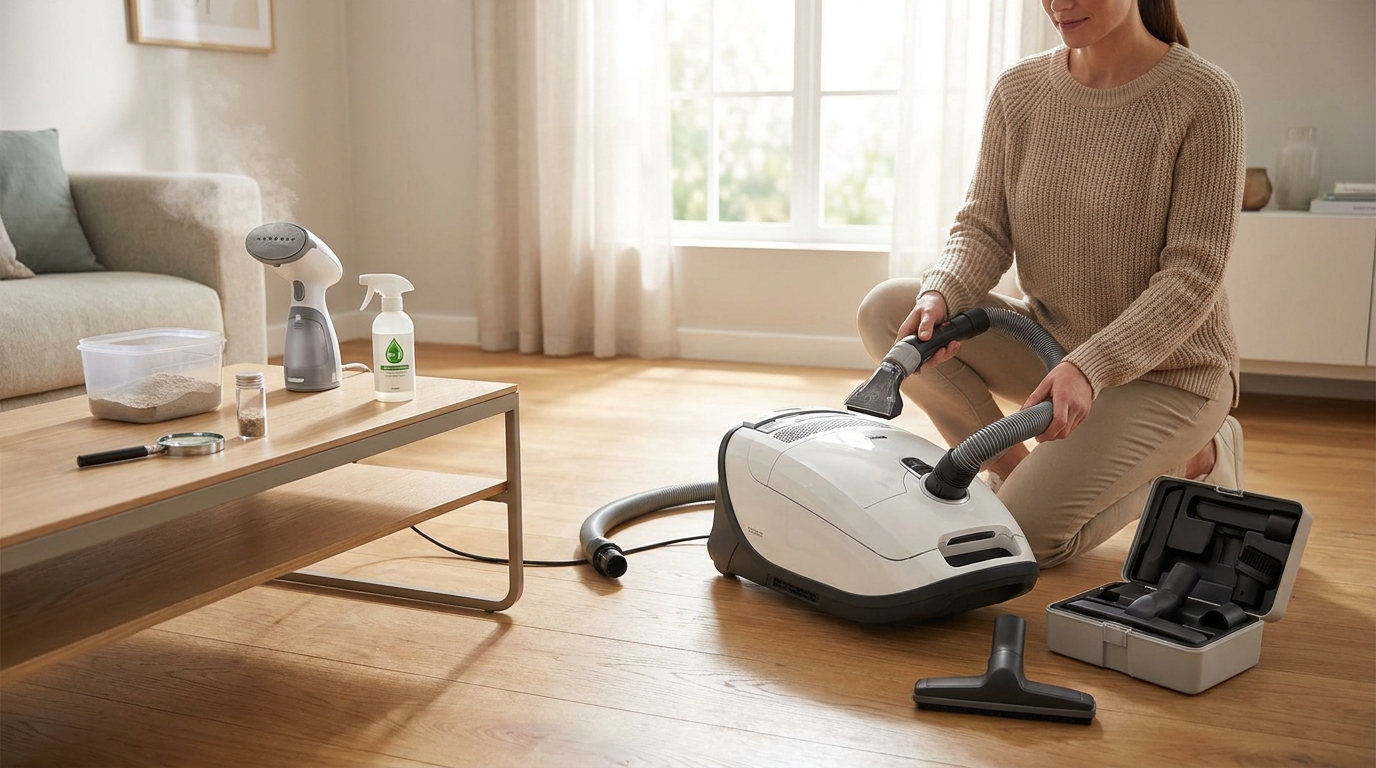
The survival of fleas in the vacuum cleaner depends on several factors. First, the type of collector. A vacuum cleaner with a bag creates a confined, dark and dusty environment where the survivors have little chance of escaping, especially if you throw the bag away immediately after vacuuming. Killing fleas in the bag is simple: you remove it, seal it, put it in a garbage bag, and out. Not tomorrow. Right now.
With a bagless vacuum cleaner, the situation changes. Vacuumed fleas land in a plastic bin, often with enough space to survive for a few hours. And flea larvae are more resistant than adults to mechanical shocks. They can remain viable in the collector, feeding on the organic debris sucked in (hair, dead skin), and potentially continuing their development. When it comes to fleas in a bagless vacuum cleaner, emptying and cleaning the bin after each use is not optional: it's mandatory.
In terms of price, a complete flea treatment for your home will cost between 150 and 300 euros if you call in a professional. A good vacuum cleaner costs between 80 and 250 euros, depending on the model. A replacement anti-chip vacuum bag costs between 2 and 5 euros each. Compared with the cost of repeated professional pest control, investing in the right equipment from the outset is frankly more cost-effective.
A point often overlooked: eggs. They represent around 50 % of the total infestation population. These eggs don't stick to carpet fibers. They fall, roll and lodge between floorboards and in cracks. Vacuuming dislodges them mechanically, which is very effective. But you need to insist, to go over the same area several times, and above all to vacuum daily for at least two weeks to cover the entire flea life cycle, which lasts between 14 and 21 days in favourable conditions.
Here's a practical tip: slip a piece of flea collar into your vacuum cleaner bag. The continuously released insecticide will finish off any survivors. It's a trick documented by several U.S. pest control services, and it costs next to nothing.
Offers and equipment: how to guarantee the death of sucked-in parasites?
Not all vacuum cleaners are equal when it comes to dealing with infestations. Far from it. The number-one criterion is suction pressure. A vacuum cleaner with less than 20 kPa of suction will not remove larvae clinging to the base of textile fibers. You should aim for a minimum of 25 kPa, ideally more. Top-of-the-range canister vacuum cleaners and some upright models reach 30 to 35 kPa: this is the range to look for.
Then there's the HEPA filter. A vacuum cleaner with a HEPA filter retains 99.97 % of particles 0.3 microns and larger. Flea eggs measure around 0.5 mm, larvae between 1 and 5 mm, adults 2 to 3 mm. All this is largely captured. But the real benefit of a HEPA filter is to prevent the allergens produced by flea droppings (which are microscopic) from being released back into the ambient air. For people with allergies or asthma, this is not a luxury, it's a health necessity.
What's the best vacuum cleaner for fleas? The answer depends on your situation. If you have a cat or dog and the infestation is localized, a cat or dog flea vacuum cleaner doesn't exist as a commercial category per se. What do exist are high-performance vacuum cleaners with the right features: strong suction, HEPA filtration, motorized rotating brush and, if possible, a bag system (more hygienic for parasite removal).
Brands such as Miele, Dyson and Rowenta offer models that tick all these boxes. The Miele Complete C3, for example, combines high suction power, an AirClean HEPA filter and a sealed bag system. The Dyson V15 Detect, on the other hand, offers bagless vacuuming with full filtration and a laser that reveals microscopic particles on the floor. Handy for checking that you haven't left anything behind.
What about UV-C light to kill fleas? More and more devices are being sold with this technology, which is supposed to kill micro-organisms using ultraviolet radiation. Let's be clear: UV-C light is effective against bacteria and certain viruses on directly exposed surfaces. On chips, scientific data is very limited. No study published in a peer-reviewed journal shows that a domestic UV-C device reliably eliminates fleas or their eggs. The exposure time required would be far too long for aspiration use. Don't rely on it as your main solution.
What really works, however, is the mechanical and thermal combination. Some steam cleaners reach 120°C at the nozzle outlet. At this temperature, adult fleas, larvae and eggs are instantly destroyed. Using a steam cleaner after vacuuming is the most formidable combo you can deploy without chemicals. Studies by the University of Florida's Entomology Department confirm that heat above 60°C is lethal to all stages of the flea life cycle.
One final point on equipment: invest in spare bags. If you vacuum daily for two to three weeks (which is the recommended protocol), you're going to use up a lot of bags. Keep a stock of vacuum bags adapted to your model. An anti-chip vacuum bag is not a specific product: any bag compatible with fine filtration will do, as long as you change it regularly and never reuse it.
Purchasing stages and limits: is vacuum a complete solution?
No. Let's be frank: vacuuming alone won't get rid of an established infestation. It's a pillar of treatment, probably the most important in terms of mechanical population reduction, but it's only one pillar among many.
Here's why. Vacuuming is highly effective against fleas on accessible surfaces: carpets, rugs, sofas, mattresses. But fleas also lay their eggs in areas your vacuum cleaner can't reach: under heavy furniture, in gaps in parquet flooring, behind skirting boards, in the nooks and crannies of staircases. The photophobic larvae actively migrate to these dark, protected areas. You can vacuum your living room impeccably and still have a thriving colony under your chest of drawers.
The flea eradication steps, in order, look like this:
-
Treat the animals first. Pipette, oral tablet, anti-parasite collar prescribed by your vet. As long as your animals are carriers, they will continually reinfest the environment. This is the source, and we cut the source first.
-
Vacuum the entire dwelling. Every room, every corner, every fabric. Insist on areas where your pets sleep or rest. Vacuum cushions, blankets, under beds, along baseboards.
-
Wash at 60°C minimum. Covers, sheets, plaids, removable cushions, pet baskets. Can fleas be washed in the washing machine? Yes, as long as this temperature is respected. Below this temperature, eggs and larvae can survive.
-
Apply an environmental treatment. Permethrin-based insecticide spray or fogger containing an insect growth regulator (IGR). IGR is crucial: it prevents larvae from turning into adults, breaking the reproductive cycle. Without IGR, you kill the adults, but the next generation emerges two weeks later.
-
Repeat aspiration daily for 14 to 21 days. Why? Because the pupae (cocoons) are virtually indestructible. Because pupae (cocoons) are virtually indestructible. Neither vacuum cleaners nor insecticides can reach them. They only hatch in response to vibrations and body heat. Vacuuming provokes just such vibrations, forcing the adults to hatch prematurely, leaving them exposed to the residual treatment.
Where to buy effective flea products? Your vet remains the best source for animal treatments. For environmental insecticides, specialist gardening and pet shops (Truffaut, Jardiland, Gamm Vert) offer foggers and sprays containing IGR. Online, Amazon and veterinary pharmacies list brands such as Advanthome, Beaphar and Frontline HomeGard. Always check the composition: you want an adulticide (permethrin or deltamethrin) combined with an IGR (methoprene or pyriproxyfen).
As for the vacuum cleaner itself, major household appliance retailers (Darty, Boulanger, Fnac) and specialized websites allow you to compare models according to suction power and filtration type. Don't be fooled by the watts displayed: what counts is the vacuum in kPa and the airflow in dm³/s. These data are given in the technical data sheets, rarely on the packaging.
A word about insects that might come out of the vacuum cleaner. This is a legitimate concern. Surviving adult fleas may indeed try to climb up the duct, especially with a bagless vacuum cleaner left open. The solution is simple: empty the bin immediately after each session, into a closed garbage bag. If you're using a bagged model, change it after each intensive vacuuming session during the acute phase of the infestation. Yes, that's a lot of bags consumed. That's the price of peace of mind.
What's the most effective product for killing fleas? There's no single miracle product. It's the combination of mechanical suction, chemical treatment with IGR, and animal treatment that gives results. Studies published in the Journal of Economic Entomology show that this integrated approach reduces the flea population by over 95 % in three weeks, compared with 50 to 60 % for aspiration alone over the same period.
Conclusion
The vacuum cleaner is your first-line weapon against fleas. Not a gadget, not an add-on: a weapon. But like any weapon, it only works if you use it correctly and as part of an overall strategy. Vacuum daily, change or empty the collector after each pass, treat your animals, and apply an insecticide with growth regulator to the environment.
Invest in a vacuum cleaner with high suction pressure and a HEPA filter. Forget the unproven UV-C gadgets. And above all, don't let up for three full weeks: that's how long it takes to cover the entire life cycle of these parasites. Rigor is what separates a controlled infestation from a nightmare that returns every summer.
Frequently asked questions
Does the vacuum cleaner kill fleas instantly?
Suction destroys around 96 % of adult fleas through mechanical shock in the duct. However, surviving larvae and 4 % adults can continue to develop in the collector. It is therefore essential to empty the tray or dispose of the bag hermetically immediately after each passage.
How to eliminate the survivors inside the vacuum cleaner?
To neutralize any remaining parasites, the simplest solution is to slip a piece of flea collar directly into the device's bag or tray. The continuously released insecticides will effectively eliminate captive fleas and larvae.
How much does adapted equipment cost compared with professional treatment?
The purchase of a high-performance vacuum cleaner and spare bags represents an initial investment of between €80 and €250. On the other hand, the cost of a professional pest control service is between 150 and 300 euros per visit. Choosing the right equipment from the outset is therefore a much more cost-effective strategy in the long term.
What technical specifications should you look for in a flea vacuum cleaner?
We recommend choosing a device with a vacuum of at least 25 kPa to successfully loosen deep-rooted larvae. A HEPA filter is also essential to capture microscopic droppings and prevent allergens from being released back into the air.
Should I choose a bagged or bagless vacuum cleaner?
Bagged models are preferable, as they provide a confined environment and allow more hygienic disposal without direct contact with pests. If you use a bagless vacuum cleaner, you must empty and clean the plastic bin on the outside after each use.
Are UV-C light or steam effective against fleas?
The effectiveness of domestic UV-C lamps on fleas has not been scientifically proven, as the exposure time is too short. On the other hand, using a steam cleaner (up to 120°C) after vacuuming is formidable, as the heat instantly destroys fleas at all stages of their development.
Can vacuuming alone completely eradicate an infestation?
No, vacuuming is a fundamental pillar, but it remains insufficient if used alone. It can't reach dark, remote areas (under heavy furniture, behind baseboards) where photophobic larvae tend to migrate to hide.
What are the essential steps for eliminating fleas once and for all?
The strict protocol consists of treating your pets simultaneously, then vacuuming the entire dwelling daily for 14 to 21 days. At the same time, wash textiles at 60°C and apply an environmental insecticide containing a growth regulator (IGR) to halt the reproduction cycle.
Can fleas come out of the vacuum cleaner after cleaning?
Yes, live adult fleas can travel up the suction line, especially in bagless models left open. To eliminate this risk, dispose of the bag or empty the bin hermetically into an outside waste garbage can as soon as you've finished vacuuming.
 Français de Belgique
  English
  Nederlands (België)