
Corrosive pigeon droppings: what are the risks and what can be done?
Contents
-
The chemical impact of pigeon droppings on building materials
-
Pest Patrol method: how to clean and prevent acidic droppings
A whitish stain on a windowsill, a speckled balcony, a clogged gutter. You tell yourself it's dirty, wash it off and forget about it. But pigeon droppings aren't just dirt. It's an active chemical agent that attacks your materials, day after day, silently. And by the time you realize it, the damage is often already done.
Things to remember
-
Pest Patrol unravels the chemistry of uric acid to explain why droppings are not just stains but a real structural threat.
-
By combining scientific rigor and practical advice in layman's terms, we transform a simple cleaning problem into a genuine guide to heritage preservation and domestic biosafety, citing professional safety standards.
-
The chemical impact of pigeon droppings on building materials
-
health risks and structural damage
At Pest Patrol, we treat this subject with the seriousness it deserves. Not to scare people, but because the science is clear: pigeon droppings cause measurable corrosion on metal, stone, concrete and even car paint. Together, we're going to unravel the chemistry behind it all, the real risks to your health and your building, and above all the practical methods for cleaning and protecting your home. Without useless jargon, with figures and protocols that make sense.
The chemical impact of pigeon droppings on building materials
The pH of pigeon droppings fluctuates between 3 and 4.5. To put it in perspective, that's about the acidity of vinegar. Leave some vinegar on a zinc plate for six months and see what's left. That's exactly what happens to your roofs, gutters and facades.
The main culprit is uric acid. Unlike mammals, which excrete urea (soluble, easily washed away by rain), birds produce uric acid, a crystalline compound that adheres to surfaces and persists. When decomposed by moisture and bacteria, it releases ammonia and various organic acids. This chemical cocktail is formidably effective at gnawing through just about anything it touches.
On metals, the mechanism is direct. Pigeon uric acid causes electrochemical corrosion: it attacks the protective oxide layer covering galvanized steel, copper, zinc or aluminum. A study published in the Journal of Architectural Conservation showed that steel plates exposed to droppings for 12 months lost up to 0.3 mm in thickness. On a thin gutter, perforation is guaranteed within a few years. Bird droppings can absolutely cause rust, and not just a little.
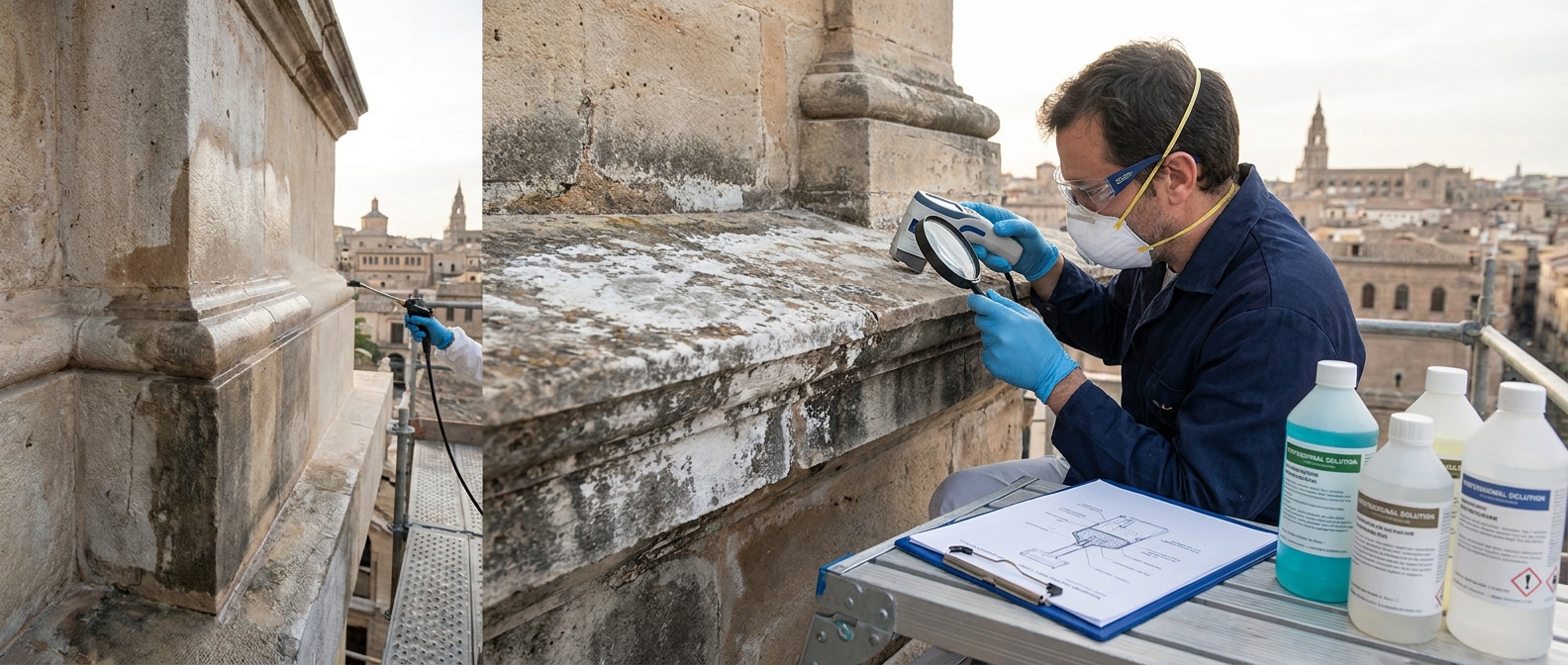
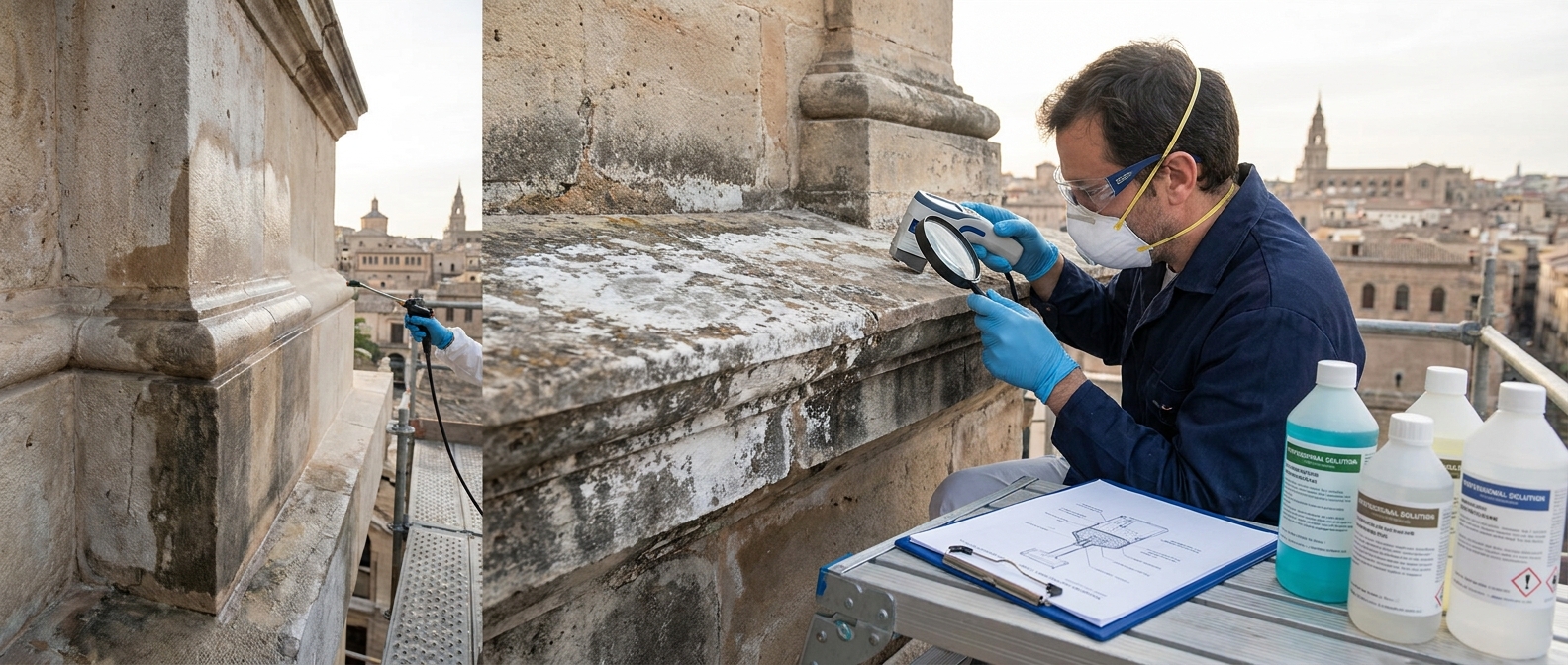
Limestone is even more vulnerable. Limestone (calcium carbonate) reacts chemically with acids to form soluble salts. The result: the surface literally dissolves. Historical monuments know all about this. Milan Cathedral, the Houses of Parliament in Westminster, the Haussmann façades of Paris: wherever pigeons settle in large numbers, the deterioration of limestone accelerates dramatically. Surveys carried out by the Laboratoire de Recherche des Monuments Historiques (LRMH) estimate that areas exposed to droppings deteriorate two to three times faster than protected areas.
Concrete is not spared either. Even if its surface is basic (pH around 12-13), repeated acid attack gradually neutralizes this protective alkalinity. Once the surface pH drops below 9, the steel reinforcement inside the concrete begins to rust. This is the start of a vicious circle: the rust swells, splintering the concrete and further exposing the steel. Engineers call this accelerated carbonation, and it's a real structural problem.
What about your car? Modern car paint is made up of very thin layers (varnish, color base, primer). The acidic pH of droppings attacks varnish within a few hours in hot weather. If you leave a dropping to dry in the sun on your hood for 48 hours, chances are the mark will remain even after cleaning. Car manufacturers themselves acknowledge that bird droppings are among the most common chemical aggressors on bodywork.
A point often overlooked: accumulation. An isolated dropping is a nuisance. Ten kilos of droppings accumulated on a balcony over two years is a continuous chemical attack, moistened by every rainfall and constantly reactivated. The corrosive nature of pigeon droppings is not an urban myth, it's basic chemistry.
Invisible hazards: health risks and structural damage
3 to 5 % of urban pigeon droppings contain active pathogens, according to a meta-analysis published in Epidemiology and Infection (Haag-Wackernagel & Moch, 2004). This figure may seem low. It isn't, however, when you consider that each pigeon produces around 12 kg of droppings per year, and that a colony of 50 birds - a common sight on a building - generates more than half a tonne of droppings annually.
The health risks associated with pigeon droppings have been documented for decades. Three pathologies systematically recur in medical literature. Cryptococcosis, a fungal infection caused by Cryptococcus neoformans, which thrives particularly well in dry droppings and can cause meningitis in immunocompromised individuals. Histoplasmosis, caused by the fungus Histoplasma capsulatum, which attacks the lungs. And psittacosis (or ornithosis), a bacterial infection of the lungs. Chlamydia psittaci transmitted by inhalation of contaminated dust.
The main danger is not touching fresh droppings. It's breathing in dry droppings particles. When droppings dry and disintegrate, they release fungal spores and bacterial fragments that remain airborne. A dry sweep, a blow from a blower, or even a draught in an infested attic is all it takes to get these particles into circulation. The bacteria and fungi present in droppings are all the more dangerous because they cannot be seen or smelled.
In terms of building structure, the damage goes far beyond mere aesthetics. The accumulation of droppings in gutters and downspouts creates blockages. Water stagnates, overflows and seeps into the walls. I've seen cases where humidity from gutters clogged with droppings has caused mold to grow all the way up an interior wall. The owner was looking for a roof leak. The problem was 30 cm of compacted droppings in the gutter.
Building integrity is also threatened by mechanical action. Droppings hold moisture against surfaces, creating an environment conducive to freeze-thaw in winter. Water seeps into micro-cracks, freezes, expands and cracks stone or plaster. This process, combined with the acid attack mentioned above, considerably accelerates facade ageing.
A scientific article published in Building and Environment (2017) quantified the economic impact: restoration costs for stone facades exposed to droppings are on average 40 % higher than those for facades simply exposed to air pollution. This is no mean feat when it comes to building restoration.
Another point rarely mentioned: pigeon droppings are fertile ground for other pests. Dermestes (small beetles), moths and certain mites feed on the organic matter present in droppings. An accumulation of droppings in an attic can become a secondary source of infestation. We treat the pigeon, but forget what it leaves behind.
For asthmatics and allergy sufferers, proximity to bird droppings, even outdoors, can aggravate symptoms. Allergenic particles from feathers and droppings are classified as indoor aeroallergens by the WHO when birds nest in or on the building.
Pest Patrol method: how to clean and prevent acidic droppings
The first rule is non-negotiable: never scrape or sweep up dry droppings without protection. Never ever. Cleaning up pigeon droppings without precaution is more dangerous than the droppings themselves. You raise a cloud of contaminated particles, breathe them in, and expose anyone in the vicinity.
Here is the safety protocol we recommend at Pest Patrol, in line with INRS (Institut National de Recherche et de Sécurité) recommendations:
Minimum personal protective equipment :
-
FFP2 mask minimum (FFP3 if large accumulation or confined space)
-
Waterproof goggles
-
Nitrile or thick latex gloves
-
Disposable hooded overalls for heavily soiled areas
-
Closed shoes, ideally with disposable overshoes
This protective equipment is not a luxury. It's all you need for safe cleaning.
Step 1: moisten first. Spray dry droppings generously with water. Wait 15 to 20 minutes. The aim is simple: to prevent particles from becoming airborne. Some people add a little washing-up liquid to improve penetration. This works well.
Step 2: stripping. Once the droppings have softened, scrape them off with a plastic spatula (not a metal one, to avoid scratching surfaces). Collect in a sturdy garbage bag and seal tightly. For porous surfaces such as stone or concrete, you'll need a stiff-bristled brush.
Step 3: Disinfection. That's where white vinegar comes in. A mixture of equal parts white vinegar and hot water makes an effective, natural and inexpensive disinfectant. Apply it to the cleaned area, leave for 10 minutes, then rinse thoroughly. White vinegar has the advantage of being both bactericidal and safe for most materials (with the exception of marble and some very fine limestone, where it's best to use a pH-neutral disinfectant).
For metal surfaces already attacked by corrosion, cleaning alone will not reverse the damage. After decontamination, apply a rust converter followed by a coat of anti-rust paint. On heavily degraded stone, a water-repellent treatment after cleaning will slow down water penetration and thus future acid attacks.
Now for prevention. Cleaning up is all very well, but if the pigeons come back the next day, you'll have to start all over again in three months' time. The most effective preventive solutions, in order of reliability:
-
Anti-pigeon nets The most durable solution. Properly installed, they totally exclude birds from an area. Lifespan: 10 to 15 years.
-
Spikes Effective on narrow ledges, cornices and window sills. Beware of low-end models that peel off in two seasons.
-
Tensioned wire systems Discreet, suitable for heritage buildings. Requires professional installation to be truly effective.
-
Regular cleaning Even without a pigeon-proofing system, quarterly cleaning of exposed areas considerably reduces the build-up of corrosion.
Sound repellents and fake birds of prey? Frankly, their effectiveness is very limited in time. Pigeons get used to them within a few weeks. We'd rather be honest about that than sell you the dream.
A final point on cleaning protocol: if the contaminated surface exceeds 2 m², or if droppings have accumulated for more than a year, call in a professional. The quantities of spores involved on this scale justify treatment with air extraction and area containment. This is no longer do-it-yourself, it's decontamination.
Conclusion
Pigeon droppings are not a cosmetic problem. It's a documented corrosive agent, a real health vector and a threat to the integrity of your building. The uric acid they contain attacks metal, dissolves stone and degrades concrete. The pathogens they harbor can make you sick. And all this worsens with time and accumulation.
The good news is that solutions exist and are readily available. Regular cleaning with the right protocol, the right protective equipment, and properly installed prevention devices are all it takes to provide lasting protection for your home. If the situation is beyond your control, or if you have any doubts about the extent of the damage, contact Pest Patrol. We assess, advise and intervene with the methods that really work.
Frequently asked questions
Why are pigeon droppings corrosive to buildings?
Pigeon droppings have a highly acidic pH of between 3 and 4.5, equivalent to that of vinegar. They contain uric acid, which does not dissolve in water and releases ammonia as it decomposes. This chemical cocktail continuously attacks metals, limestone, concrete and paint.
Which materials are most vulnerable to the acidity of droppings?
Limestone is the most fragile, as it literally dissolves on contact with acid, degrading two to three times faster. Metals (zinc, copper, steel) undergo rapid electrochemical corrosion, which can lead to perforated gutters. Finally, concrete loses its protective alkalinity, causing iron reinforcements to rust and shatter.
What are the health risks associated with pigeon droppings?
Around 3 to 5 % of droppings contain pathogens responsible for serious pulmonary or neurological diseases such as cryptococcosis, histoplasmosis and psittacosis. The main danger comes from inhalation of the dust and fungal spores released when droppings dry.
How to clean up pigeon droppings safely?
Never scrape or sweep up dry droppings without protection, or you risk breathing in contaminated dust. Make sure you wear an FFP2 mask, gloves and goggles, then moisten the area thoroughly before scraping. Then disinfect the surface with a mixture of hot water and white vinegar, and rinse.
What are the best solutions for keeping pigeons from returning?
As visual or audible deterrents are not very effective in the long term, mechanical physical barriers are preferable. Anti-pigeon netting remains the most durable overall solution, while spikes and taut wire are ideal for protecting windowsills and cornices.
When should you call in a professional company like Pest Patrol?
As soon as the soiled surface exceeds 2 m², or if the accumulation of droppings has lasted for more than a year, professional intervention is essential. At this scale, the volume of dangerous spores requires a strict decontamination protocol, with confinement of the area and professional equipment.
 Français de Belgique
  English
  Nederlands (België)