
How can I avoid bringing bedbugs home?
Contents
You've just come back from the cinema, you've had a great evening, and three days later you've got injections all over your arms. Worst-case scenario? Not really. Since the massive resurgence of infestations in Belgium, bedbugs in cinemas and on trains have become a very real concern. Not an unfounded psychosis: a real risk, documented by entomologists.
Things to remember
-
Overcome the media scare with a factual analysis of the biology of Cimex lectularius
-
This article details how these ‘hitchhikers’ exploit human flows and proposes a rigorous prevention protocol, based on entomological sources, to secure your home.
-
why are public places used as vectors?
-
good reflexes at the cinema and on public transport
The problem is that most of the advice you find online is vague. «Be careful. »Inspect your stuff.« Okay, but how, exactly? At Pest Patrol, we prefer to give you a clear protocol, based on what we know about the biology of pests. Cimex lectularius and real-life behavior. No panic, no shortcuts: facts and gestures that work.
This article is your field guide. We're going to break down the mechanism that enables these bugs to travel from a public place to your bed, the reflexes to adopt when you're in a high-risk area, and the precise protocol to follow when you get home to neutralize any threat. The aim is to ensure that you can continue to live your normal life, go to the cinema or take the train, without bringing bedbugs back in your luggage.
The transfer mechanism: why are public places vectors?
A common misconception: bed bugs only live in mattresses. Not true. Cimex lectularius is an opportunistic species that takes up residence wherever humans remain motionless for long enough. A cinema armchair, a TGV seat, a subway bench: these are environments perfectly suited to their lifestyle. They hide in the seams, crevices and folds of fabric, and wait.
Passive transfer is the heart of the problem. Unlike fleas, bed bugs don't jump. Nor do they fly. They crawl, moving at about one meter per minute. What makes them so formidable is their ability to climb onto your belongings without you noticing. A bag on the floor, a coat on an armrest, a suitcase in a luggage compartment: all potential vehicles. This is what is known as hitchhiking, a term used by researchers at the University of Kentucky in their seminal work on the subject.
Why are high-traffic public places particularly concerned? The answer lies in one figure: the turnover of occupants. A cinema seat welcomes several people a day. A train seat, potentially dozens on a long-distance journey. Each person who sits down may deposit a bedbug or, conversely, take one with them. The human flow creates an extremely efficient involuntary distribution system.
A study published in the Journal of Economic Entomology has shown that adult bed bugs can survive without feeding for several months under normal temperature conditions. This means that a bedbug dropped on a seat on a Tuesday may well be picked up by someone else the following Friday. It doesn't need to feed in the meantime. It just waits.
The bedbug's life cycle amplifies the risk. A fertilized female found in your apartment can lay between 200 and 500 eggs in her lifetime. The eggs hatch in 6 to 10 days at room temperature. In just a few weeks, you go from an isolated individual to a colony. That's why prevention is so much more important than treatment: once an infestation has taken hold, costs and efforts skyrocket.
A point often overlooked: bedbugs aren't attracted by dirt. They're attracted by body heat and the CO2 you exhale. A five-star cinema presents exactly the same risk as a neighborhood theater. The standing of the venue is irrelevant. What counts is the density of footfall and the frequency of preventive treatments carried out by the exhibitor. And that, as a spectator or traveler, you can't verify.
That's precisely why you need to adopt barrier measures against these pests every time you go out in a shared space. Not out of paranoia, but out of method.
Detection and precautions: the right reflexes at the cinema and on the move
Thirty seconds. That's how long it takes to do a proper seat inspection before you sit down. No need for a UV lamp or professional equipment. Just your eyes and fingers.
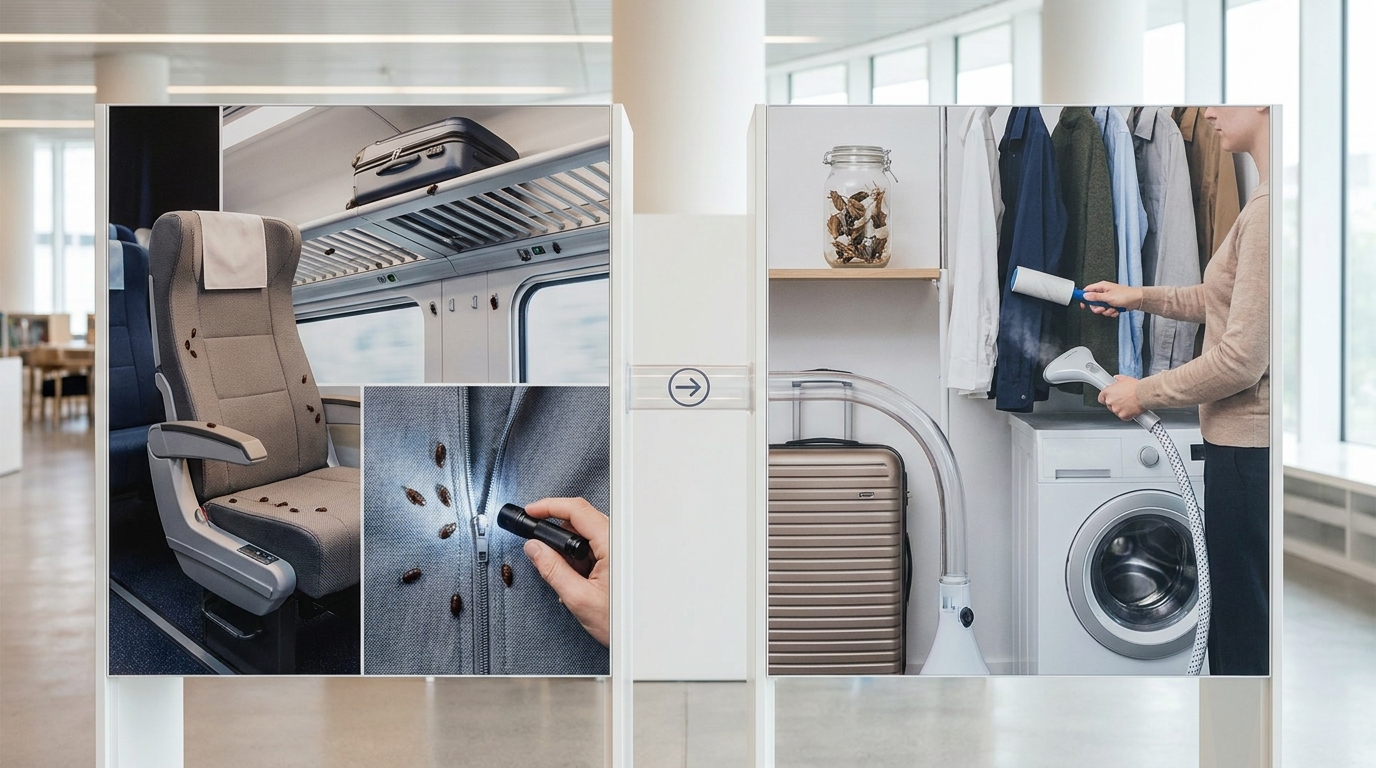
When you get to your seat, at the cinema or on the train, start by looking at the seams of the seat. Adult bedbugs measure between 4 and 7 millimeters and are visible to the naked eye. They are flat, oval, reddish-brown insects. But what you're more likely to find are indirect signs of infestation: small black spots (their droppings), rusty marks on fabric (digested blood), or exuviae, the small translucent skins that nymphs leave behind each time they moult.
Run your hand along the side seams and into the folds of the backrest. If the seat is made of fabric, be more vigilant than with leatherette or plastic: textile surfaces offer more hiding places. On a train, also check the space between the seat and the armrest, and the area under the headrest if it's a model with a removable cover.
How common is it to catch bedbugs in a cinema? Statistically, the risk per individual session remains low. The French National Health and Safety Agency (Anses) points out that the majority of domestic infestations still come from temporary accommodation (hotels, rentals). But the risk does exist in cinemas and on public transport, and increases mechanically with the frequency of your outings. Someone who takes the train three times a week has a very different exposure profile from someone who takes it once a year.
When it comes to prevention on the train, a few simple reflexes can make all the difference. Keep your bag on your lap or on the tray table, rather than on the floor or the seat next to you. If you have a suitcase, use the overhead luggage rack: bedbugs crawl downwards or horizontally, rarely upwards on smooth metal surfaces. Avoid putting your coat on the seat next to you, especially if no one is occupying it and you haven't inspected it.
At the cinema, the same logic applies. Keep your jacket on or fold it in your lap. Your bag, wedge it between your feet, not against the seat. These are simple, almost harmless gestures, but they drastically reduce the contact surface between your belongings and potentially colonized areas.
And if you spot something suspicious? Move. Report it to the staff. Take a photo if possible: it helps operators to target their interventions, and is useful evidence if you have to make a complaint later. Don't be ashamed to do it. Industry professionals prefer to be alerted early than to deal with an infestation that spreads to an entire row or room.
One final point about bedbug bites: they don't appear immediately. The skin reaction may take several hours or even days to appear. Some people don't react at all. So if you don't have pimples when you come out of the cinema, it doesn't mean a thing. Your best weapon is to be vigilant about visual signs at the time of inspection.
Return-home protocol: neutralizing the risk of infestation
You've just returned home from a train journey or an evening at the cinema. Everything went well, and you didn't notice anything out of the ordinary. Can you let your guard down? No. Because passive transfer, by definition, is invisible. Here's the step-by-step protocol we recommend.
Stage 1: the entrance hatch. Don't leave your belongings just anywhere when you arrive. Ideally, you should treat the entrance to your apartment as a buffer zone. Put your bag and coat on a smooth, light surface (a tiled floor, an uncluttered table) rather than on the sofa or bed. The aim: to be able to inspect quickly and avoid contaminating sleeping areas.
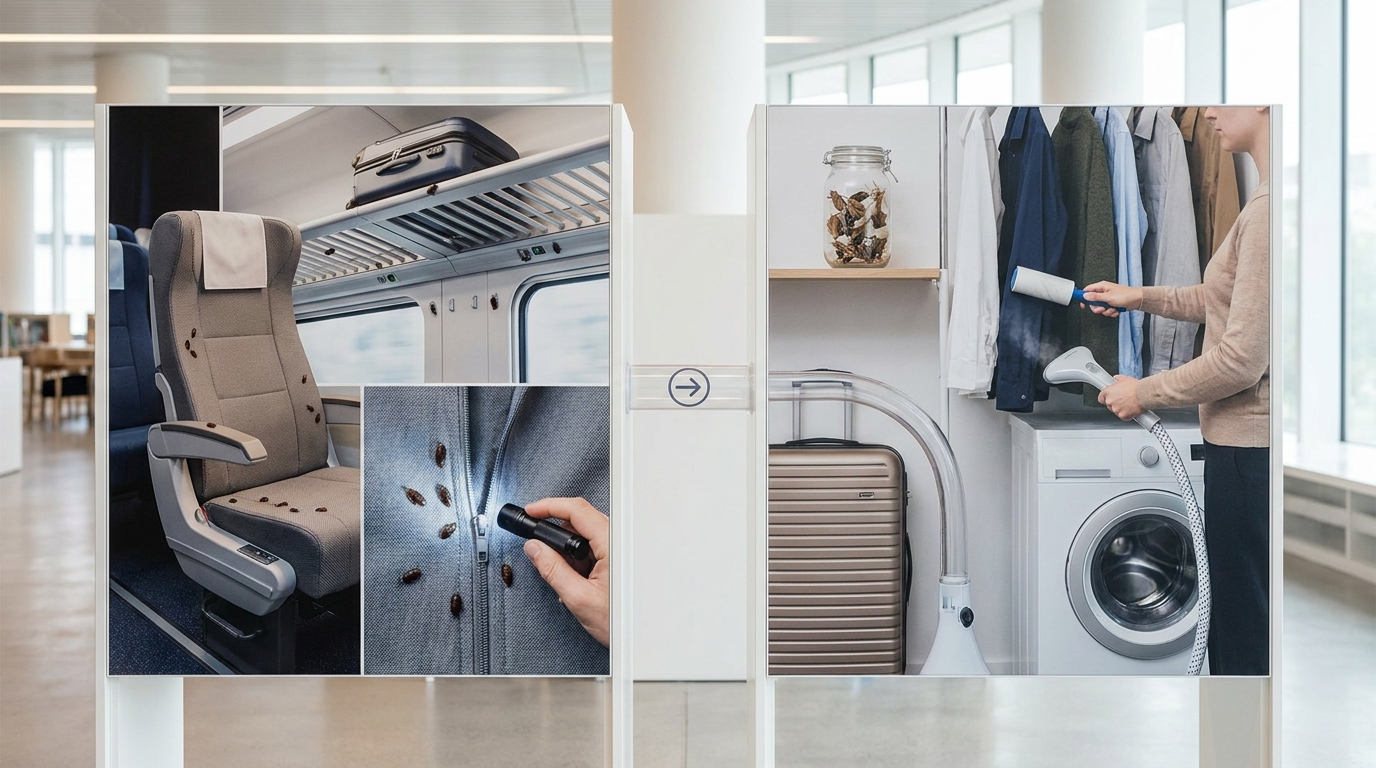
Step 2: Baggage handling. For worn clothing, head straight for the washing machine. Washing at 60 degrees for at least 30 minutes kills bedbugs at all stages of development, including eggs. This is a threshold validated by entomological literature. Below 60°C, you're taking a risk. If some of your clothes can't stand this temperature, put them through a tumble-dryer on high heat for at least 30 minutes: the thermal effect is the same.
Step 3: Non-washable items. Your bag, your shoes, your wallet. Examine them visually. Inspect the seams, pockets and zippers. For in-depth treatment, dry steam is the most effective method available to homeowners. A device capable of producing high-pressure steam (at least 110°C at the nozzle outlet) eliminates bedbugs on contact. Pass the nozzle slowly over all surfaces, paying particular attention to nooks and crannies. Slowness is the key: too fast and the heat won't penetrate far enough.
If you don't have a steam cleaner, there's an alternative: seal suspect objects in an airtight plastic bag and place them in the freezer at -18°C for at least 72 hours. Studies show that this time is necessary to guarantee the death of the eggs, which are more resistant to cold than the adults.
Step 4: Post-exposure monitoring. Stay alert for the next two weeks. Check your sheets in the morning: small spots of blood or blackheads on the mattress are warning signs. If you notice bites grouped in threes or fours, often in a row (the dermatologists« famous »breakfast, lunch, dinner" pattern), it's time to act fast. Call a certified professional. Don't try to treat alone with commercial insecticides: most strains of Cimex lectularius present in Belgium have developed resistance to pyrethroids, as documented by Anses in its 2023 report.
For regular travelers, those who take the train several times a week or frequent movie theaters, the protocol should be systematized. Investing in a small steam cleaner (expect to pay between €80 and €150 for an effective model) is an investment that quickly pays for itself, when you consider that a professional treatment against infestation costs between €500 and €2,000, depending on the surface.
An extra reflex that makes a difference: use certified bedbug covers for your mattress and box spring. These tight-mesh covers prevent any bedbugs from settling in the seams of the mattress and facilitate early detection. It's a modest investment (30 to 60 euros) that turns your bed into a safe zone.
Conclusion
Bringing bedbugs home after a trip to the cinema or a train journey is not inevitable. It's a measurable risk, and there are specific steps you can take to prevent it. A quick inspection before sitting down, intelligent management of your belongings during the journey and a systematic thermal protocol on your return: these three pillars are enough to reduce the risk considerably.
The key is regularity. A protocol applied every other time is useless. Make these reflexes part of your routine, just as you've made hand-washing part of your routine. In 2026, with the ever-increasing flow of travellers, individual prevention is your best protection. Bed bugs won't disappear from public spaces. But they have no reason to enter your home if you close the door to them.
In doubt after a trip? Don't delay. At Pest Patrol, we're here to help you identify the problem and solve it before it sets in.
Frequently asked questions
Why are cinemas and public transport a breeding ground for bedbugs?
Bed bugs take advantage of passenger immobility and high human turnover to spread by «hitchhiking» via clothing or bags. Attracted by body heat and CO2, they nestle in seat textiles and wait for the next passenger, regardless of how clean the environment is.
How to detect bedbugs on the train or in the cinema?
Before settling in, quickly examine the seams and folds of the seat for live insects or signs of infestation. Pay particular attention to small black spots of droppings, traces of dried blood or translucent molt skins left on the fabric.
What protocol should you follow when returning home to avoid infestation?
Place your belongings in a buffer zone (such as the hallway) and immediately wash your clothes at 60°C for at least 30 minutes, or tumble dry them. For non-washable items such as bags or shoes, use a dry steam cleaner at 110°C or place them in the freezer at -18°C for 72 hours.
 Français de Belgique
  English
  Nederlands (België)