
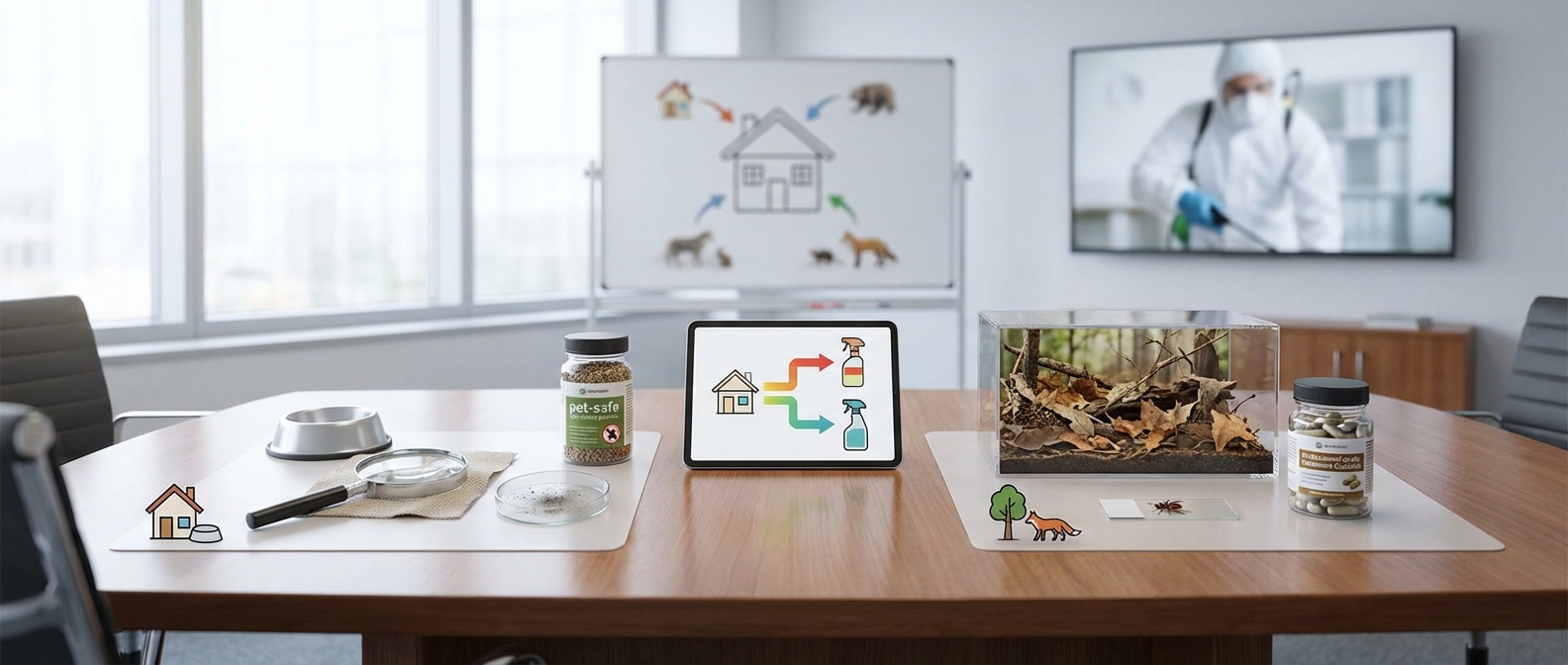
Source of fleas: how to explain a pet-free infestation?
Contents
-
Environmental origin: Former occupants vs. passive transport
-
Recommendations prior to intervention: Adapt treatment at source
You don't have a dog, cat or hamster. And yet, for the past few days, you've had bites appearing on your ankles, in rows of three, itching like never before. You've turned over your bed, inspected your baseboards and vacuumed twice a day. Nothing works. The fleas are there, firmly established, and you don't understand where they're coming from.
Things to remember
-
Find out why your home is infested even without a dog or cat
-
Pest Patrol analyzes external reservoirs (wildlife) and passive transport mechanisms, based on entomology, to identify the true source of your fleas.
-
Pets vs. wildlife
-
Former occupants vs. passive transport
It's more common than you might think. At Pest Patrol, we regularly receive calls from tenants or owners who are completely lost: «But I don't have a pet, it's impossible!» Yes, it is. And the reasons are often very concrete, very identifiable, provided you know where to look. The source of fleas in a pet-free home is not a mystery: it's applied entomology.
Let's take a look at the real mechanisms behind these «phantom» infestations. Wildlife, former occupants, passive transport of insects: each scenario has its own logic, and above all, each requires a different response. Understanding the origin of fleas is the first step to getting rid of them effectively.
Identify the source: Pets vs Wildlife
95% of flea infestations in the home are linked to Ctenocephalides felis, the cat flea. Yes, even when there's no cat. This figure comes from well-documented entomological studies, and it always comes as a surprise. You'd think that without a pet, you'd be safe. The reality is that the order Siphonaptera (the order that groups all flea species) includes over 2,500 species, and their hosts are not limited to pets.
So what causes fleas in a pet-free home? Wildlife. It's the first suspect, and often the right one.
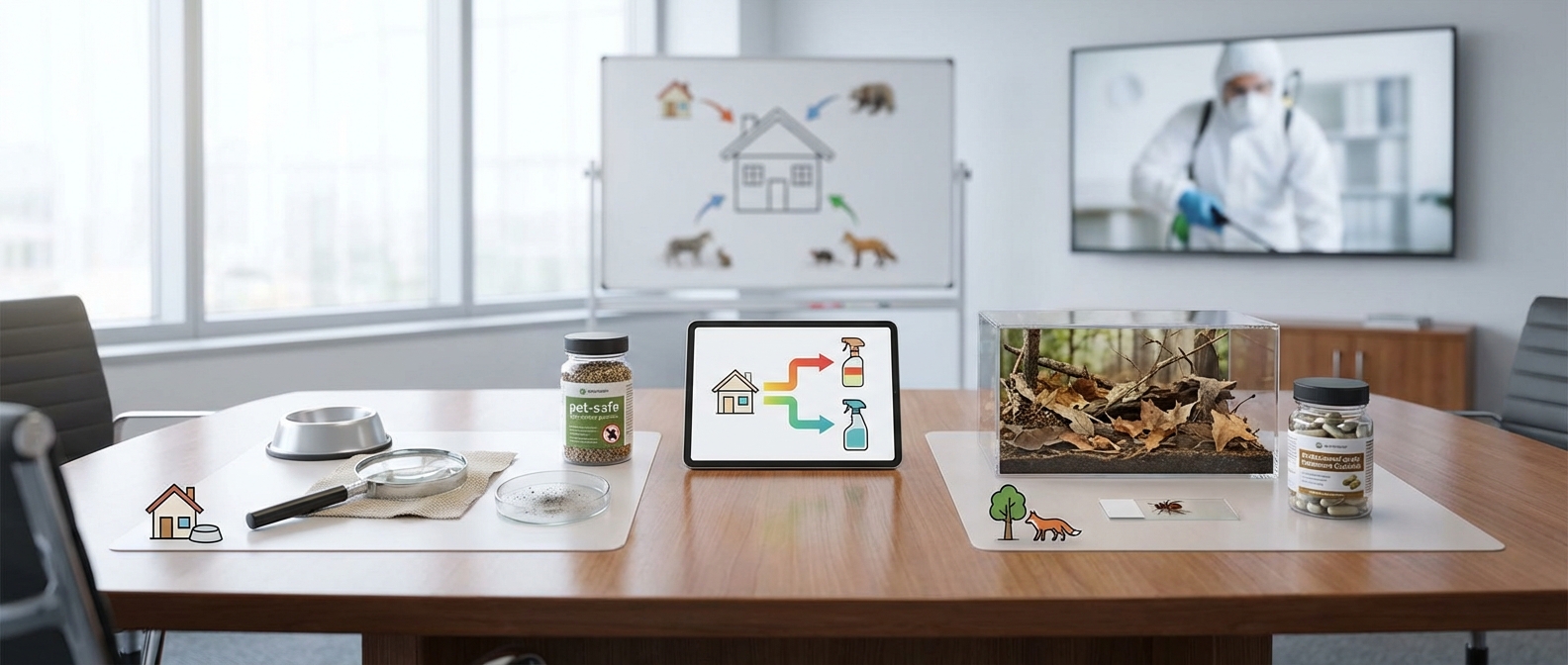
Think of the hedgehogs that cross your garden at night. Weasels nesting in the attic. Pigeons under your roof. Rats in cellars and crawl spaces. Each of these animals is a potential reservoir of fleas. A hedgehog can harbor several hundred fleas simultaneously, according to a study published in Parasitology Research (Brinck-Lindroth & Smit, 2007). These fleas lay eggs that fall to the ground, disperse into the environment and eventually colonize adjacent living spaces.
A classic case: you live on the first floor with a small garden. A stray cat or hedgehog regularly passes by your French window. The tiny flea eggs (0.5 mm) fall from the animal, roll into the gaps in the sill, and the larvae develop inside your home. You've never seen the animal. But the fleas are there.
Another common scenario: attics. If pigeons or starlings are nesting under your roof, their fleas (often Ceratophyllus gallinae, (the bird flea) can migrate into living areas, especially when birds leave the nest. Deprived of their usual host, adult fleas seek a blood meal elsewhere. You become the default target.
So how do you know where the flea nest is? Look for areas where wildlife passes through or rests: attics, basements, cellars and the immediate vicinity of openings. Flea larvae avoid light and concentrate in dark, damp areas rich in organic debris. If you find wild animal droppings in your attic, you've probably found your source.
An important point: fleas are not specific to a single host. Ctenocephalides felis bites cats, dogs, humans, foxes and ferrets. This versatility explains why an infestation can start in wildlife and then persist in a dwelling occupied solely by humans. Fleas adapt. They're not picky eaters.
If you live in an apartment, on an upper floor, with no garden or attic space, wildlife is less likely (but not impossible: rats circulate everywhere in an urban environment). In this case, you need to look at the history of your home. This is the subject of the next section.
Environmental origin: Former occupants vs. passive transport
You've just moved in. The apartment had been empty for three months. Everything seemed clean. And yet, two weeks after your arrival, the bites start. We see this scenario all the time, and it has a precise scientific explanation that can be summed up in one word: diapause.
The flea life cycle comprises four stages: egg, larva, nymph, adult. What most people don't know is that the nymph, enclosed in its silken cocoon, can remain dormant for months. Some studies suggest up to 12 months in favorable conditions. This is known as diapause, a state of suspended development triggered by the absence of stimuli: no vibrations, no body heat, no CO2 exhaled by a potential host.
Concrete translation: the previous tenants had a dog. They left. The adult fleas died for lack of a blood meal. But the nymphs stayed warm in the carpet fibers, between the floorboards, under the baseboards. For weeks, nothing happened. The apartment is empty, silent. Then you arrive. Your footsteps vibrate the floor. Your body gives off heat and CO2. The nymphs receive the signal: a host is there. Emergence is almost simultaneous, sometimes within hours. The result: you're left with dozens of hungry adult fleas that seem to appear out of nowhere.
The resistance of nymphs in their cocoons is remarkable. They can withstand low temperatures and variable humidity, and are protected from most surface insecticides. The sticky cocoon is covered in dust and debris, making it virtually invisible and chemically protective. This is why parquet fleas are such a nightmare in older homes: the gaps between floorboards are perfect refuges for these cocoons.
The Siphonaptera reproductive cycle is highly efficient. A single female lays 40 to 50 eggs a day. In just one month, given the right conditions (temperature between 20 and 30°C, relative humidity around 70%), one flea can produce an offspring of several thousand individuals. When you understand this, you understand why an infestation explodes so quickly.
The other mechanism to be aware of is passive transport. You don't have a pet, nobody did, and yet: fleas. But how? Because fleas travel. Not by flying (they don't have wings), but by clinging. A visitor who has a cat at home can carry adult fleas or eggs on his clothes, in the cuffs of his pants, on his shoes. Second-hand furniture, carpets bought at flea markets, moving boxes stored in garages: these are all potential vectors for the passive transport of insects.
I've seen a case where the infestation came from a wicker basket bought at a garage sale. The basket had belonged to a household with cats. Flea cocoons were lodged in the weave. Two weeks after purchase, the customer had fleas all over her living room. Without ever having had a pet in her home.
Fleas don't come from nowhere. There's always a source, always a vector. The question is not «why me?», but «by what path did they arrive?».»
And why are fleas only found on certain people in the same household? It's not a myth. The chemical composition of sweat, the level of exhaled CO2, body temperature: all these influence an individual's attractiveness to fleas. Some people also react more strongly to bites, giving the impression that they are more targeted, whereas everyone gets bitten.
Recommendations prior to intervention: Adapt treatment at source
Here's the most common mistake: buy an insecticide can at the supermarket, spray it everywhere, and hope it's enough. It won't. It never is. If you don't treat the source, you treat the symptoms, and the infestation returns in a matter of weeks.
The first step, before any eradication, is diagnosis. Where do fleas come from? The answer determines everything else.
If the source is wildlife : the first step is to prevent animals from gaining access to the building. Plug up attic entrances, install grilles over vents and secure crawl spaces. As long as hedgehogs, weasels or pigeons can nest nearby, you'll have a constant supply of fleas. Treating the indoor environment will do no good if the external source remains active. Call in a professional to identify and seal entry points, then treat any flea nests identified in the animals' resting areas.
If the source is a former occupant with animals: the problem is mainly linked to diapausing nymphs. Treatment must specifically target these tanks. The vacuum cleaner is your best ally, and that's no joke. Vacuuming causes vibrations that stimulate the emergence of adults from the cocoon, making them vulnerable to insecticides. An Ohio University study (Hinkle et al.) showed that vacuuming alone eliminated 96% of adult fleas and a significant proportion of eggs and larvae. Vacuum daily for at least two weeks, paying particular attention to baseboards, nooks and crannies, and areas under furniture. Dispose of the bag after each use.
For chemical treatment, opt for products containing an insect growth regulator (IGR), such as methoprene or pyriproxyfen. These molecules prevent larvae from developing into adults, thus breaking the reproduction cycle. An adulticide alone is not enough: it kills the adults present, but does not prevent the nymphs protected in their cocoon from emerging later.
If the source is a passive transport : identify the object or vector. Used furniture? Treat it or get rid of it. Regular visitor with pets? Ask them to treat their own pets (it's not always an easy conversation, but it's necessary). Then treat your interior as in the previous case.
A few technical points to keep in mind:
-
Flea larvae feed on organic matter, particularly adult flea droppings (which contain digested blood). Thorough cleaning deprives the larvae of food.
-
Diatomaceous earth is sometimes recommended as a natural solution. It works by drying out the insects' cuticle. It is a complement, not a primary treatment. Its effectiveness is limited on nymphs in their cocoons.
-
All household linen, cushions, plaids and curtains must be washed at 60°C. Eggs and larvae cannot survive at this temperature.
-
A single treatment is generally not enough. Plan to spray twice, 15 days apart, to cover the entire life cycle (from egg to adult: 2 to 3 weeks in optimal conditions).
What attracts fleas and keeps them in your home? Heat, humidity and the presence of a host. If you go on vacation hoping that the fleas will disappear on their own, the opposite will happen: the nymphs will go into diapause and wait for you. When you return, the mass emergence will be even worse.
For severe or recurring infestations, call in a pest control professional. Technicians use long-lasting products and nebulizers that reach areas inaccessible to the general public (under wooden floors, in wall cracks, behind pipes). A good professional will always start with a diagnosis before taking out his sprayer. If someone turns up and sprays without asking you about the history of your home, the presence of wildlife or your habits, change service providers.
Eradicating fleas in a pet-free home is entirely possible. But it requires method, rigor and, above all, correct identification of the source. Without that, you'll be going round in circles.
Conclusion
Fleas without animals are neither mysterious nor exceptional. Wildlife in the vicinity, diapausing nymphs left behind by former occupants, contaminated objects: the routes of entry are multiple and well documented by entomology. The key is to trace the source before treating. An insecticide without diagnosis is a band-aid on a wooden leg.
If you find yourself in this situation, take the time to inspect your surroundings: attics, cellars, garden, newly acquired furniture. Note when the bites started and in which rooms they are concentrated. This information is invaluable to a professional. And if the infestation persists despite your efforts, contact Pest Patrol: we'll identify the source of your fleas and set up a protocol tailored to your specific situation.
Frequently asked questions
How can you have fleas without having pets?
Infestation usually comes from wildlife (hedgehogs, birds in the attic, rats) or passive transport (visitor's clothes, second-hand furniture). Fleas can also remain dormant in the floor in the form of pupae for several months after the departure of former tenants with pets.
Do floor fleas die on their own?
No, fleas don't disappear without intervention. In the absence of a host, nymphs enter diapause (a state of survival) in their protective cocoon, and can wait up to a year. They «wake up» instantly as soon as they perceive the warmth or vibrations of a human presence.
Why do fleas bite me when I don't have a cat?
The cat flea (Ctenocephalides felis) is opportunistic, biting humans in the absence of an animal host. If there are pigeon nests or rodents in the vicinity of your home, the fleas will migrate to the living areas to find a blood meal, making you their default target.
How to get rid of fleas for good without a pet?
Success depends on diagnosing the source: block access to wildlife, vacuum daily to stimulate cocoon hatching, and wash laundry at 60°C. Use an insecticide with growth regulator (IGR) to break the life cycle from egg to adult.
 Français de Belgique
  English
  Nederlands (België)