
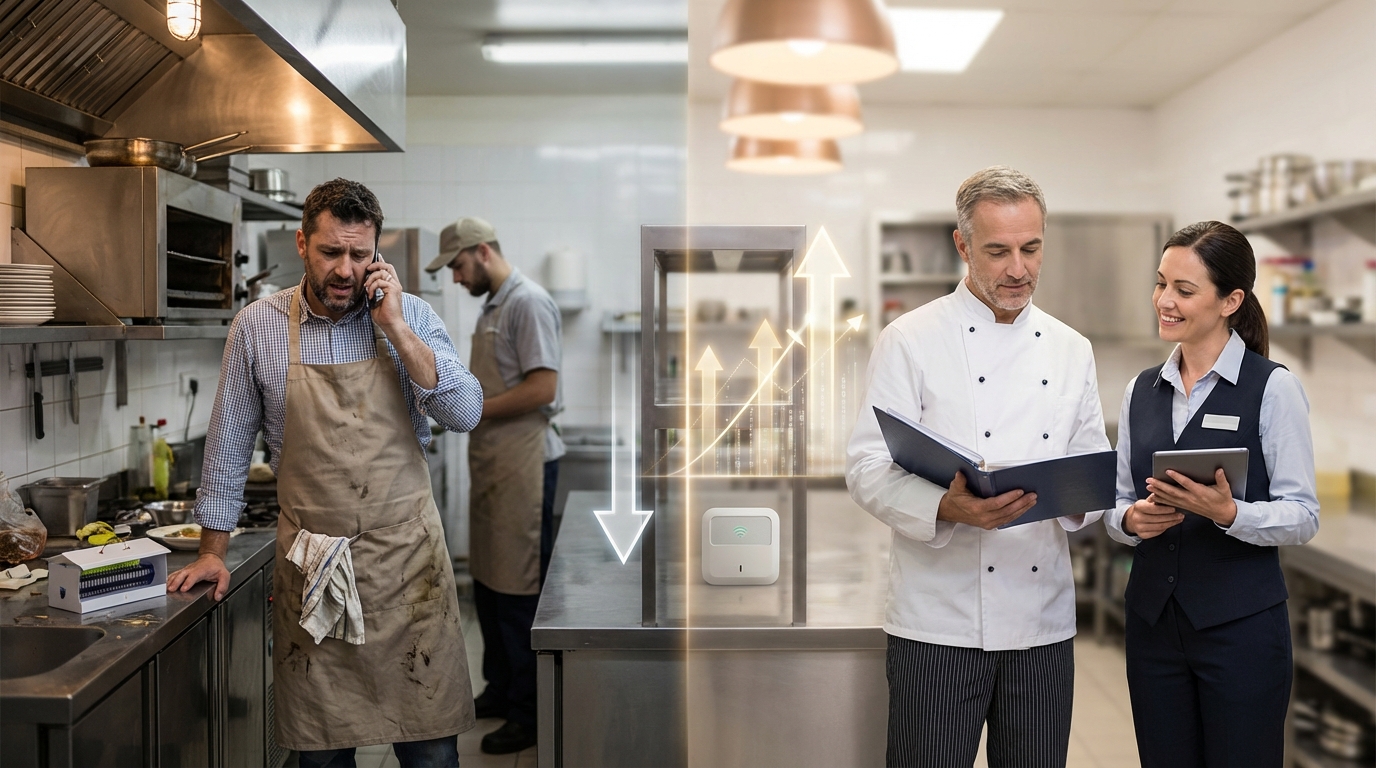
Restaurant pest control: the benefits of an annual contract
Contents
-
HACCP regulations and science: why waiting for infestation is a mistake?
-
Annual contract vs. one-off intervention: the match of cost and efficiency
-
Choosing the right rat removal contract: selection criteria and real rates
A rat crossing the room on a Friday night is a guaranteed one-star Google review. But beyond the nightmarish anecdote, the issue of rat control in restaurants touches on something far more structural: your regulatory compliance, your profitability and, let's face it, the survival of your establishment in the event of a health inspection.
Things to remember
-
Using a scientific and economic approach, we demonstrate that one-off intervention is a financial trap for restorers.
-
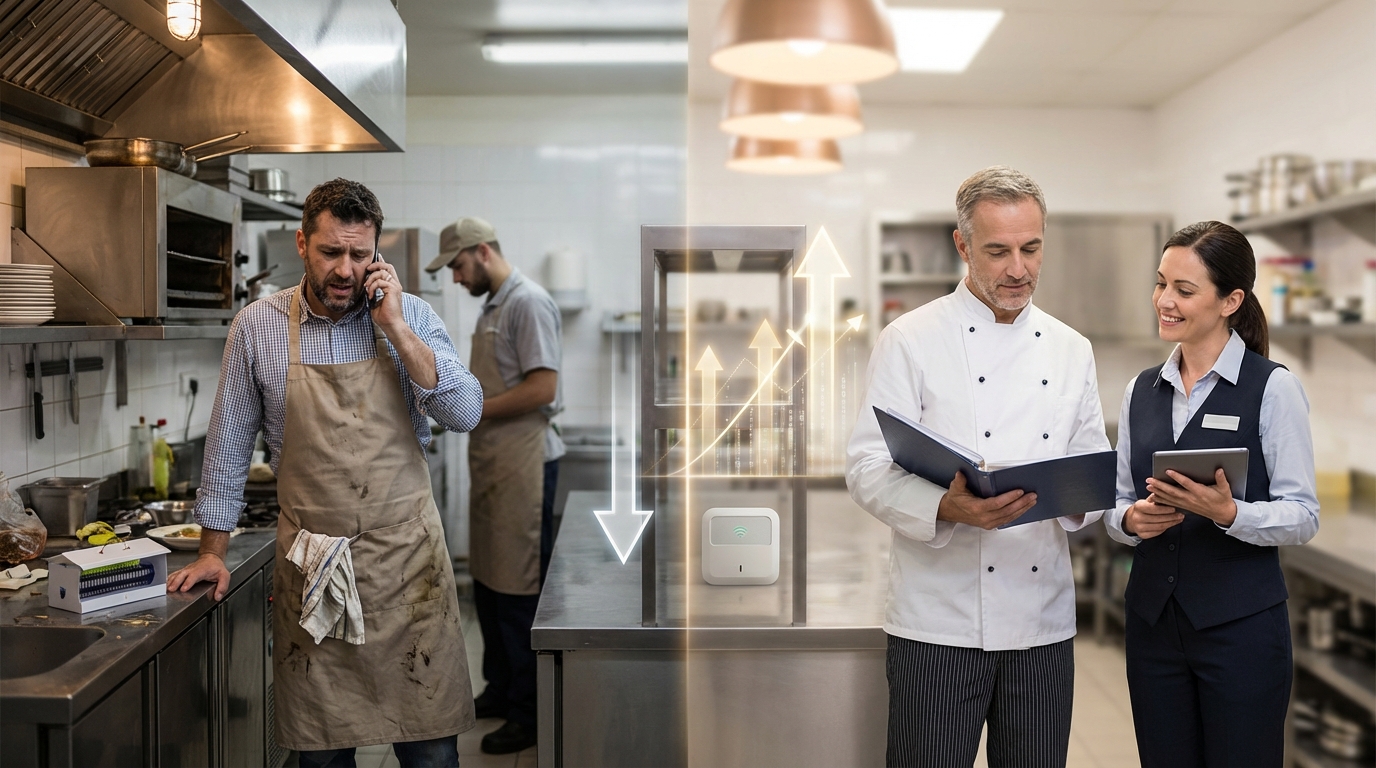
By contrasting the stress of the ‘call-out’ with the serenity of the HACCP omium contract, we prove that prevention is a profitable investment in brand image.
-
Why waiting for infestation is a mistake?
-
Compare the different options before deciding.
Most independent restaurateurs still operate in firefighter mode. A rodent appears, a technician is called in urgently, full price is paid, the problem is fixed. Then forget about it. Until the next time. This pattern is a financial and health trap that science and economics can easily dismantle. An annual deratting contract for restaurants is not an unnecessary expense: it's a measurable investment, with a tangible return on your costs, your peace of mind and your brand image.
We're going to break it all down together: the regulations, the real figures, and the criteria for choosing a service provider who doesn't sell you hot air.
HACCP regulations and science: why waiting for infestation is a mistake?
Let's start with what the law says, because it's often misunderstood. The requirement for deratting in restaurants is not a recommendation. It's a regulatory requirement enshrined in European regulation (EC) no. 852/2004, transposed into Belgian law. The text is crystal-clear: any operator in the food sector must put in place procedures for pest control. Not «if necessary». Not «when we see them». All the time.
HACCP (Hazard Analysis Critical Control Point) standards go even further. They require a preventive, documented and traceable approach. Your sanitary logbook must contain proof of your rodent control actions: deratting plans, intervention sheets, baiting station records. During a health inspection, the inspector doesn't ask you if you've seen rats. He asks you to prove that you are taking action to prevent them.
And that's where science comes in. A study published in the Journal of Pest Science (Buckle & Smith, 2015) has shown that populations of Rattus norvegicus, rats, found in 90% of urban infestations, follow an exponential growth curve when left uncontrolled. A pair of rats can produce up to 1,500 offspring in one year under favorable conditions. A restaurant kitchen, with its sources of food and warmth, is exactly such favorable conditions.
Waiting to see a rodent before taking action means intervening when the colony is already established. Field studies confirm this: when you observe a rat in broad daylight, the underground or hidden population often numbers several dozen individuals. At this stage, eradication costs three to five times more than a preventive program, according to data from the Chambre Syndicale des Industries de Désinfection (CS3D).
There's also an aspect that many restaurateurs underestimate: cross-contamination. Rodents don't just nibble your stock. They leave traces of urine and feces on work surfaces, cooktops and storage areas. Leptospirosis, salmonellosis, hantavirus: these are not theoretical risks. They are documented pathologies, transmissible to humans through contact with contaminated surfaces. A study by the Pasteur Institute points out that leptospirosis affects around 600 people a year in mainland France, with an over-representation in the food and sanitation professions.
So the question isn't «is deratting compulsory for a restaurant? The answer is a resounding yes. The real question is: would you rather deal with it calmly, with a structured plan, or in a panic, with an inspector handing you a report?
Annual contract vs. one-off intervention: the match of cost and efficiency
Let's put some figures on the table. The price of deratting in restaurants varies enormously depending on the method of intervention, and this is precisely what creates the illusion.
An emergency intervention, such as the one triggered when an employee screams while opening the storeroom, costs between €150 and €400, depending on the size of the premises and the severity of the infestation. Sounds manageable. Except that this single intervention never solves the underlying problem. It only treats the symptoms. Three weeks later, the rodents come back through the same passage, and you call again. Two, three, four times a year. Total cost? Between €600 and €1,600 a year, with no guarantee of lasting results, no documented follow-up for your health record, and operational stress for every episode.
In comparison, an annual restaurant pest control contract is usually between €400 and €900 per year for a medium-sized establishment (less than 200 m²). This rate typically includes four to six preventive visits, installation and monitoring of secure baiting stations, provision of HACCP-compliant intervention reports, and often an emergency intervention clause at no extra cost.
Do the math. Even in the most optimistic scenario for one-off intervention, the annual contract is less expensive. And in the realistic scenario, where the infestation recurs (which happens in 70% of cases, according to feedback from pest control professionals in the field), the gap widens significantly.
But the direct cost is only the visible part. Pest prevention through a structured contract also protects your indirect sales. A restaurant that is administratively closed following an unfavorable health inspection costs you between €2,000 and €10,000 a week in lost earnings, depending on your volume. Not to mention your reputation. A closure for unsanitary conditions is reported in the local press within 24 hours. It stays on Google for years.
There's another angle that's often overlooked: the mental burden. Dealing with deratting on an ad hoc basis means you're not devoting the time of your brain to your kitchen, your teams and your customers. With an annual contract, you get a service provider who manages the schedule, who comes on the scheduled dates, who documents everything. You sign the contract, file the reports and that's it.
Industry data is clear on this point. The CS3D annual report shows that plants under preventive contracts report 85% fewer severe infestations than those operating under curative contracts. Not 10%, not 30%. Eighty-five percent. That's the difference between a structural problem and a non-event.
Choosing the right rat removal contract: selection criteria and real rates
Not all service providers are created equal. Here's what separates a serious contract from a cosmetic service.
First criterion: registration. A 3D service provider (deratting, disinsectisation, disinfection) must be registered with the restricted biocidal circuit, mandatory since 2016a for any company using biocidal products. Ask for it. If they can't provide it, walk away immediately. It's non-negotiable.
Second criterion: the initial diagnosis. A good service provider doesn't email you a pest control estimate after a three-minute conversation. They come to your premises, inspect them, identify entry points, risk areas and the type of pest. This diagnosis must be free of charge or included in the contract. If it's billed separately without obligation, beware: this is often the sign of a business model based on multiple interventions.
Third criterion: the content of the contract. Demand a document that specifies :
-
Number of visits per year (minimum four, ideally six for a restaurant)
-
Type of devices installed (secure baiting stations, mechanical traps, detectors)
-
The products used, with their safety data sheets
-
Systematic provision of detailed intervention reports
-
An emergency response clause included in the annual contract price
-
Cancellation conditions
Let's be precise about the actual rates. For an independent restaurant of between 80 and 200 m², a serious annual contract with a certified 3D service provider is in this range:
-
Deratting only : 400 to 700 € HT/year (4 to 6 passages)
-
Full 3D contract (deratting + disinsectisation + disinfection): €700 to €1,200 excl. tax/year
-
Superstores (over 300 m², central kitchens): €1,200 to €2,500 excl. tax/year
If you're offered a contract for €200 a year, ask yourself some questions. At that price, the service provider can't afford to visit you six times, use quality products and write compliant reports. You'll get a quick pass every quarter, a stamp on a standard form, and zero added value in the event of an inspection.
An often overlooked point: make sure the service provider is familiar with the specificities of the restaurant business. Rodent control in a restaurant is very different from rodent control in a warehouse or apartment building. The constraints are different: food safety, presence of the public, staggered working hours, food storage areas. A technician who places brodifacoum-based baits next to your foodstuffs without adequate protection is a health risk in itself.
Ask for references too. Serious providers have other restaurants in their portfolio and can put you in touch with them. Give them a call. Ask if reports are delivered on time, if technicians are punctual, if emergency interventions are really without extra cost. This feedback is worth more than any sales brochure.
Finally, a word of advice: never sign a contract for more than 12 months with tacit renewal without a reasonable exit clause. The market evolves, and so do your needs. A good service provider doesn't need to lock you in to keep you. They keep you because they do their job well.
Conclusion
A deratting contract for a restaurant is not an optional expense item. It's a regulatory compliance tool, a cost-saving lever and an insurance policy for your reputation. The figures are indisputable: prevention costs less than cure, better protects your food safety, and puts you in a position of strength in the face of any health inspection.
If you don't already have a contract in place, ask for three quotations from certified 3D pest control companies in your area. Compare content, not just price. And implement the system before the problem arises, not afterwards. Your health record, your accountant and your customers will thank you.
Frequently asked questions
Is deratting legally compulsory for a restaurant in Belgium?
Yes, under European regulation (EC) no. 852/2004, all food business operators must implement pest control measures. In the event of an inspection by the FASFC, you must present a deratting plan and an up-to-date health logbook proving your preventive actions.
Why choose an annual contract rather than a one-off intervention?
An isolated intervention treats the symptoms but not the colony, leading to costly recurrences in 70% of cases. An annual contract guarantees HACCP monitoring and constant prevention, and is statistically less expensive than multiple emergency interventions (between €400 and €900 per year).
What is the average cost of a pest control contract for a restaurant?
For a standard establishment (less than 200 m²), a serious contract including 4 to 6 annual visits costs between €400 and €700 ex-VAT. For complete «3D» protection (rats, insects, disinfection), rates are generally between €700 and €1,200 ex-VAT per year.
How do I know if my pest control company is certified?
A reliable professional must be registered with the restricted biocide circuit. Ideally, they should also be CEPA-certified. Beware of abnormally low rates that don't allow for rigorous, compliant documentation...
 Français de Belgique
  English
  Nederlands (België)