
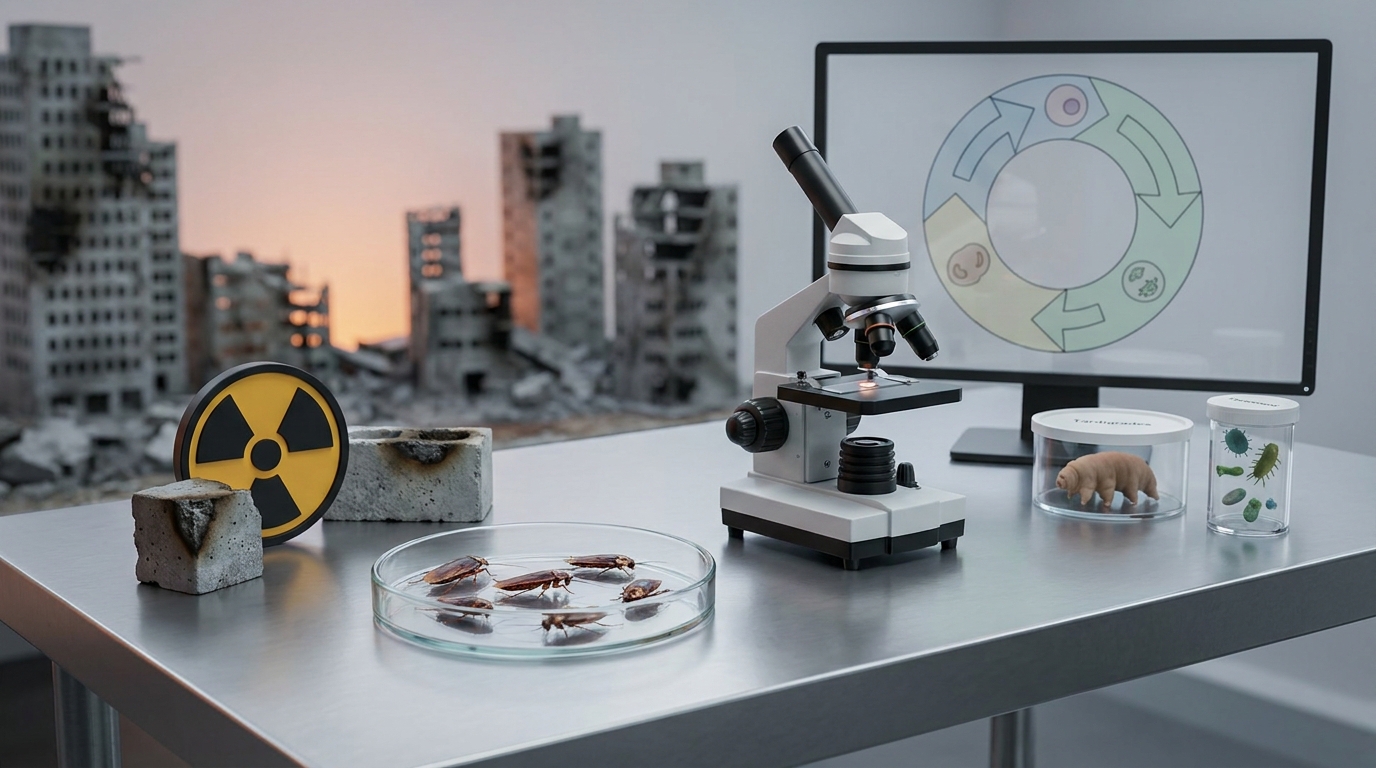
Can cockroaches really survive a nuclear explosion?
Contents
-
The biological secret of cockroach resistance to ionizing radiation
-
Lethal doses and physical limits: what scientific studies say
-
Survivors of the apocalypse: cockroaches face the new champions of survival
We've all heard the phrase at least once: «Even after a nuclear bomb, cockroaches will still be around.» It's become a cultural reflex, almost a meme. But when you dig a little deeper, the reality is more nuanced, and frankly more interesting, than the myth.
Things to remember
-
An in-depth scientific deciphering of cockroach resistance, explaining the role of the cell division cycle and setting the real limits of their survival in the face of heat blast and radiation compared to other extremophilic species.
-
The biological secret of cockroach resistance to ionizing radiation
-
what scientific studies say
-
cockroaches face the new champions of survival
Cockroaches are actually more resistant to radiation than we are. That's a fact. But there's more to surviving a nuclear explosion than ionizing radiation. There's the blast, the heat, the shockwave. And there's nothing magical about cockroaches. So where does this reputation come from? What does science really say about cockroach survival in the face of radiation? And above all, are they really the champions of resistance, or do we steal their thunder?
We're going to break it all down, with studies to back it up. No sensationalism, just verifiable facts and a few surprises.
The biological secret of cockroach resistance to ionizing radiation
To understand why a cockroach takes in doses of radiation that would kill us in a matter of hours, we need to go back to cellular biology. More precisely, to cell cycle.
Ionizing radiation is most damaging when a cell is in the process of dividing. During mitosis, DNA is exposed, unwound and vulnerable. This is when gamma rays break DNA strands, causing lethal mutations. In humans, our cells are constantly dividing: bone marrow, intestines, skin. We're cell division factories, and that's exactly what makes us fragile in the face of radiation.
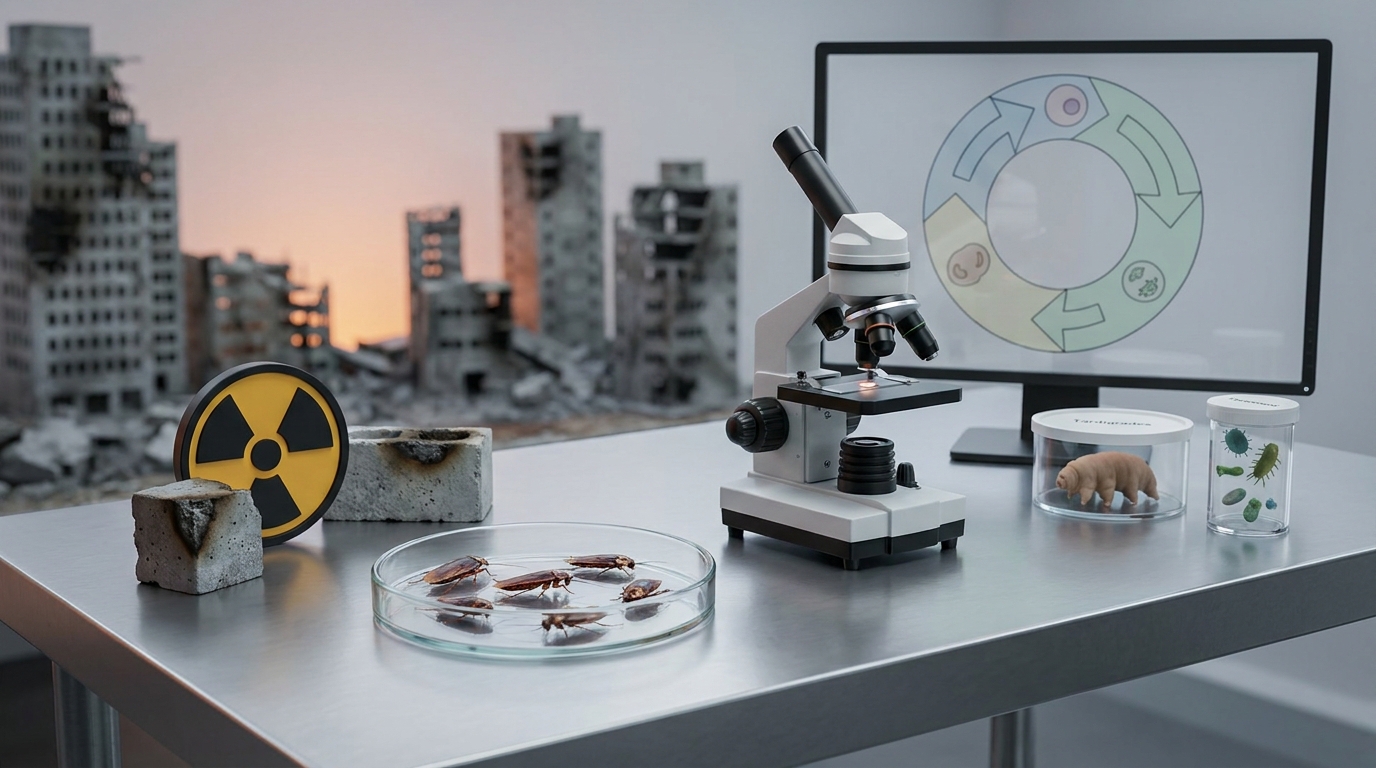
In insects, and cockroaches in particular, the rhythm is radically different. Cockroaches divide massively only during moulting. The rest of the time, their cells are in a resting phase (the famous G0 phase of the cell cycle). DNA is compact, tidy and protected. The result: when ionizing radiation passes through a cockroach's body between molts, there are far fewer dividing cells to be damaged.
A study published in Discovery Magazine and repeated by several entomologists, confirms this mechanism. Cockroaches moult about once a week in the pupal stage. During the remaining six days, their rate of cell division is minimal. It is this feature of the insect cell cycle that lies at the heart of their biological resistance to radiation.
Another factor is the relative simplicity of their organism. Cockroaches have no bone marrow. Their circulatory system is open, without the rapidly renewing tissues which, in mammals, are the first to suffer from irradiation (acute irradiation syndrome). Fewer sensitive tissues, less damage.
Does that mean they're invincible? No. Their DNA is still damaged. But their ability to «take it» comes from this favorable biological timing: few cell divisions at the moment of exposure. It's mechanical, not miraculous.
An often overlooked point: this biological resistance is not unique to cockroaches. Many resistant insects share the same pattern of widely spaced cell divisions. Fruit flies, certain beetles and even ants have a higher tolerance to radiation than vertebrates. Cockroaches are not unique; they're simply the most famous.
Lethal doses and physical limits: what scientific studies say
Let's move on to the figures, because this is where the myth begins to crack.
The lethal dose for a human being is around 4 to 10 Grays (the Gray being the unit of radiation that measures the energy absorbed per kilogram of tissue). At 10 Grays, death is almost certain in a matter of days, sometimes hours.
For a German cockroach (Blattella germanica), the lethal dose climbs from 64 to 100 Grays depending on the study. The American cockroach (Periplaneta americana) can withstand up to 100 Grays before succumbing. That's roughly ten times more than a human. Impressive? Yes. Enough to survive a nuclear bomb? Not that quickly.
A nuclear explosion isn't just radiation. It's three simultaneous phenomena:
-
Thermal flash temperatures of several million degrees at ground zero, and several thousand degrees within a radius of a few kilometers. Thermal heat carbonizes everything organic. A cockroach, however resistant it may be to radiation, is instantly roasted at these temperatures.
-
The shock wave The result: an overpressure that destroys buildings, hurling debris at hundreds of km/h. An insect weighing just a few grams has no chance against this blast. The shockwave alone is enough to kill almost all living creatures in a large area.
-
Radioactive fallout This is where cockroach resistance comes into play. In areas far from the epicenter, where the blast and heat are no longer lethal, residual radiation can still kill. And it's in this very context that cockroaches fare better than we do.
Experiments conducted in the 1950s and 1960s, in particular those reported by the MythBusters in 2008, confirmed this hierarchy. The program exposed German cockroaches to increasing doses of cobalt-60. At 100 Grays, around 10 % cockroaches still survived after a month. At 1,000 Grays, none survived. For comparison, ground-level radiation in Hiroshima was estimated at around 34 Grays within a 1.5 km radius. So yes, a cockroach could have survived the radioactive fallout at that distance. But the blast and thermal heat had wiped out everything long before.
So, what animal would survive a nuclear bomb? If we're talking about the explosion itself, with the blast, the heat, the whole package: no macroscopic animal within a significant radius. The question only makes sense in terms of residual radiation. And here, cockroaches aren't even the best candidates.
A final point on doses in Grays: the median lethal dose (LD50, the dose that kills 50 % of a population) varies according to the species of cockroach, the age of the individuals and their stage in the moulting cycle. A cockroach in full moult at the moment of irradiation dies at much lower doses. Timing, again and again.
Survivors of the apocalypse: cockroaches face the new champions of survival
100 Grays is remarkable for an insect. But on the scale of living organisms, cockroaches are far from the most resistant to radiation. Really far.
Let's take the tardigrades, These micro-animals, less than a millimetre in size, are nicknamed «water bears». In a state of cryptobiosis (a kind of suspension of all metabolic activity), they can withstand doses in excess of 5,000 Grays of gamma rays. Fifty times more than a cockroach. A study published in Astrobiology in 2012 showed that they can also survive the vacuum of space, temperatures close to absolute zero and crushing pressures. In a post-nuclear ecosystem, tardigrades would have a considerable head start over any insect.
And then there's Deinococcus radiodurans, a bacterium that microbiologists have nicknamed «Conan the Bacterium». Its resistance? Up to 15,000 Grays without flinching. Its secret is fascinating: it possesses a DNA repair system unrivalled in the living world. Where radiation breaks DNA into hundreds of fragments, Deinococcus radiodurans reconstitutes its genome in just a few hours, like a puzzle that puts itself back together again. A publication in PLOS ONE detailed this repair mechanism, which involves multiple copies of the genome and specialized enzymes.
To put things in perspective:
-
Human: lethal dose around 4 to 10 Grays
-
Cockroach: lethal dose around 64 to 100 Grays
-
Fruit fly: approx. 640 Grays
-
Parasitic wasp Habrobracon up to 1,800 Grays
-
Tardigrade: over 5,000 Grays
-
Deinococcus radiodurans 15,000 Grays
The cockroach isn't even in the top 5 of the most radiation-resistant organisms. The wasp Habrobracon, also an insect, far surpasses it. When it comes to resistant insects, cockroaches are beaten by many of their arthropod cousins.
So why does this myth persist? Probably because cockroaches are the hardy pests we all know. We see them in our kitchens, we crush them (by the way, contrary to popular belief, crushing a cockroach doesn't cause an invasion; the real risk is scattering eggs if the cockroach is a female carrying an ootheca). Their everyday presence in our lives makes them perfect candidates for urban legends. Tardigrades, on the other hand, are invisible to the naked eye. Less spectacular for a myth.
In a realistic nuclear apocalypse scenario, the first to recolonize an irradiated environment would probably be extremophilic bacteria, radiotrophic fungi (some Chernobyl fungi use radiation as an energy source, which is pretty crazy), then various insects, nematodes, and yes, cockroaches among others. The post-nuclear ecosystem would not be a world of giant cockroaches. It would be a microbial world first, then arthropods, and vertebrates much later.
Can cockroaches survive better than we do? Without a doubt. Would they be the last ones standing? Absolutely not.
Conclusion
The myth of the indestructible cockroach rests on a foundation of truth: thanks to their particular cell cycle and infrequent cell divisions, cockroaches tolerate doses of radiation ten times higher than those that would kill us. This is a solid scientific fact. But a nuclear explosion is much more than radiation. The blast, the thermal heat, the shock wave make no distinction between a human and a cockroach.
And even in the field of pure radiation, cockroaches are crushed (no pun intended) by tardigrades, by Deinococcus radiodurans, and many other insects. Their real strength, the one that concerns you on a daily basis, is their ability to adapt to our domestic environments: they resist starvation, reproduce quickly and sneak in everywhere.
If you find them in your home, don't rely on a nuclear bomb to get rid of them. Contact a pest control professional: it's far more effective, and less damaging to the decor.
Frequently asked questions
Can cockroaches really survive a nuclear bomb?
Near the epicenter, no: the thermal heat and shockwave would kill them instantly. However, they could survive the radioactive fallout in more remote areas, where the radiation would kill any human being.
Why are cockroaches more resistant to radiation than humans?
Their secret lies in their slow cell cycle. Radiation damages DNA mainly during cell division; as cockroach cells only divide during molting (about once a week), they are much less vulnerable than our own.
How much radiation can a cockroach withstand?
A cockroach can take between 64 and 100 Grays, around ten times more than a human, for whom a dose of 10 Grays is fatal. However, beyond 1,000 Grays, no cockroach survives, proving that they do have a physical limit.
Which animal is the most resistant to radiation (better than the cockroach)?
The cockroach is far from the champion: the tardigrade can withstand over 5,000 Grays, and the Deinococcus radiodurans bacterium can withstand up to 15,000 Grays. Even certain insects, such as the Habrobracon wasp, far surpass the cockroach in resistance.
Will cockroaches rule the Earth after an apocalypse?
In a post-nuclear world, the first survivors would be extremophilic bacteria and fungi. Cockroaches would be part of the landscape, but they would share this world with many other insects and micro-organisms far more resistant than they are.
 Français de Belgique
  English
  Nederlands (België)