
Does iron steam kill bedbugs?
Contents
-
Iron vs. steam cleaner: comparison and equipment limitations
-
Practical guide and pre-purchase recommendations for a successful steam treatment
You've discovered bedbugs in your home, and before you spend €300 on a professional treatment, you look at your iron and wonder: could this work? The short answer is yes, heat kills bedbugs. But the short answer is yes, heat kills bedbugs. But the long answer is worth considering, because there's a gulf between «killing a bedbug» and «eradicating an infestation».
Things to remember
-
This content sets itself apart by analyzing the science of thermal shock (lethal temperature of 60°C) to validate the use of domestic iron, while exposing its limitations in the face of professional cleaners.
-
We propose a rigorous application protocol based on entomological studies to transform an everyday tool into an effective pest control weapon.
-
Why iron steam kills bedbugs
-
Compare the different options before deciding.
What we're going to do here is put the figures on the table. What temperature do we really need to reach? How long does it take? Can your iron compete with a professional steam cleaner? We're relying on serious entomological studies to answer all these questions, not grandma's tricks copied ten times over from the Internet.
The aim: to give you a clear protocol, honest about its limitations, for transforming an everyday tool into a pest control weapon. And above all, to help you decide whether it's enough for your situation, or whether you need to step up a gear.
Thermal efficiency: why iron steam kills bedbugs
60°C. That's the number to remember. At this temperature, maintained for at least 10 minutes, bedbugs die in all stages: adults, nymphs and even eggs. This is the so-called lethal temperature for bedbugs, confirmed by several studies, including those published by the Journal of Economic Entomology. Above 80°C, death is almost instantaneous.
Why does heat work so well? Because bed bugs are cold-blooded insects. They have no thermoregulatory mechanisms. When you expose a bedbug to a brutal thermal shock, its proteins denature and its cells burst. It's irreversible. No resistance is possible, unlike chemical insecticides against which some strains have developed a tolerance (a study by the University of Kentucky showed that some populations are resistant to over 1,000 times the normal dose of deltamethrin).
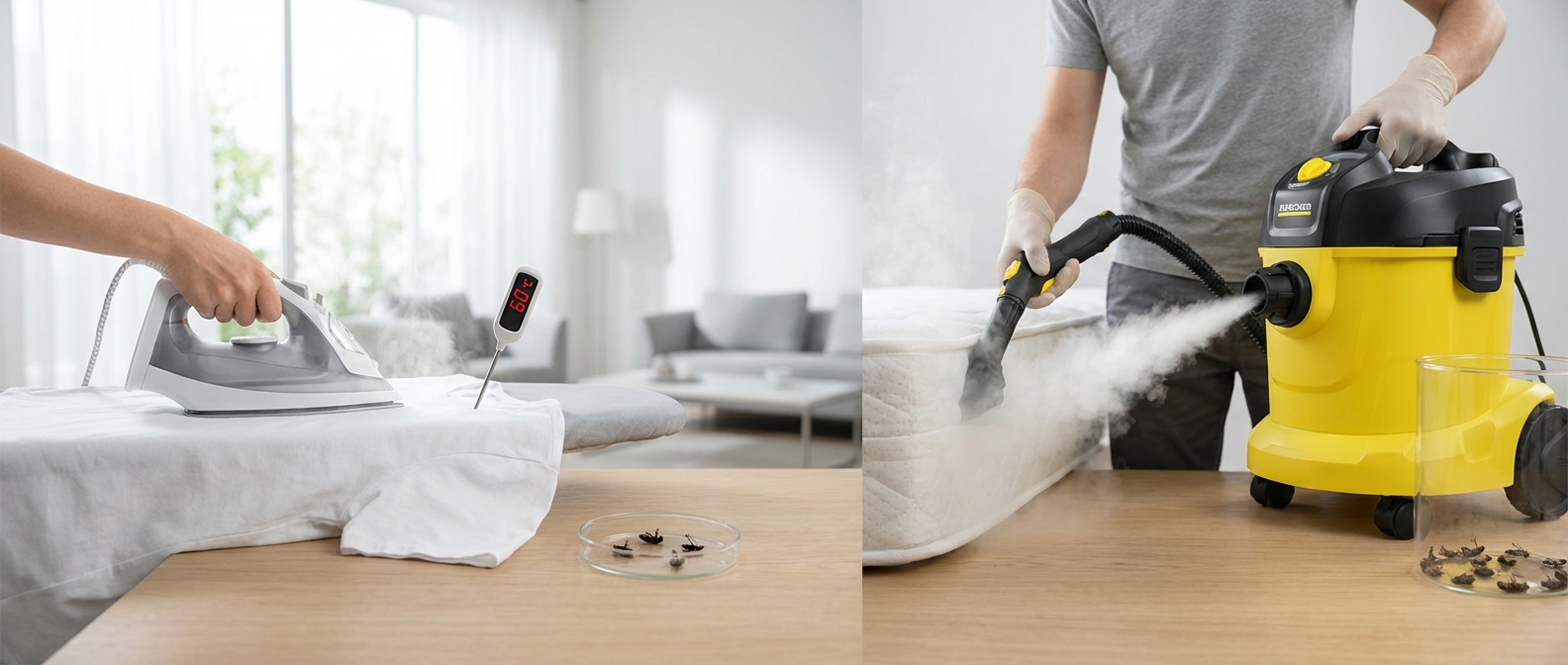
A conventional iron produces steam at between 100°C and 220°C from the soleplate. On paper, this is well above the threshold needed to kill bedbugs with heat. The steam penetrates the fabric fibers, reaching the seams, the folds, the areas where these bugs love to hide. That's where it gets interesting.
But there's a fundamental difference: the temperature at the footbed outlet is not the temperature that reaches the mattress core. Steam cools very quickly on contact with air and fabric. At a depth of 2 cm in a folded sheet, you may already have fallen below the fateful 60°C. That's why the steam must be applied slowly, methodically and repeatedly.
Eliminating bedbug eggs is even more demanding. The eggs are protected by a tough shell and require prolonged exposure. According to Kells and Goblirsch (2011, Journal of Medical Entomology), you need to maintain 60°C for at least 60 seconds to obtain 100% of egg mortality. With an iron, this means insisting on each area, not just a quick pass.
Does ironing also kill fleas, while we're at it? Yes. Fleas have a similar, if not lower, heat tolerance. The steam from an iron kills them just as effectively. But back to our bedbugs.
Natural heat treatment has a huge advantage: it leaves no chemical residue, poses no risk to children or pets, and is available immediately. No need to wait for an appointment with a professional. Your iron is in the cupboard, the infestation is there now. It's this immediacy that makes the method so popular. And it works, provided you understand its limitations, which we'll get to right away.
Iron vs. steam cleaner: comparison and equipment limitations
An iron and a professional steam cleaner are a bit like comparing a lighter to a blowtorch. Both produce heat, but not with the same power, range or regularity.
Let's start with the iron. Its steam is «wet»: it contains many water droplets in suspension. It's perfect for smoothing a shirt, less ideal for a bedbug treatment. Why is this so? Because this humidity rapidly cools the steam and can soak your textiles before the heat has had time to penetrate deeply. Heat penetration into fabrics remains superficial, limited to the first few millimeters. On a thin sheet or pillowcase, this may be enough. On a thick mattress, box spring or the reinforced seams of a sofa, forget it: the iron won't reach the bedbugs nestling inside.
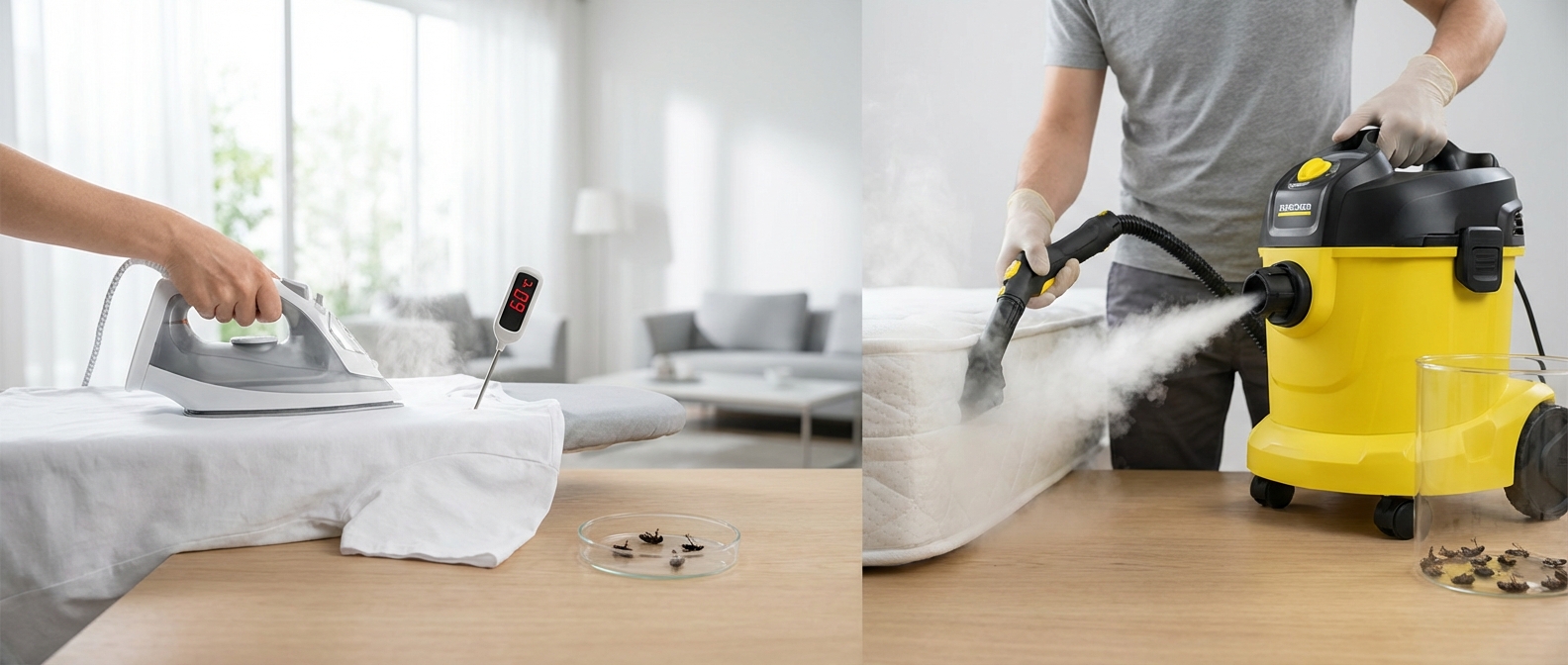
Professional steam cleaners, on the other hand, produce dry steam. The difference between dry steam and wet steam is crucial: dry steam contains less than 5% of residual moisture, enabling it to rise to a much higher effective temperature at the point of contact (often 150°C to 180°C) and penetrate deeper without soaking surfaces. Manufacturers specializing in pest control, such as Polti or Dupray, design devices with specially-adapted nozzles that focus the jet on precise areas: mattress seams, skirting boards, cracks in parquet flooring, bed frames.
Here's what it looks like in practice:
-
Contact temperature : the iron reaches 100-120°C on the immediate surface, but drops off quickly. A professional steam cleaner maintains 150°C and more at the nozzle outlet.
-
Coverage area : the soleplate of an iron covers around 200 cm². A steam cleaner nozzle can treat cracks from a few millimeters to large surfaces.
-
Autonomy : an iron needs to be refilled every 15-20 minutes. A professional steam cleaner has a one- to two-liter tank, sometimes with continuous filling.
-
Depth of action : dry steam penetrates up to 3-4 cm into dense fabric. Wet steam rarely penetrates more than a centimeter.
Can steam from an iron bring bedbugs out of hiding? Sometimes, yes. The heat disturbs them and may cause them to flee, enabling you to spot them. But this is a double-edged sword: if they flee without being killed, they'll simply colonize another area of your home. You're moving the problem instead of solving it.
Let's face it: the iron is an auxiliary treatment tool. It works well on bed linen, which can be laid flat and ironed methodically, on clothes and on fine curtains. For mattresses, box springs, sofas, headboards and baseboards, dry steam cleaners are incomparably more suitable. If your infestation exceeds the stage of a few individuals spotted on a sheet, iron alone will not suffice.
A point often overlooked: residual moisture left by an iron can encourage mold if you treat a mattress without letting it dry properly. The dry steam of a professional cleaner doesn't pose this problem.
Practical guide and pre-purchase recommendations for a successful steam treatment
Enough theory. Here's how it's done, whether you're using your own iron or thinking of investing in a steam cleaner.
Steam eradication protocol using an iron:
-
Remove all bed linen and machine wash at 60°C minimum for 30 minutes. This is non-negotiable. Ironing will complement, not replace, washing.
-
Iron each piece of laundry at the maximum temperature. supported by the fabric, with the steam function activated. Focus on seams, hems and creases. Passage speed: approx. 30 seconds per 20 cm² area.
-
For sheets and pillowcases, iron on both sides. Bedbug eggs can be stuck anywhere.
-
Treat clothes too stored near the bed. Bedbugs don't just live in bedding: they also colonize drawers, closets and suitcases.
-
Repeat every 5 to 7 days for at least three weeks. Eggs hatch in 6 to 10 days. A single pass is never enough.
This protocol works to eradicate bedbug larvae and adults present on linen. But it doesn't treat the mattress itself, or the box spring, or the nooks and crannies of the bedroom. This is where a steam cleaner becomes indispensable.
Selection criteria when buying a device :
Don't pick just any steam cleaner. When it comes to bed bug control, here's what really counts:
-
Nozzle outlet steam temperature : minimum 110°C, ideally 150°C or more. Below that, you won't reach the 60°C required deep in the fabric.
-
Pressure : between 4 and 6 bars. Too much pressure (over 8 bar) can disperse bedbugs and eggs instead of killing them.
-
Steam type : dry steam is essential. Small steam cleaners costing €50 often produce steam that is too damp and ineffective for deep cleaning.
-
Accessories : a fine nozzle for cracks and seams, a wide nozzle for flat surfaces. Some models include a textile tip to slow heat dispersion.
-
Realistic budget : expect to pay between €150 and €400 for a truly effective device. Polti Cimex Eradicator (designed specifically for bedbugs) or Dupray Neat models are around €300-400. It's an investment, but less expensive than a professional intervention costing €500-800.
Prevention of infestation after treatment :
Treating without warning is like draining the water from a leaky boat. Once the bulk of the infestation is under control, implement preventive measures. Certified anti-flea covers on mattresses and box springs. Interceptor traps under bed legs. Weekly visual inspection of mattress and headboard seams for at least two months. And keep your steam cleaner handy for a monthly preventive cleaning of bedding.
One last point, and this is an important one: if, after two full treatment cycles (i.e. about six weeks), you still find live bedbugs, stop going it alone. Call in a certified professional. Some infestations are too well-established and too widely scattered in the home to be dealt with by domestic equipment, even of the highest quality. Steam remains a remarkable first-line and preventive tool, but it has its limits in the face of massive colonization.
Conclusion
Steam from an iron does kill bedbugs. It's proven, it's scientific, and it's accessible to everyone. On bed linen, clothing and fine textiles, the iron does the job if you're methodical and patient. For everything else (mattresses, box springs, furniture, skirting boards), a dry steam cleaner will be far more effective, thanks to its higher temperature and its ability to get into the nooks and crannies.
Whatever tool you choose, the key is regularity. A single pass will never get rid of an infestation. Treat, wait a week, repeat. Three cycles minimum. And if the problem persists, don't wait for the situation to get out of hand: contact a professional. Heat is your best ally against bedbugs, but use it methodically.
Frequently asked questions
Is an iron really effective against bedbugs?
Yes, because the steam from an iron comes out at between 100°C and 200°C, well above the 60°C needed to instantly kill adults, larvae and eggs. It's an excellent back-up solution for treating bed linen, curtains and clothing.
What's the difference between an iron and a professional steam cleaner?
An iron produces «wet» steam that doesn't penetrate deep enough, while a professional cleaner generates dry steam under pressure. The latter penetrates deep into mattresses and cracks without soaking surfaces, guaranteeing more complete eradication.
How long does an area need to be exposed to steam to kill eggs?
For total effectiveness, it is advisable to maintain steam exposure for around 30 to 60 seconds on critical areas such as seams. The heat must have time to penetrate the substrate to reach the lethal temperature at the heart of the fibers.
Can a mattress be treated with an iron alone?
This is not advisable, as the iron soleplate only treats the surface, and the moisture released can encourage mold and mildew. For mattresses, use a steam cleaner with a minimum pressure of 4 bars, or install a certified anti-flea cover.
 Français de Belgique
  English
  Nederlands (België)