
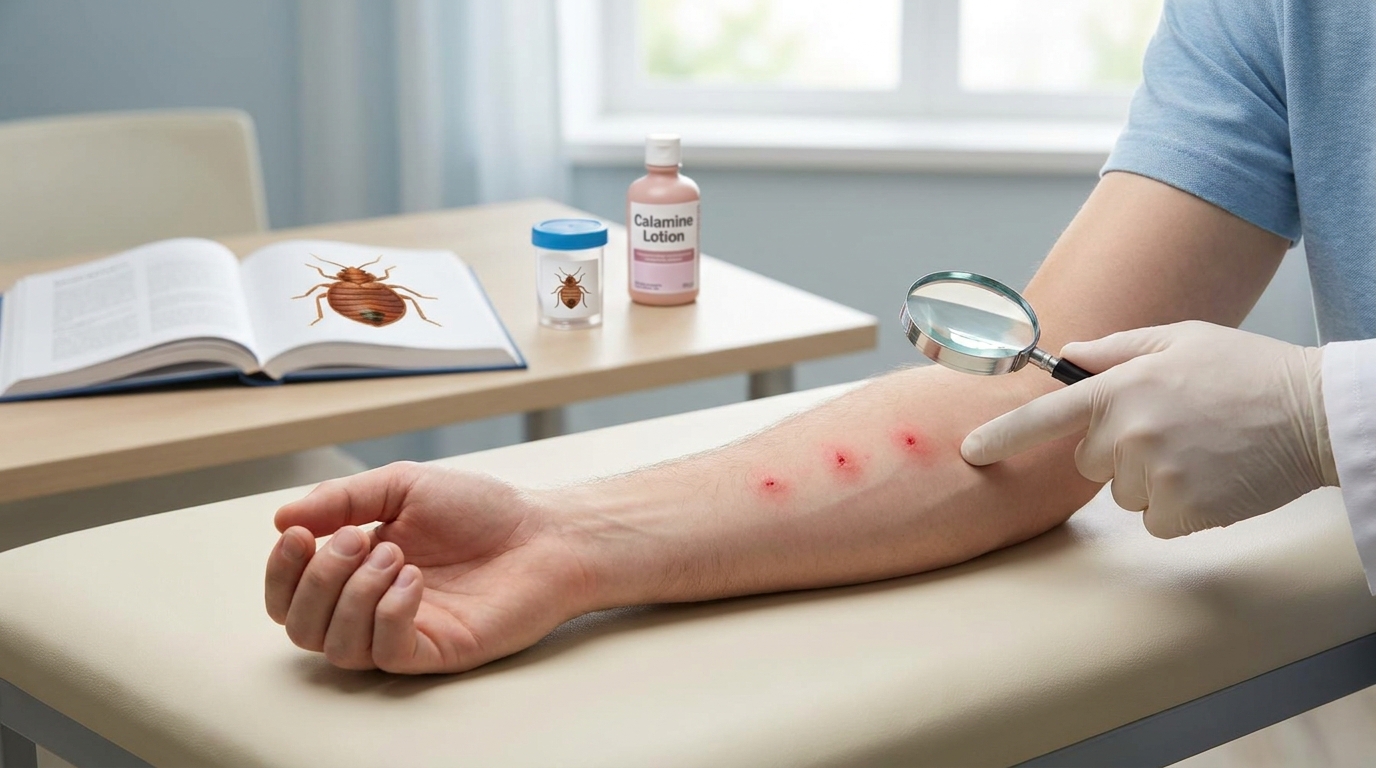
Bedbug bites: why online and how to identify them?
Contents
You wake up to three red spots on your arm. You look at them, scratch them, and the question arises: mosquito, spider, allergy? Except that this line pattern, this almost geometric trajectory on the skin, is precisely the signature of Cimex lectularius, the bedbug. Entomologists call this the «breakfast, lunch, dinner» pattern. And no, it's not a poetic image: it's a well-documented feeding behavior that makes it possible to recognize a bedbug bite with a good degree of certainty.
The problem is that many people spend days, sometimes weeks, wondering what's biting them. They look for fleas, inspect mosquito nets, change laundry detergents. Meanwhile, the colony grows. A female lays between 200 and 500 eggs in her lifetime (source: Annual Review of Entomology, 2012). In other words, every day of doubt is costly.
This article gets straight to the point: understand why bedbug bites line up the way they do, know how to distinguish them visually from other insects, and act quickly to relieve itching before moving on to eradication. We rely on serious entomological and dermatological sources, because on this subject, preconceived ideas waste precious time.
Things to remember
-
A scientific but accessible focus on the specific linear trajectory of bites (the so-called ‘breakfast, lunch, dinner’ phenomenon) to dispel doubts about other insects, backed up by entomological sources to establish the authority of Pest Patrol.
-
Why do bedbugs bite in lines or clusters?
-
Recognizing the visual characteristics of a bedbug bite
-
What to do about itching
Why do bedbugs bite in lines or clusters?
To understand this famous linear trajectory, we first need to understand how a bedbug eats. Cimex lectularius is a strictly hematophagous insect: it feeds exclusively on blood. No crumbs, no sugar, no waste. Preferably human blood, drawn at night when you're asleep.
Unlike mosquitoes, which bite, pump and fly, bedbugs have a sequential feeding behavior. It moves over exposed skin (arms, shoulders, neck, legs) and takes successive blood samples along the way. Why do they do this? Because it is often disturbed by the sleeper's micro-movements. She then repositions herself a few centimetres away and starts all over again. The result: a series of aligned punctures, spaced one to three centimetres apart, forming this characteristic line.
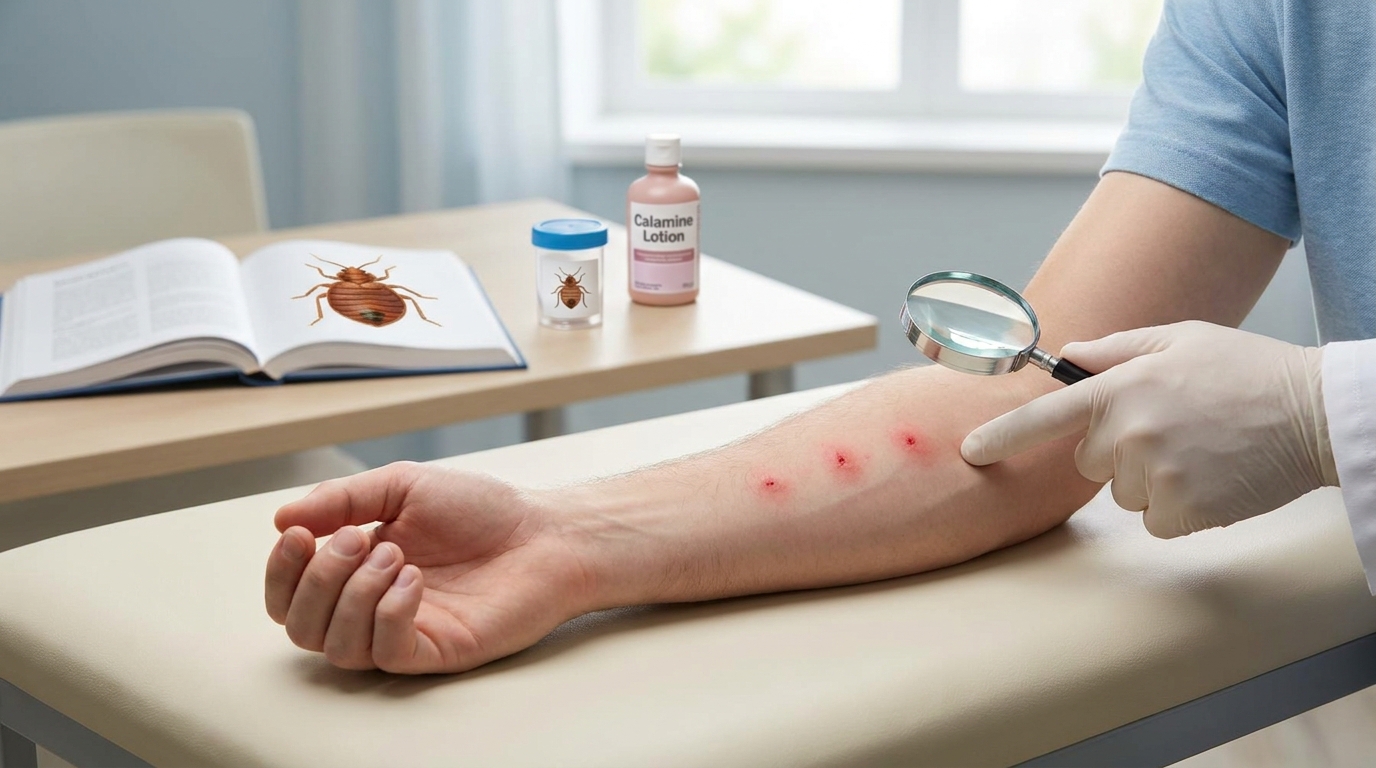
This is exactly what pest control professionals call the «breakfast, lunch, dinner» pattern. The expression comes from the Anglo-Saxon world (breakfast, lunch, dinner) and describes these three punctures (sometimes two, sometimes four or five) arranged in sequence on the same skin axis. A study published in the Journal of Medical Entomology (Reinhardt & Siva-Jothy, 2007) details this hematophagous behavior and confirms that stink bugs make an average of 2 to 5 bite attempts per meal.
Are three red dots aligned on the body necessarily a bedbug bite? Not at 100 %, no. But combined with other clues (nocturnal schedule, location on uncovered areas during sleep, absence of bites during the day), this linear pattern is a very reliable marker. Fleas, for example, also bite in clusters, but their bites tend to be concentrated around the ankles and feet, without this typical rectilinear trajectory.
A point people often overlook: bedbugs don't bite through clothing. They look for bare skin. If your bedbug spots only appear on your arms, face or upper back (the areas that stick out from the comforter), that's another clue. Someone who sleeps in a t-shirt will have bites on their arms and neck. Someone who sleeps shirtless may have lines on the stomach or flanks.
There's also the question of timing. Bed bugs are lucifuges: they shun light and come out mainly between 2 and 5 a.m., at the peak of your deep sleep. They are attracted by the CO2 you exhale and by body heat. It's not dirt, it's not a hygiene problem. Five-star hotels have as many as student studios. The hematophagous behavior of Cimex lectularius makes no social distinction.
One last thing about the mechanism of the bite itself: the bug injects a cocktail of saliva containing an anticoagulant and an anesthetic. That's why you don't feel anything at the time. The skin reaction (redness, itching) only appears several hours later, sometimes the very next day. Some people don't react at all, which complicates the diagnosis. According to a study by the entomology department at the University of Kentucky, around 30 % of people stung develop no visible reaction.
Recognizing the visual characteristics of a bedbug bite
You wake up with suspicious pimples and want to know if it's a bedbug bite. Here's what to look for, point by point.
In dermatology, bedbug bites typically take the form of maculopapules Lesions: slightly raised, red or pinkish lesions, sometimes with a darker central spot corresponding to the exact site of the sting. Their diameter varies between 2 and 5 millimeters, sometimes more in cases of marked allergic reaction. These maculopapules are often pruritic, i.e. itchy, sometimes intensely so.
Visual diagnosis is based on several combined criteria:
-
Row or cluster layout This is criterion number one. Mosquito bites are isolated and scattered. Those of bedbugs (another common name for fleas) form groups, but rarely such clear lines.
-
Location on open areas Arms, forearms, shoulders, nape of neck, face, calves. Rarely under clothing.
-
Morning appearance Bed bug spots appear after a night's sleep. If lesions appear during the day after a walk in the woods, look elsewhere.
-
Progression over 7 to 14 days Skin symptoms last longer than a classic mosquito bite, which fades in 2-3 days.
How can you tell if you've been bitten by bedbugs rather than mosquitoes or mites? Bedbug bites have no central vesicle (unlike some spider bites) and do not form a furrow (unlike scabies). The absence of a linear lesion dug into the skin rules out scabies. The absence of a very hard, persistent papule generally rules out a tick bite.
A common pitfall: mistaking an allergic reaction to bedbugs for hives. In some people, a bedbug bite triggers a disproportionate allergic reaction. The lesions swell, spread and become very red. Patches 2 to 3 centimetres in diameter can sometimes be seen. In the most severe cases (rare, but documented), a systemic allergic reaction can occur, with generalized oedema. Dr. Stéphane Gayet, infectiologist at Strasbourg University Hospital, points out that sensitization to the salivary antigens of Cimex lectularius increases with repeated exposure. In other words: the more you're stung, the stronger your reaction.
For those who want to go further in visual diagnosis, there is an often overlooked criterion: the delayed reaction. When first exposed to bedbugs, most people don't react at all. The bites go unnoticed. It's only after several weeks' exposure that the immune system begins to react and skin symptoms appear. This delay explains why many people discover their infestation late.
A word about the photos you find online: they often show extreme cases, with dozens of injections on the same arm. The reality is often more subtle. Two or three small pimples in a row, slightly swollen, moderately itchy. Nothing spectacular. That's why so many people hesitate and waste time. If you have the slightest doubt, look for other evidence: small black spots on the mattress (droppings), traces of blood on the sheets, translucent shed skins in the seams of the box spring. These physical clues, combined with bedbug bites, confirm the diagnosis far better than a photo on the Internet.
Treatments and first aid: what to do about itching?
The first thing to do when bedbug bites are discovered: don't scratch. Easy to say, very difficult to do. Scratching causes skin microlesions that can become infected (impetigo, bacterial cellulitis). This is the most frequent complication, far more so than the allergic reaction itself.
To relieve itching quickly, start by washing the area with warm water and mild soap. Nothing fancy. Then apply a cold compress for 10 to 15 minutes: the cold reduces inflammation and calms the itch mechanically. It's simple, free and works in most cases.
If itching persists, a antihistamine (cetirizine, loratadine) is the first-line treatment. These molecules block the histamine response triggered by bedbug saliva, reducing both swelling and pruritus. Available over-the-counter in pharmacies, they cost between 3 and 6 euros a box. For more severe local reactions, a mild corticosteroid cream (hydrocortisone 1 %) can be applied twice a day for a maximum of 5 to 7 days. For longer periods, consult a doctor or dermatologist.
How to treat bedbug bites in more severe cases? When the allergic reaction gets out of control (severe swelling, numerous bites, fever), medical advice is essential. The doctor may prescribe a stronger corticosteroid or a second-generation antihistamine. Cases of anaphylaxis linked to bedbugs do occur, but remain exceptional (a few cases have been described in the literature, notably in Clinical Infectious Diseases, Goddard & de Shazo, 2009).
Now, let's be clear about one essential point: treating the bites without treating the infestation is like putting a band-aid on a wooden leg. As long as bedbugs are around, you'll be bitten every night. Creams and antihistamines relieve the symptoms, but they don't solve the problem.
In the vast majority of cases, bedbug eradication involves a thorough professional pest control. Home treatments (essential oils, white vinegar, diatomaceous earth alone) are inadequate when faced with an established infestation. Studies clearly show that a professional intervention combining heat treatment (dry steam at over 60°C) and targeted chemical treatment offers an eradication rate of over 95 % in two passes (source : Pest Management Science, 2018). A single pass is generally not enough, as the eggs, which are resistant to many insecticides, must also be eliminated.
There are a few things you can do immediately, even before the professional intervenes:
-
Wash all bed linen and clothing close to the bed at 60°C minimum. Bedbugs and their eggs cannot survive at this temperature.
-
Vacuum mattresses, box springs, headboards and baseboards thoroughly. Dispose of the vacuum bag in a sealed garbage bag outside.
-
Install integral bedbug covers on mattresses and box springs. They trap the remaining individuals and prevent new ones from reaching their hiding place.
-
Don't move your mattress to another room: you risk spreading the infestation.
Treatment of a bedbug bite is basically a two-stage process. The short term: relieve the itch, avoid superinfection and get a good night's sleep. The long term: call in a professional pest control technician, follow the preparation protocol, and check for any recurrence over the following weeks. The two are inseparable. One without the other leads nowhere.
One final point is often overlooked: the psychological impact. For many people, bedbug bites cause anxiety, sleep disturbance and even distress. This is no minor matter. If stress persists after eradication, don't hesitate to talk to your doctor. The fear of being bitten again can last long after the insects have disappeared.
Conclusion
Recognizing a bedbug bite isn't so complicated when you know what to look for: pimples in a line, on uncovered areas, appearing on waking. The famous «breakfast, lunch, dinner» pattern remains the best visual clue at your disposal. Combine this with an inspection of the mattress and box spring, and you've got your answer.
Don't wait to act. Every night that passes, a colony grows. Relieve itching with an antihistamine, protect your bedding, and call in a pest control professional without delay. At Pest Patrol, we support individuals from identification to complete eradication, with validated protocols and post-treatment follow-up. If in doubt, contact us: better an inspection for nothing than an infestation that takes hold.
Frequently asked questions
Why do bedbugs often bite online?
This phenomenon, known as «breakfast, lunch, dinner», is due to the insect's sequential feeding behavior. The bedbug is often disturbed by your nocturnal movements and moves a few centimetres to continue its meal, creating a straight trajectory on your skin.
How can you tell the difference between a bedbug bite and a mosquito bite?
Unlike mosquitoes, which bite in isolated, random patterns, bedbugs leave groups of pimples in a row on uncovered areas (arms, neck, back). What's more, bedbug spots appear exclusively after sleep, and often persist for more than a week.
What are the visual signs of a bedbug bite?
They appear as maculopapules: red pimples measuring 2 to 5 mm, sometimes with a darker central spot. They cause intense itching (pruritus), and may swell further in people with allergic sensitivities.
Does everyone react to bedbug bites?
No, around 30 % of the population develop no visible skin reaction. The absence of pimples therefore does not guarantee the absence of infestation; it's crucial to check for other clues such as black spots on the mattress or traces of blood on the sheets.
How can I quickly relieve bedbug itching?
The first reflex is to clean the area with a mild soap and apply cold to reduce inflammation. For lasting relief, the use of an oral antihistamine or a soothing hydrocortisone cream is generally recommended.
What's the best treatment for getting rid of bedbugs for good?
As natural remedies are often ineffective, professional insect control combining heat treatment (dry steam) and chemical treatment is the most reliable solution. At the same time, wash your laundry at 60°C and use full protective covers for your bedding.
 Français de Belgique
  English
  Nederlands (België)