
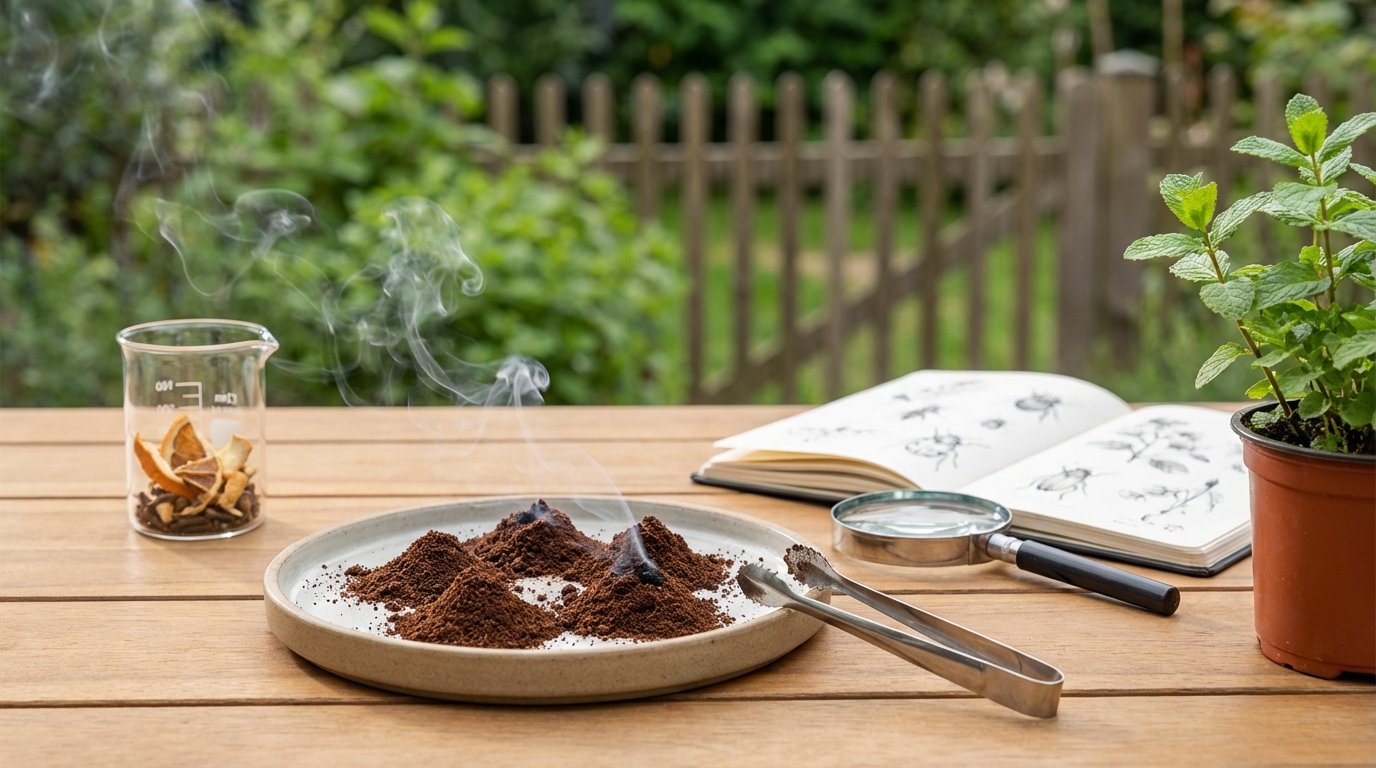
Does coffee grounds really keep wasps away? The guide
Contents
Every summer, it's the same circus. You put your plate outside, and in less than two minutes, a wasp swoops in. Then two. Then five. And then someone gives you the famous advice: «Burn coffee grounds to scare them away. The grandmotherly tip par excellence. Everybody talks about it, but nobody really knows why it works, or even if it works.
Things to remember
-
More than just grandma's advice, this article analyzes the burning of coffee grounds from a technical and scientific perspective, while offering a rigorous guide to repellent alternatives to assert Pest Patrol's authority.
-
The science behind repellent
-
How to burn coffee safely
-
Natural alternatives and global strategies against wasps
At Pest Patrol, we wanted to take a serious look at the subject. Not just repeat what you read everywhere, but find out what we really know about the link between wasps and coffee, the combustion of the grounds, the volatile compounds released, and above all: is this enough to protect your terrace on a Saturday night in July? We'll also talk about natural alternatives that work, because spoiler, coffee grounds alone don't work miracles.
This guide is for you if you're looking for an eco-friendly, chemical-free solution, and you want to understand what you're doing instead of blindly following advice. Let's get started.
How burnt coffee grounds work: the science behind the repellent
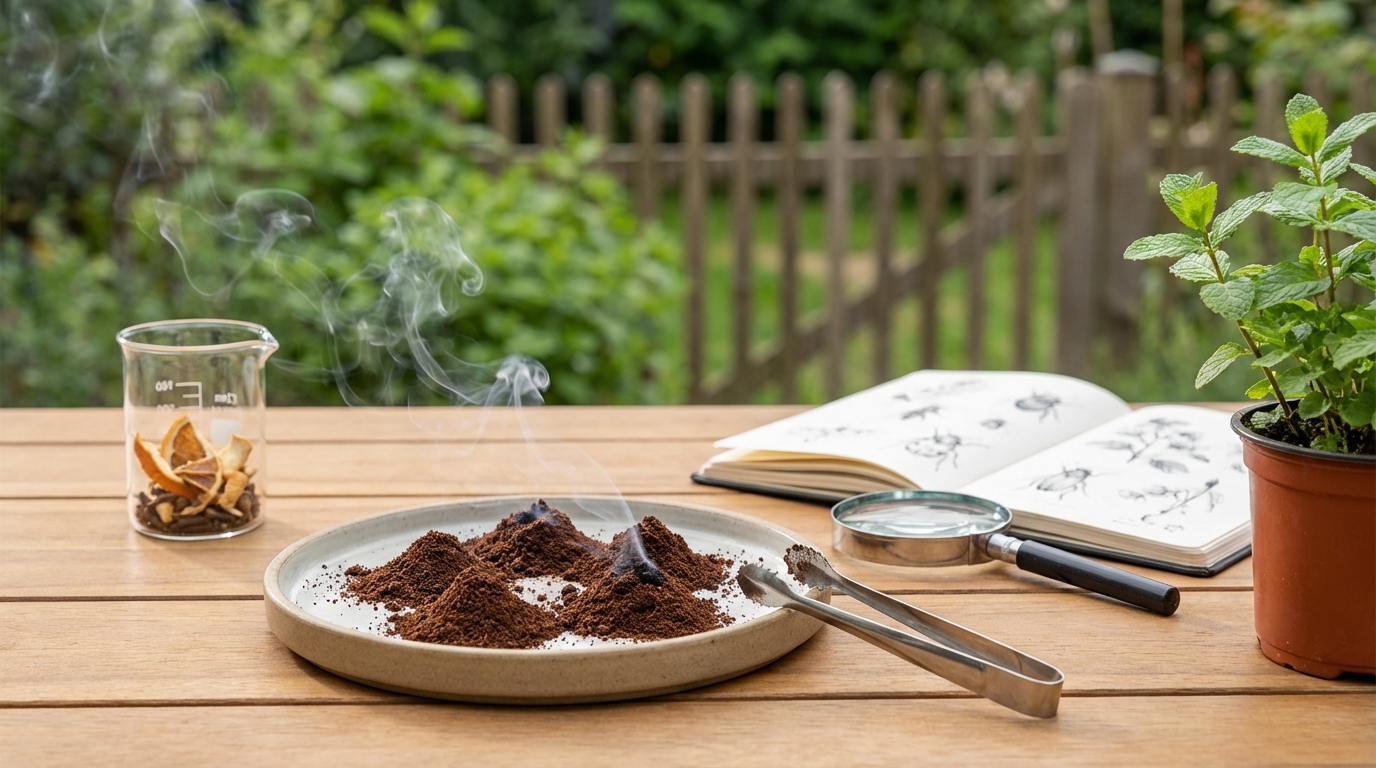
When you burn coffee grounds in a cup, you don't just «make smoke». You trigger a slow combustion, an incomplete pyrolysis that releases a cocktail of volatile organic compounds. These include diterpenes, cafestol, kahweol and, above all, a healthy dose of caffeine in gaseous form. It's this chemistry that interests us.
Wasps, like most Hymenoptera, perceive their environment primarily by smell. Their antennae are covered with ultra-sensitive olfactory receptors, capable of detecting molecules at minute concentrations. A study published in the Journal of Chemical Ecology has shown that certain aromatic compounds disrupt the chemical communication of social insects, including wasps. The dense, pungent smell of burnt coffee clearly falls into this category of repellent stimuli.
Coffee grounds work on what might be called a thermal repellent principle: it's the heat of combustion that volatilizes the active molecules. Without combustion, there is no effective release. A bowl of cold marc on the table? Virtually useless. That's where the difference lies. It's the smoke loaded with these compounds that creates an olfactory discomfort zone for wasps.
Now, let's be honest about the limits. The repellent smoke produced by burning coffee covers a restricted area: about one to two metres around the point of combustion, in windless conditions. As soon as there's a breeze, the effectiveness drops drastically. And if there's a wasp nest in the immediate vicinity - less than five meters away, for example - the burnt grounds won't be enough to discourage workers on a feeding mission. The smell of coffee disturbs wasps, yes, but it doesn't terrorize them.
A point often overlooked: European hornets (Vespa crabro) and Asian hornets (Vespa velutina) seem less sensitive to this type of olfactory repellent than common wasps (Vespula vulgaris). If your problem involves hornets, coffee grounds will be just one element in your strategy.
Another question we're often asked: what insects are attracted to coffee grounds? The good news is that burning coffee grounds doesn't attract many insects. On the other hand, wet, unburned grounds can attract certain diptera (flies) and beetles. All the more reason to dry it thoroughly before use.
The scientific verdict? Burning coffee grounds against wasps has a real, documented repellent effect, but is limited in scope and duration. It's a tool, not a miracle solution. And like any tool, you need to know how to use it correctly.
Practical guide: how to burn coffee safely
90% people who try this trick fail on the first step. They take some still wet pomace, put it in a container, try to light it, and nothing happens. No problem. Coffee grounds have to be perfectly dry to burn. This is non-negotiable.
Here's how to do it, step by step:
-
Recover your coffee grounds after running your espresso or filter. Spread it out on a flat plate or baking sheet lined with parchment paper.
-
Let it dry completely. Air-drying takes 24 to 48 hours, depending on ambient humidity. You want a marc that crumbles between your fingers, almost powdery. If you're in a hurry, put it in the oven at 100°C for 30 to 45 minutes, stirring occasionally.
-
Choose your container. A small, heat-resistant container: terracotta dish, thick ashtray, ceramic ramekin. Avoid thin glass, which can shatter, and of course plastic.
-
Drop in two to three tablespoons of dry pomace into the container. Pack lightly, without compacting.
-
Light with a lighter or long match. The pomace doesn't ignite like paper: it burns slowly, like incense. You should see a trickle of white smoke rising after a few seconds. If it doesn't, your pomace isn't dry enough.
-
Place the container in the center of your table or close to the area you wish to protect. Burning takes between 15 and 30 minutes, depending on the quantity.
One question comes up all the time: freshly ground coffee or used grounds, which works better? Unused ground coffee burns more easily and gives off a more intense, fragrant smoke. Ground coffee, on the other hand, has lost some of its oils during infusion, which slightly reduces the quantity of volatile compounds released. In practice, ground coffee works very well and is free. Freshly ground coffee is a step up in terms of efficiency, but it's like burning money. It's up to you.
When it comes to safety, there are a few simple rules. Never leave the container unattended, especially with children or pets around. Place it on a stable, non-flammable surface. And watch out for the wind: a gust of wind can scatter even small embers of pomace. On a wooden balcony, place a large saucer underneath.
To effectively scare away wasps with coffee grounds, think ahead. Light your grounds 10 to 15 minutes before you sit down to eat. Just long enough for the smoke to saturate the area. If you wait until the wasps are already there, it's less effective: they're in «food spotting» mode and their motivation is strong.
Here's an extra tip: you can multiply the points of combustion. Two bowls at the ends of the table are better than one in the middle. You create a wider olfactory perimeter, and this compensates for draughts.
A final detail often overlooked. Burnt coffee grounds leave a residual odor on textiles (tablecloths, chair cushions). It's harmless, but if it bothers you, protect your fabrics or use washable tablecloths.
Natural alternatives and global strategies against wasps
Coffee grounds are great. But relying on it alone to get you through the summer is like putting one lock on a door that needs three. You need a combined approach. Here's what really works among natural solutions, and what's myth.
Essential oils against wasps Some have a proven repellent effect. Java citronella essential oil (Cymbopogon winterianus) came out on top in several entomological studies. Clove (eugenol), spike lavender and peppermint follow. A 2019 publication in Pest Management Science has confirmed the repellent effect of geraniol and citronellol on Vespidae. In practical terms, soak a few drops in absorbent cotton or cloth strips and place them around your eating area. Repeat every hour or so, as the compounds evaporate quickly.
Which scent do wasps dislike most? According to the available data, it's the clove and citronella combination that provokes the most marked avoidance reaction. Not one or the other alone: the combination.
Repellent plants are an in-depth strategy, not an emergency solution. Mint, citronella, scented geranium (Pelargonium graveolens), basil and lavender create an olfactory environment unfavorable to wasps when planted in sufficient numbers around a terrace. We're talking about several pots, not one shy plant in a corner. The advantage: it's permanent, attractive and works against mosquitoes too.
Environmental management, and here we come to the real subject. Wasps come to your house for two reasons: food and water. Cover your dishes, don't leave open cans lying around (wasps love sugar), and eliminate stagnant water sources. A simple bowl of water on the terrace is a wasp trough. These basic gestures will reduce the number of wasps on your terrace by 50 to 70%, without the use of any products.
Wasp traps (bottle cut with sugar water or beer) work, but be careful where you place them. Put them 5 or 10 meters from your living area, not on the table. The aim is to attract the wasps elsewhere, not to invite them to your table before trapping them.
What doesn't work, or doesn't work very well: conventional mosquito repellent spirals (wasps don't care for them), ultrasound (no serious scientific proof), and the famous paper bag that imitates a rival nest. This last tip is circulating a lot on social networks. A study by the University of Guelph in Canada has shown that wasps are no fools: they identify a real nest by its pheromones, not by its shape.
The most effective strategy? Combine burnt coffee grounds for immediate protection during meals, essential oils for continuous diffusion, repellent plants for permanent installation, and good dietary practices. This multi-layered approach delivers solid results all season long.
If, despite everything, you find a nest under your roof or in your garden, don't intervene yourself. Wasps defend their nests aggressively, and multiple stings can cause serious reactions, even in non-allergic people. Call in a professional.
Conclusion
Burning coffee grounds to keep wasps away works. Not as a magic shield, but as an honest, free, chemical-free olfactory repellent. Science confirms that the smoke from burning coffee disrupts wasp receptors. Not bad for a waste product that's usually thrown in the garbage can.
The mistake would be to stop there. Marc alone won't protect an entire terrace in high winds, and it won't do a thing against an active nest nearby. Combine it with essential oils, repellent plants and good dietary habits for a truly serene summer.
Have you tried any of these methods? Share your experience in the comments. And if the situation goes beyond the do-it-yourself stage, the Pest Patrol team is there to intervene cleanly and quickly.
Frequently asked questions
Does burning coffee grounds really scare wasps away?
Yes, it's a real repellent. The slow combustion of coffee grounds releases volatile organic compounds (such as caffeine and diterpenes) that wasps hate. The strong odor and smoke disrupt their olfactory receptors, creating a zone of discomfort that keeps them away from your table.
How can I burn coffee grounds effectively?
The secret lies in drying: the pomace must be perfectly dry (put it in the oven for 30 min at 100°C if necessary). Place two tablespoons in a heat-resistant dish and light it with a flame. It should burn slowly, like incense, without producing bright flames.
What are the limits of this natural trick?
Coffee grounds are effective within a radius of 1 to 2 metres and in calm weather. In windy conditions, or if a nest is in the immediate vicinity (less than 5 meters), the smoke will be too dispersed to be effective. It's a mealtime aid, not an extermination solution.
What do wasps hate most?
In addition to burnt coffee, wasps are very sensitive to Java citronella and clove. Using these essential oils alongside burnt coffee grounds considerably enhances the repellent effect on your terrace.
Is burnt coffee grounds dangerous?
Used with care, it is harmless. Just make sure you use a fireproof container (terracotta, ceramic) and never leave the dish unattended, as combustion, though slow, produces embers that can be dispersed by the wind.
What if coffee grounds aren't enough to keep wasps away?
If wasps keep coming back, despite the use of repellents, this often indicates the presence of an active nest nearby. In this case, natural tricks are no longer enough. Contact Pest Patrol for a safety diagnosis and professional intervention.
 Français de Belgique
  English
  Nederlands (België)